
Blockchain Oracle Network

Blockchain Oracle Network: Decentralized Data Feeds

Blockchain oracle networks provide external data to smart contracts through decentralized systems rather than single data sources. It’s like having multiple weather stations instead of relying on one thermometer.

A blockchain oracle network is a decentralized system of nodes that collectively provide external data to blockchain networks, reducing single points of failure and manipulation risks. Multiple independent operators contribute to data accuracy and reliability.

How Oracle Networks Work

Multiple data sources aggregate information from various external APIs, exchanges, and data providers to create more reliable price feeds.

Consensus mechanisms combine individual oracle reports using weighted averaging, outlier detection, or voting systems to determine final data values.

Economic incentives reward honest data provision while penalizing operators who provide inaccurate or manipulated information.
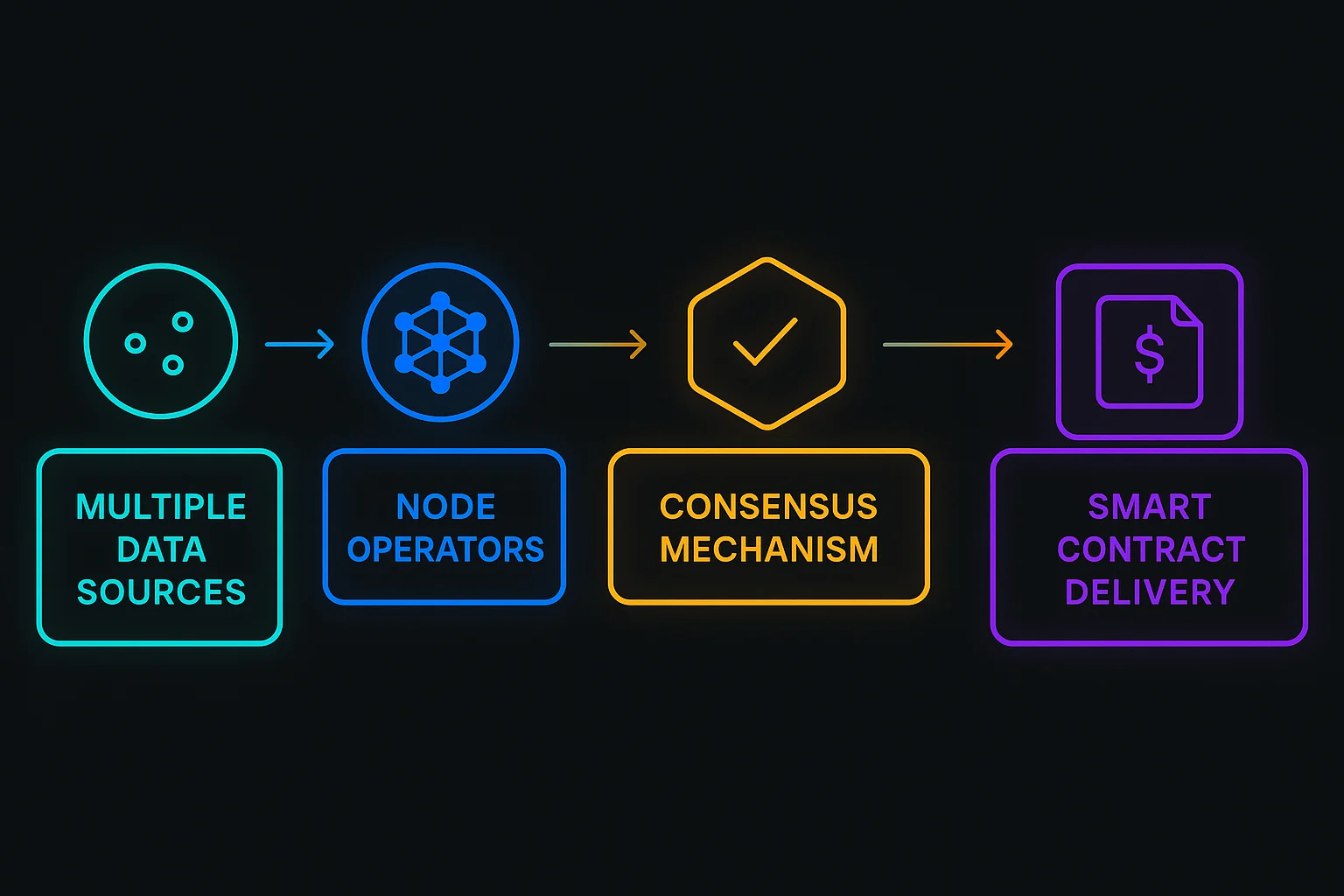
Oracle network architecture showing data sources, node operators, consensus mechanism, and smart contract delivery

Real-World Examples

  • Chainlink operates the largest decentralized oracle network with thousands of nodes
  • Band Protocol provides cross-chain oracle services with delegated proof of stake
  • Pyth Network focuses on high-frequency financial data with sub-second updates

Why Beginners Should Care

Data reliability improves through decentralization compared to single oracle sources that could fail or be manipulated.

DeFi security depends heavily on accurate price feeds for lending, trading, and liquidation mechanisms.

Network effects make established oracle networks more valuable as they gain more data sources and users.

Related Terms: Oracle, Price Feed, Smart Contract

Back to Crypto Glossary

Similar Posts

  • ENS

    ENS: Ethereum Name ServiceENS provides human-readable names for Ethereum addresses, making cryptocurrency transactions more user-friendly. It's like having domain names for websites instead of remembering IP addresses.Ethereum Name Service (ENS) is a decentralized naming system that maps human-readable names to Ethereum addresses, smart contracts, and other identifiers. ENS makes blockchain interactions more accessible by replacing complex…

  • MEV (Maximal Extractable Value)

    MEV (Maximal Extractable Value): The Hidden Tax on DeFi MEV is the extra profit that miners and validators can extract by reordering, including, or excluding transactions within blocks. It’s like cutting in line at the blockchain cafeteria. Maximal Extractable Value (MEV) is the additional profit that block producers can capture by strategically ordering transactions, beyond…

  • Real Yield

    Real Yield: Sustainable Revenue-Based Returns Real yield comes from actual protocol revenue rather than token emissions or inflationary rewards. It’s the difference between earning from productive business activity versus printing more money. Real yield refers to returns generated from genuine protocol revenue, fees, or value creation rather than token inflation or emissions. These yields can…

  • Proof of Work (PoW)

    Proof of Work (PoW): Bitcoin’s Security Model Proof of Work is how Bitcoin solves the double-spending problem without trusted authorities. It’s energy-intensive by design – that’s a feature, not a bug. Proof of Work is a consensus mechanism where miners compete to solve computationally difficult puzzles to validate transactions and create new blocks. The winning…

  • Merkle Tree

    Merkle Tree: Efficient Data Verification Merkle trees enable efficient verification of large datasets without downloading everything. They’re like having a fingerprint for an entire library that proves any book belongs. A Merkle tree is a binary tree structure where each leaf represents a data element and each branch contains cryptographic hashes of its children. The…

  • zk-STARKs

    zk-STARKs: Advanced Zero-Knowledge Proofszk-STARKs are cryptographic proofs that enable verification of computations without revealing underlying data, offering better scalability than earlier zero-knowledge technologies. They're like magic tricks where you can prove the trick worked perfectly without revealing how it was done, even to expert magicians.zk-STARKs (Zero-Knowledge Scalable Transparent Arguments of Knowledge) are advanced cryptographic proofs…