
Layer 1

Layer 1: The Foundation Blockchain

Layer 1 refers to the base blockchain protocol that processes transactions and maintains consensus. It’s the foundation that everything else builds on top of.

Layer 1 (L1) is the main blockchain network that handles transaction processing, consensus, and security independently without relying on other blockchains. These are the foundational networks like Bitcoin and Ethereum that other solutions build upon.

How Layer 1 Blockchains Work

Complete functionality includes transaction processing, consensus mechanisms, security validation, and native token economics all within the base protocol.

Independence means L1 networks operate without requiring other blockchains for basic functionality like transaction settlement or security.

Scalability limitations often exist as L1s prioritize security and decentralization over transaction throughput, leading to development of Layer 2 solutions.
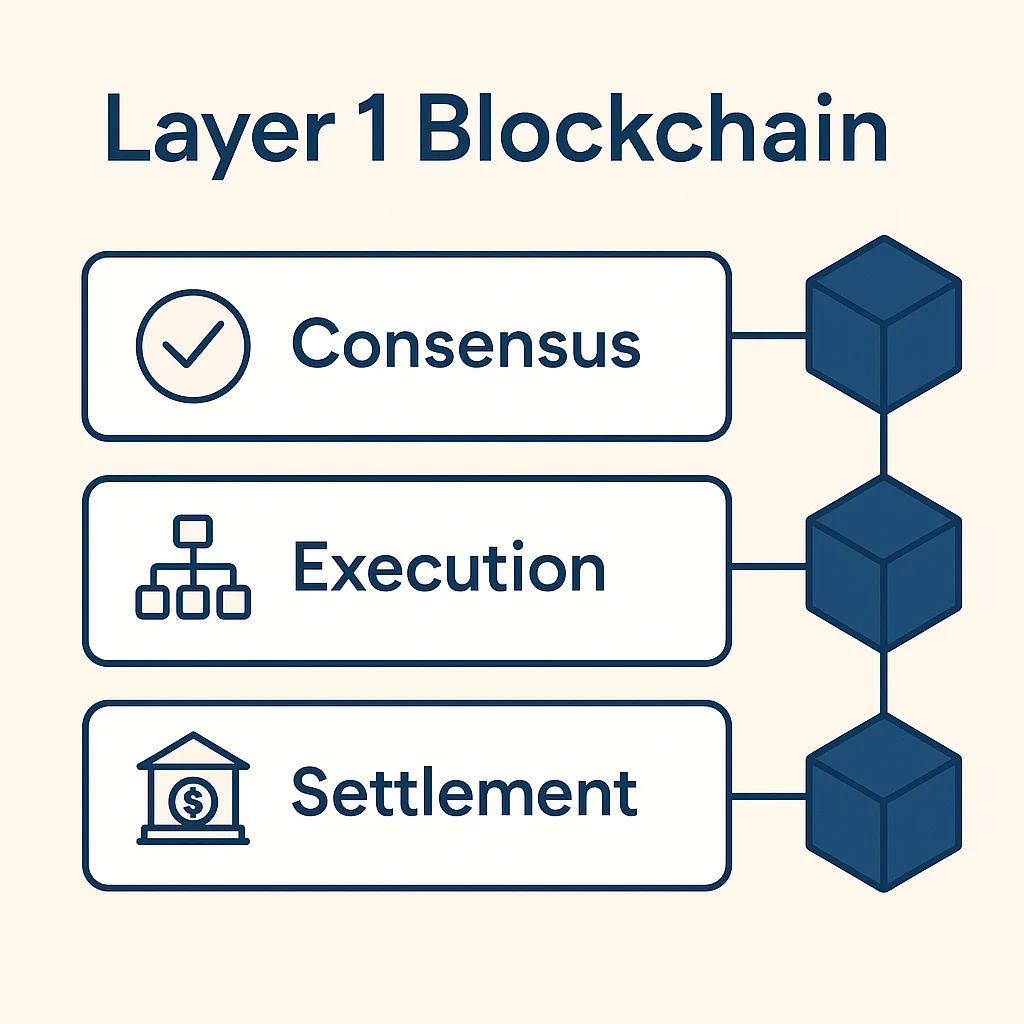
Infographic showing Layer 1 blockchain architecture with consensus, execution, and settlement integrated into a single stack

Real-World Examples

  • Bitcoin – The original Layer 1 focused on peer-to-peer digital payments
  • Ethereum – Smart contract platform that enabled DeFi and NFT ecosystems
  • Solana – High-performance L1 optimized for speed and low costs

Why Beginners Should Care

Foundation understanding helps explain why different blockchains have different capabilities, costs, and security models.

Investment considerations as Layer 1 tokens often represent bets on which fundamental blockchain infrastructure will succeed long-term.

Ecosystem effects since applications built on specific L1s inherit their security, performance, and economic characteristics.

Related Terms: Layer 2, Consensus Mechanism, Base Layer, Blockchain Trilemma

Back to Crypto Glossary

Similar Posts

  • Message Passing

    Message Passing: Cross-System CommunicationMessage passing enables different blockchain networks or applications to communicate by transmitting information across system boundaries. It's like having a universal postal service that can deliver letters between different countries with different languages and customs.Message passing refers to communication protocols that enable different blockchain networks, smart contracts, or applications to exchange information…

  • dApp Browser

    dApp Browser: Gateway to Decentralized Apps dApp browsers enable easy access to decentralized applications through integrated wallet functionality and Web3 connectivity. They’re like having a web browser that speaks cryptocurrency natively. A dApp browser is a specialized web browser or application that integrates cryptocurrency wallet functionality to seamlessly interact with decentralized applications. These browsers handle…

  • Rollup-as-a-Service (RaaS)

    Rollup-as-a-Service (RaaS): Custom Blockchain Infrastructure RaaS platforms provide infrastructure for deploying custom rollups without building all the technical components from scratch. It’s like having a franchise model for blockchain networks. Rollup-as-a-Service (RaaS) provides infrastructure and tooling for organizations to deploy their own application-specific rollups without deep blockchain development expertise. These platforms handle the technical complexity…

  • Bonding Curve

    Bonding Curve: Algorithmic Token Pricing Bonding curves use mathematical formulas to automatically price tokens based on supply. As more tokens get bought, prices increase predictably according to the curve’s formula. A bonding curve is an algorithmic pricing mechanism that determines token price based on token supply through a mathematical function. Prices increase as supply grows…

  • Exit Scam

    Exit Scam: When Projects Disappear With Your Money Exit scams occur when project teams abandon their platforms after raising funds, taking investor money and disappearing. It’s the digital equivalent of skipping town with the cash register. An exit scam is when cryptocurrency project developers abandon their project after raising funds from investors, typically taking user…

  • Cross-Chain Messaging

    Cross-Chain Messaging: Inter-Blockchain Communication Cross-chain messaging enables smart contracts on different blockchains to communicate and trigger actions across networks. It’s like having a universal translator for blockchain conversations. Cross-chain messaging allows smart contracts on different blockchain networks to send data, trigger functions, and coordinate actions across multiple chains. This enables true interoperability beyond simple asset…