
Mining

Mining: How New Bitcoins Are Created

Bitcoin mining is the process that creates new bitcoins and secures the network. It’s like a global lottery where miners compete to solve mathematical puzzles for rewards.

Mining is the computational process of validating transactions and adding new blocks to a blockchain while earning newly created cryptocurrency as rewards. Miners use specialized hardware to compete for the right to create the next block.

How Mining Works

Proof of Work requires miners to find a specific number (called a nonce) that, when combined with transaction data, produces a hash starting with a certain number of zeros. This requires massive computational power and energy.

Block rewards compensate miners for their work – currently 6.25 Bitcoin per block, plus transaction fees. This reward halves every 210,000 blocks (roughly every 4 years).

Mining difficulty automatically adjusts every 2,016 blocks to maintain 10-minute block times regardless of total network computing power.
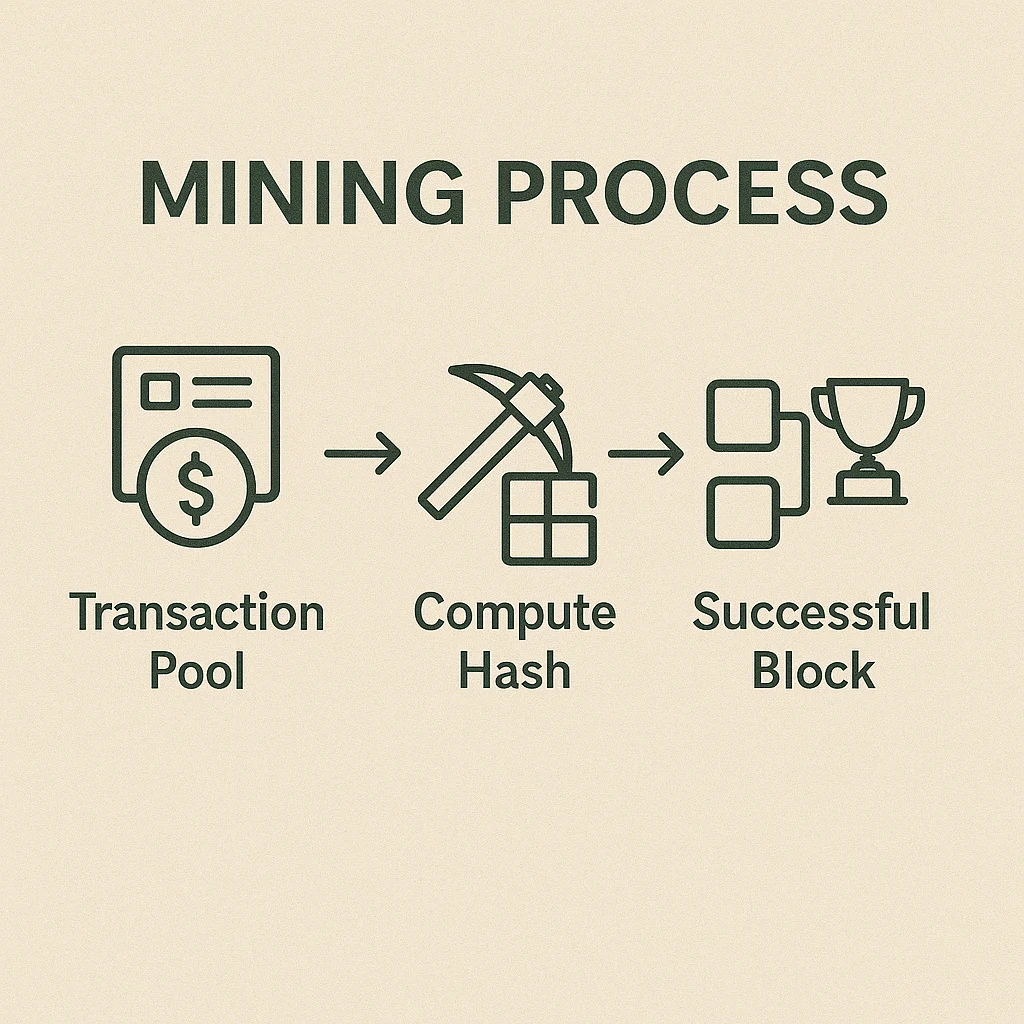
Infographic showing the mining process from transaction pool to hash computation and successful block creation with reward

Real-World Examples

  • ASIC miners like the Antminer S19 Pro can hash at 110 TH/s while consuming 3,250 watts
  • Mining pools combine individual miners’ power to increase chances of earning rewards
  • Large mining farms in countries with cheap electricity dominate hash rate distribution

Why Beginners Should Care

Mining secures the Bitcoin network through decentralized consensus. The more miners participate, the more secure and censorship-resistant Bitcoin becomes.

Individual mining is no longer profitable for most people due to competition from industrial operations. Most retail miners join pools to earn steady, smaller rewards rather than hoping for rare big wins.

Related Terms: Hash Rate, Proof of Work, Block Reward, Mining Pool

Back to Crypto Glossary

Similar Posts

  • Message Passing

    Message Passing: Cross-System CommunicationMessage passing enables different blockchain networks or applications to communicate by transmitting information across system boundaries. It's like having a universal postal service that can deliver letters between different countries with different languages and customs.Message passing refers to communication protocols that enable different blockchain networks, smart contracts, or applications to exchange information…

  • Go

    Go: Programming Language for BlockchainGo is a programming language widely used for building blockchain infrastructure and cryptocurrency applications. It's like the construction language for digital money systems.Go (also called Golang) is a programming language developed by Google that's popular for blockchain development due to its performance, simplicity, and excellent concurrency support. Many major cryptocurrency projects use…

  • Layer 2

    Layer 2: Scaling Solutions for Expensive Blockchains Layer 2 networks solve Ethereum’s biggest problem – ridiculous gas fees. They process transactions cheaply and quickly while inheriting Ethereum’s security. Layer 2 is a separate blockchain or protocol built on top of a main blockchain (Layer 1) to improve scalability and reduce transaction costs. These solutions handle…

  • HTLC

    HTLC: Hash Time-Locked ContractsHTLCs are smart contracts that lock cryptocurrency until specific conditions are met within time limits. They're like escrow services with built-in deadlines that automatically return funds if deals fall through.Hash Time-Locked Contracts (HTLCs) are smart contracts that require both cryptographic proof and time-based conditions to be met before cryptocurrency can be accessed. These…

  • Solver Network

    Solver Network: Optimized Transaction ExecutionA solver network consists of specialized entities that find optimal execution paths for complex transactions across multiple protocols and chains. They're like GPS systems that find the best routes for your crypto transactions.A solver network comprises specialized services that analyze and execute complex transactions by finding optimal paths across multiple protocols,…

  • Exchange

    Exchange: Where Crypto Gets Bought and Sold Crypto exchanges are the on-ramps to digital money. But not all exchanges are created equal – some prioritize security, others prioritize profits. A cryptocurrency exchange is a platform where you can buy, sell, and trade cryptocurrencies using traditional money or other digital assets. Think of it as a…