
Mining Pool

Mining Pool: Collaborative Block Mining

Mining pools combine computational power from multiple miners to increase chances of finding blocks and earning rewards. It’s like joining a lottery syndicate to improve your odds.

A mining pool is a collaborative group of cryptocurrency miners who combine their computational resources to increase their chances of successfully mining blocks and earning rewards. Pool participants share rewards proportionally based on their contributed computing power.

How Mining Pools Work

Resource pooling combines hash power from many individual miners to compete more effectively against large mining operations.

Reward distribution splits block rewards and transaction fees among pool participants based on their proportional contribution to the pool’s total hash rate.

Consistent payouts provide more regular income compared to solo mining, where individual miners might wait months between successful blocks.
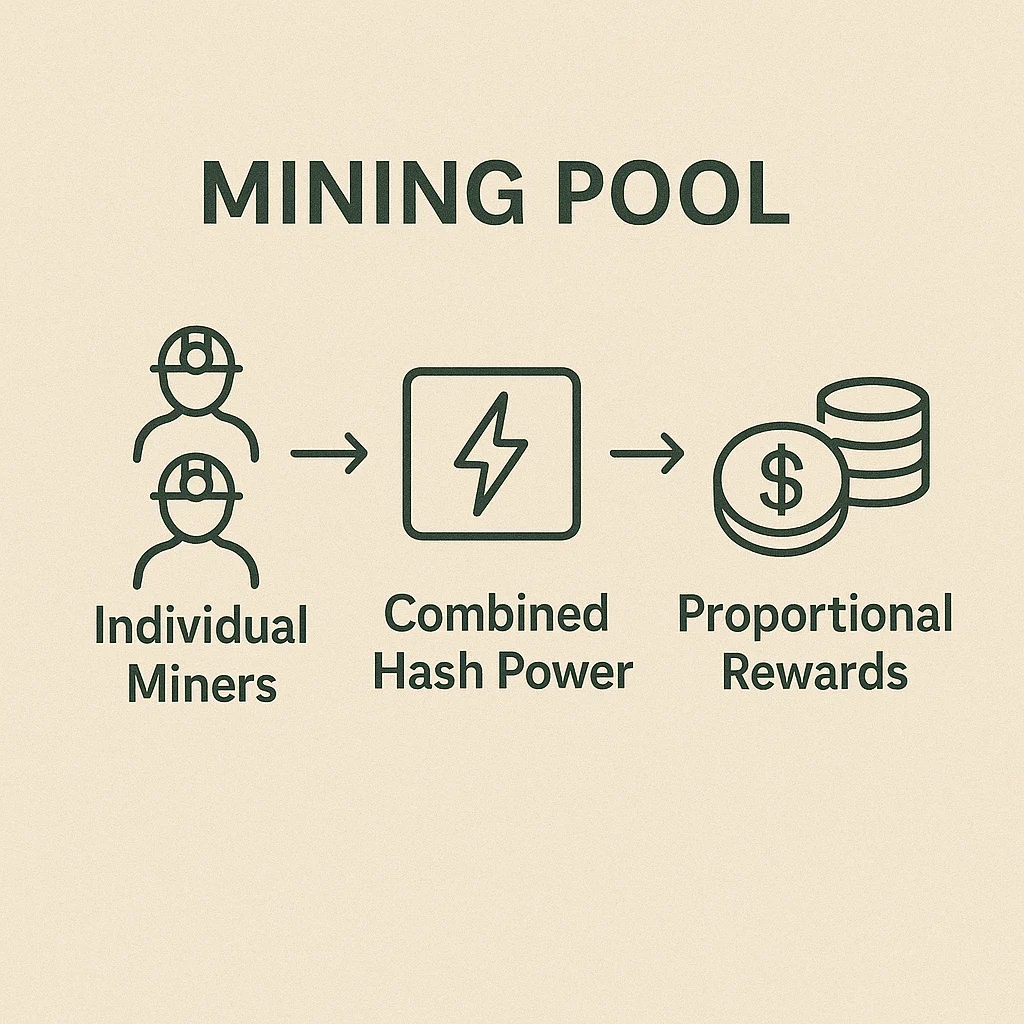
Infographic showing mining pool process from individual miners combining hash power to proportional reward distribution

Real-World Examples

  • Antpool and F2Pool are among the largest Bitcoin mining pools by hash rate
  • Ethereum mining pools like Ethermine dominated before the Proof of Stake transition
  • Small miners typically join pools to receive steady income rather than gambling on solo mining

Why Beginners Should Care

Income stability through pooled mining provides predictable returns rather than the feast-or-famine nature of solo mining.

Lower barriers to mining participation since small miners can earn proportional rewards without needing massive infrastructure investments.

Centralization concerns as large pools could theoretically coordinate to attack networks, though economic incentives discourage this behavior.

Related Terms: Mining, Hash Rate, Block Reward, Proof of Work

Back to Crypto Glossary

Similar Posts

  • Public Key

    Public Key: Cryptographic Identity VerificationA public key is the openly shareable part of a cryptographic key pair that enables others to send you cryptocurrency or verify your digital signatures. It's like your mailing address that you can give to anyone who wants to send you mail.Public key refers to the cryptographic component of a key…

  • FOMO (Fear of Missing Out)

    FOMO: The Psychology That Drives Crypto Markets FOMO (Fear of Missing Out) is responsible for more bad crypto decisions than any technical analysis could prevent. It’s the emotional trap that turns rational people into panic buyers. FOMO is the anxiety that others are experiencing rewarding experiences from which one is absent. In crypto, it manifests…

  • UTXO

    UTXO: Unspent Transaction OutputsUTXOs are like digital coins in your wallet that you haven't spent yet. Bitcoin tracks every unspent "coin" to prevent double-spending and maintain accurate balances.UTXO stands for Unspent Transaction Output – pieces of bitcoin that remain after a transaction and can be used as inputs for future transactions. Think of them as individual…

  • Sunk Cost

    Sunk Cost: Irretrievable Past InvestmentsSunk cost refers to money already spent that cannot be recovered, which shouldn't influence future investment decisions. It's like refusing to leave a terrible movie halfway through just because you already paid for the ticket.Sunk cost describes past investments or expenditures that cannot be recovered and should not factor into future…

  • Front Running

    Front Running: Trading Ahead of OthersFront running involves placing trades ahead of known pending transactions to profit from anticipated price movements. It's like cutting in line when you know someone behind you will move the market.Front running is the practice of placing trades based on advance knowledge of pending transactions that will likely affect asset…

  • Blockchain

    Blockchain: The Unchangeable Digital Ledger Forget the hype – blockchain is simply a better way to keep records. It’s like a ledger book that everyone can see, but no one can cheat. Blockchain is a chain of digital records (blocks) that are linked together and secured using cryptography. Once information goes into a block, changing…