
Staking Rewards

Staking Rewards: Earning from Network Security

Staking rewards compensate users for locking up cryptocurrency to help secure proof-of-stake networks. It’s like earning interest for helping guard the bank vault.

Staking rewards are cryptocurrency payments earned by users who lock up tokens to participate in proof-of-stake network consensus and security. These rewards incentivize honest participation while providing passive income opportunities.

How Staking Rewards Work

Network participation involves locking tokens to help validate transactions, secure the network, and maintain consensus through economic incentives.

Reward calculation typically depends on factors like stake amount, network inflation rate, total staked supply, and validator performance.

Distribution mechanisms may provide rewards directly to stakers or require claiming through specific transactions or delegation to validator operators.
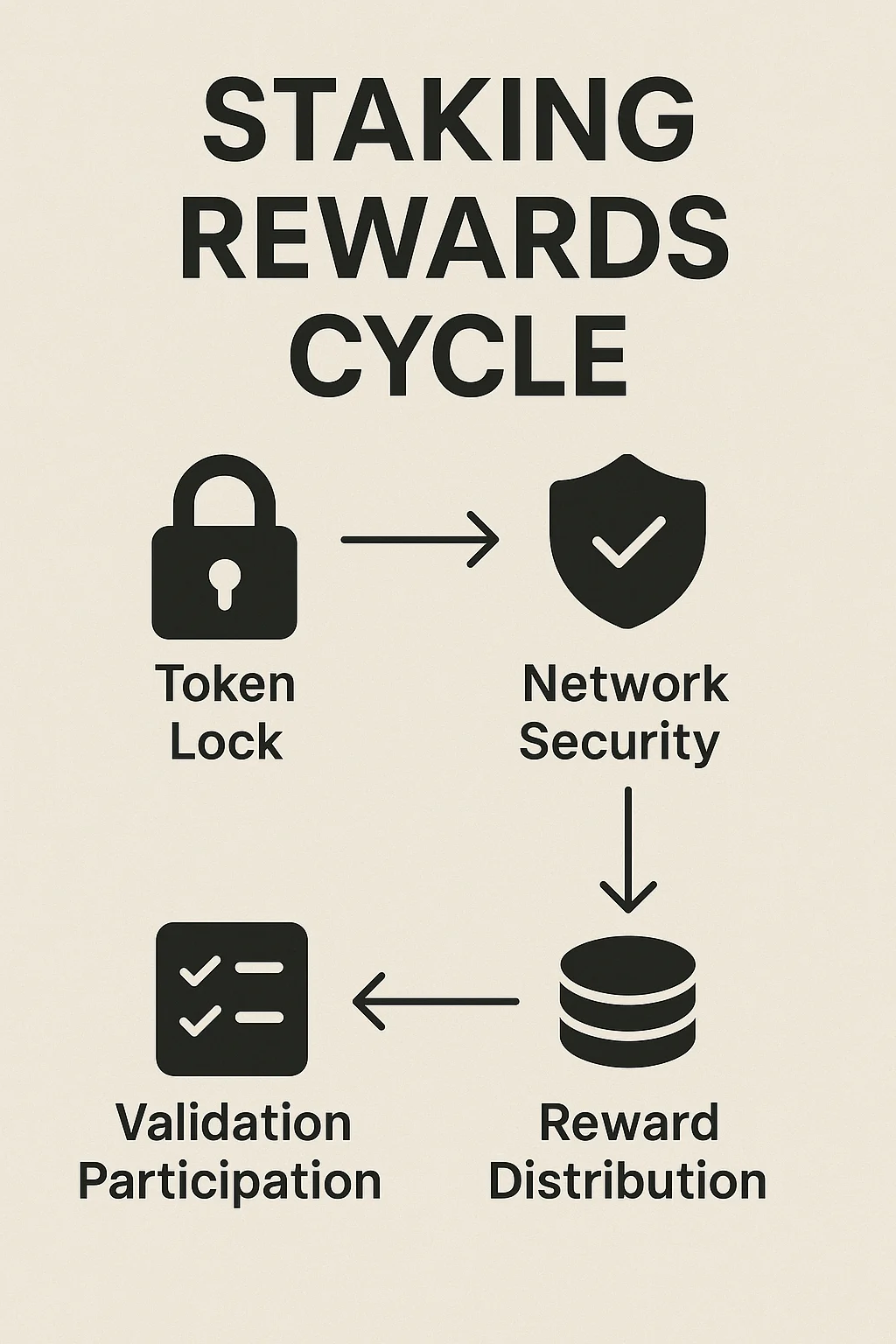
Infographic showing the staking rewards cycle with steps: token lock, network security, validation participation, and reward distribution

Real-World Examples

  • Ethereum staking provides approximately 4-6% annual returns for validators and delegators
  • Cardano (ADA) offers staking rewards through delegation pools with no lock-up periods
  • Solana staking rewards vary based on network performance and validator selection

Why Beginners Should Care

Passive income opportunities for long-term holders who want to earn returns on cryptocurrency holdings without active trading.

Network contribution as staking helps secure blockchain networks while earning rewards for productive participation.

Risk considerations including slashing penalties, lock-up periods, and validator selection that affect potential returns and fund accessibility.

Related Terms: Proof of Stake, Validator, Delegation

Back to Crypto Glossary

Similar Posts

  • Conservative Investing

    Conservative Investing: Low-Risk Investment ApproachConservative investing prioritizes capital preservation and steady returns over high-risk, high-reward strategies. It's like choosing the scenic route that takes longer but is much safer than the dangerous mountain pass.Conservative investing refers to investment strategies that prioritize capital preservation and risk reduction over maximum returns, typically focusing on established assets and…

  • Slashing Conditions

    Slashing Conditions: Validator Penalty Rules Slashing conditions define specific behaviors that result in validators losing staked funds as punishment for malicious or negligent actions. They’re the rules of engagement for network security. Slashing conditions are predetermined criteria that trigger automatic penalties for validators who violate network consensus rules or behave maliciously. These penalties involve destroying…

  • Mixing Service

    Mixing Service: Shuffling Coins for Privacy Mixing services (or tumblers) pool cryptocurrencies from multiple users then redistribute different coins to break transaction links. It’s like exchanging your marked bills for unmarked ones. A mixing service is a privacy tool that pools cryptocurrencies from multiple users and redistributes them to break the link between sending and…

  • L2 Sequencer

    L2 Sequencer: Transaction Ordering Engine L2 sequencers determine transaction order on Layer 2 networks, controlling which transactions get included and how they’re arranged. They’re like traffic controllers for blockchain highways. An L2 sequencer is a specialized node that collects, orders, and batches transactions for Layer 2 networks before submitting them to the main blockchain. Sequencers…

  • Algorithmic Trading

    Algorithmic Trading: Automated Trading StrategiesAlgorithmic trading uses computer programs to execute trades based on predetermined rules and market conditions. It's like having a robot trader that never sleeps and follows your strategy perfectly.Algorithmic trading involves using computer algorithms to automatically execute cryptocurrency trades based on predefined strategies, market signals, and risk parameters. These systems can operate…

  • Risk Assessment

    Risk Assessment: Evaluating Investment DangersRisk assessment involves systematically analyzing potential losses and their probabilities before making investment decisions. It's like checking the weather and road conditions before planning a trip.Risk assessment is the process of identifying, analyzing, and evaluating potential risks associated with cryptocurrency investments or activities to make informed decisions. This includes technical, market, regulatory,…