
Dusting Attack

Dusting Attack: Tracking Through Tiny Transactions

Dusting attacks send tiny amounts of cryptocurrency to addresses to track user behavior and deanonymize transactions. It’s like sprinkling digital breadcrumbs to follow where people go.

A dusting attack sends small amounts of cryptocurrency (dust) to many addresses to track users’ transaction patterns and potentially identify wallet owners. Attackers hope recipients will consolidate dust with other funds, revealing connections between addresses.

How Dusting Attacks Work

Mass distribution of tiny token amounts targets thousands of addresses simultaneously, often using automated tools to send minimal amounts that barely exceed network dust limits.

Behavioral analysis tracks how recipients handle dust, looking for patterns like consolidation with main balances or specific timing that reveals user habits.

Address clustering connects multiple addresses to single users when dust gets mixed with other transactions, potentially deanonymizing previously private holdings.
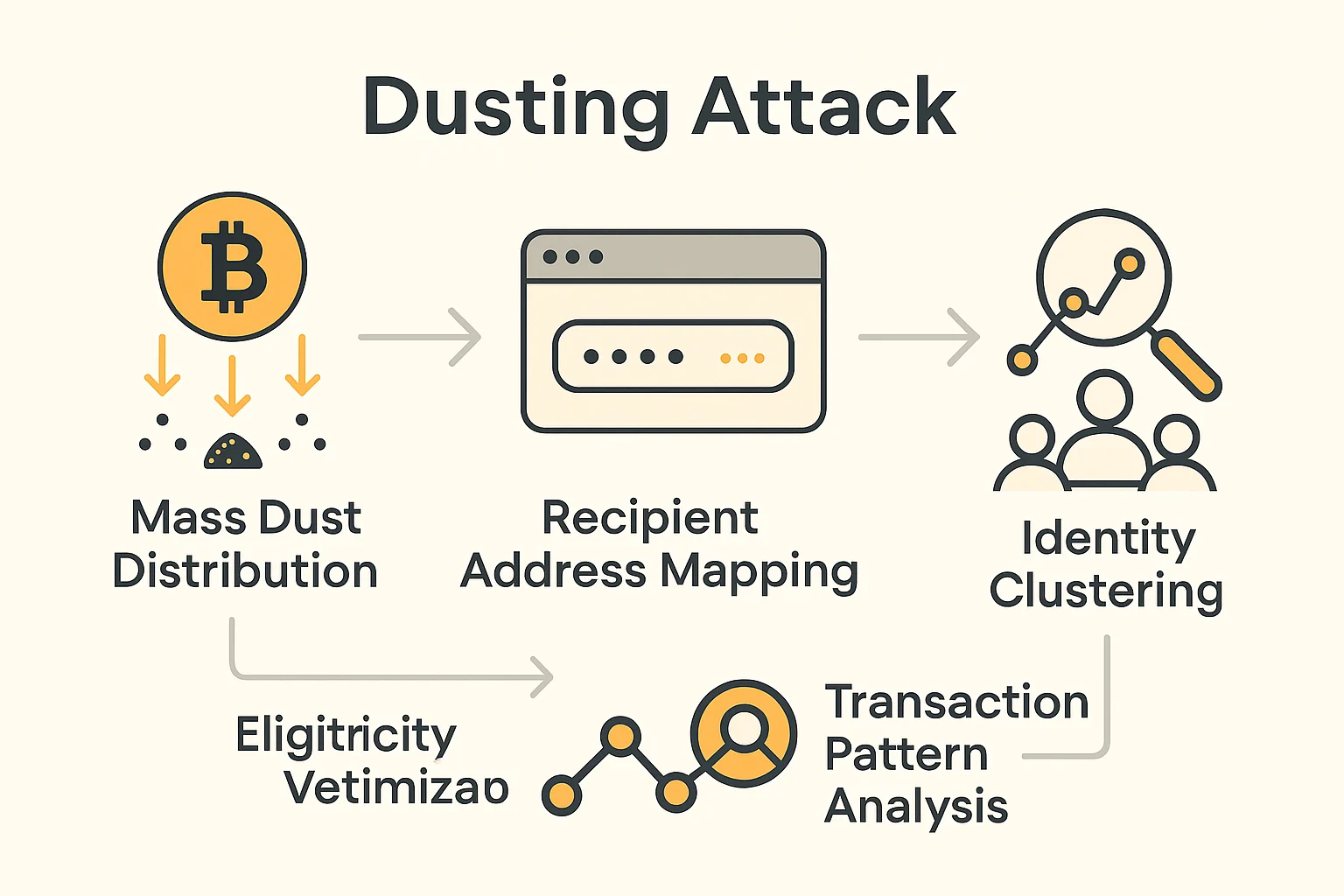
Infographic showing the dusting attack process: mass dust distribution, recipient address mapping, transaction pattern analysis, and identity clustering

Real-World Examples

  • Bitcoin dusting campaigns have targeted hundreds of thousands of addresses with minimal satoshi amounts
  • Binance Smart Chain tokens often used for dusting due to extremely low transaction costs
  • Privacy coin attacks attempt to break anonymity features through sophisticated dusting techniques

Why Beginners Should Care

Privacy erosion occurs when dust gets mixed with legitimate transactions, potentially revealing spending patterns and wallet connections to surveillance companies.

Wallet hygiene practices include freezing or ignoring dust rather than spending it, preventing attackers from gaining additional tracking information.

Limited direct harm exists from dusting attacks themselves – they don’t steal funds but can compromise privacy if handled improperly.

Related Terms: Privacy, Address Clustering, Transaction Analysis, Anonymity

Back to Crypto Glossary

Similar Posts

  • Token Allocation

    Token Allocation: Distributing Digital AssetsToken allocation determines how cryptocurrency tokens are distributed among different stakeholders like teams, investors, and communities. It's the blueprint for who gets what in crypto projects.Token allocation refers to the distribution plan for cryptocurrency tokens among various stakeholder groups including development teams, early investors, community members, and ecosystem development funds. This distribution…

  • Transaction Privacy

    Transaction Privacy: Protecting Financial InformationTransaction privacy keeps cryptocurrency transaction details confidential while maintaining network security. It's like having private bank accounts in a transparent financial system.Transaction privacy refers to techniques that conceal cryptocurrency transaction information such as sender addresses, recipient addresses, and transaction amounts from public observation. This enables financial privacy while maintaining blockchain functionality.How Transaction…

  • Seed Phrase

    Seed Phrase: Your Crypto Recovery Backup Your seed phrase is your crypto’s ultimate backup. More important than passwords, more valuable than the device itself. A seed phrase is a list of 12-24 words that can restore access to all your cryptocurrency wallets and funds. It’s your master key – lose it and your crypto is…

  • Reentrancy Attack

    Reentrancy Attack: Exploiting Function Recursion Reentrancy attacks exploit smart contracts by repeatedly calling functions before previous executions complete. It’s like withdrawing money from an ATM that forgets to update your balance between transactions. A reentrancy attack is a smart contract exploit where malicious contracts repeatedly call vulnerable functions before state changes are finalized, potentially draining…

  • Verifiable Credentials

    Verifiable Credentials: Tamper-Proof Digital DocumentsVerifiable credentials are digital documents that can be cryptographically verified without contacting the issuing authority. They're like diplomas that anyone can authenticate instantly.Verifiable credentials are digital documents that use cryptographic techniques to enable instant verification of authenticity without requiring contact with the issuing organization. These credentials enable trusted digital identity and qualification…

  • Digital Currency

    Digital Currency: Electronic Money SystemsDigital currency refers to money that exists only in electronic form, including both centralized and decentralized varieties. It's like having money that lives entirely in computers and phones instead of physical bills and coins in your wallet.Digital currency encompasses all forms of money that exist exclusively in electronic format, including cryptocurrencies,…