
Privacy Coin

Privacy Coin: Digital Cash That Actually Hides

Privacy coins use advanced cryptography to hide transaction details like amounts, senders, and receivers. They’re what Bitcoin was supposed to be before everyone realized blockchain transactions are completely transparent.

Privacy coins are cryptocurrencies designed to provide anonymous or untraceable transactions through advanced cryptographic techniques. Unlike Bitcoin where all transactions are publicly visible, privacy coins obscure transaction details to protect user financial privacy.

How Privacy Coins Work

Ring signatures mix your transaction with others, making it impossible to determine which participant actually sent the funds. It’s like having multiple people sign a document with identical handwriting.

Stealth addresses generate unique one-time addresses for each transaction, preventing outside observers from linking multiple payments to the same recipient.

Zero-knowledge proofs verify transaction validity without revealing amounts, addresses, or other sensitive information to network validators or blockchain observers.
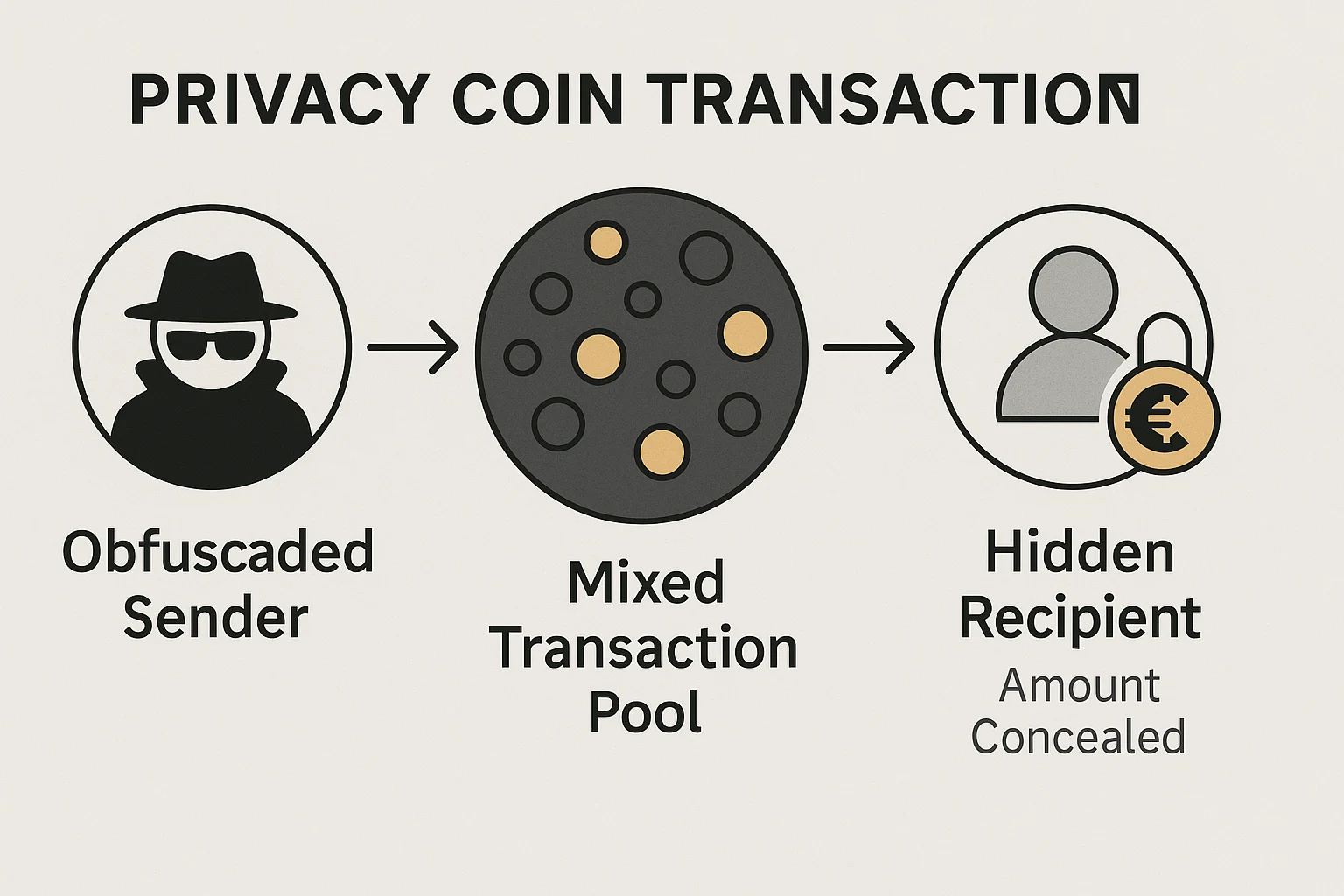
Infographic showing a privacy coin transaction flow with obfuscated sender, mixed transaction pool, and hidden recipient with concealed amount

Real-World Examples

  • Monero (XMR) – Uses ring signatures, stealth addresses, and RingCT for comprehensive privacy
  • Zcash (ZEC) – Offers optional privacy through zero-knowledge proofs called zk-SNARKs
  • Dash – Provides mixing services through CoinJoin-style transactions

Why Beginners Should Care

Financial privacy matters for legitimate reasons like preventing targeted theft, business confidentiality, and protection from authoritarian surveillance.

Regulatory pressure has forced many exchanges to delist privacy coins, limiting liquidity and adoption despite growing demand for financial privacy.

Enhanced security protects users from physical attacks since transaction histories can’t be used to identify wealthy targets for robbery or extortion.

Related Terms: Zero-Knowledge Proof, Ring Signatures, Stealth Address, Mixing Service

Back to Crypto Glossary

Similar Posts

  • Blockchain

    Blockchain: The Unchangeable Digital Ledger Forget the hype – blockchain is simply a better way to keep records. It’s like a ledger book that everyone can see, but no one can cheat. Blockchain is a chain of digital records (blocks) that are linked together and secured using cryptography. Once information goes into a block, changing…

  • Virtual Real Estate

    Virtual Real Estate: Digital Land OwnershipVirtual real estate refers to owning digital land parcels in metaverse worlds and virtual environments. It's like buying property in video game worlds that have real economic value.Virtual real estate consists of digital land parcels, buildings, or spaces within virtual worlds that can be owned, developed, and traded as NFTs. These…

  • Secure Element

    Secure Element: Hardware Security ChipA secure element is a tamper-resistant hardware chip designed to store sensitive information like private keys. It's like having a tiny vault built into your device that's extremely difficult to break into.A secure element is a specialized hardware component designed to provide isolated, tamper-resistant storage and processing for sensitive data such…

  • Dynamic NFTs (dNFTs)

    Dynamic NFTs (dNFTs): Evolving Digital Assets Dynamic NFTs can change their metadata, appearance, or properties based on external data or on-chain events. They’re like digital collectibles that grow and evolve over time. Dynamic NFTs (dNFTs) are non-fungible tokens that can modify their metadata, attributes, or visual appearance in response to external data feeds, user actions,…

  • Execution Layer

    Execution Layer: Transaction Processing EngineThe execution layer handles transaction processing and smart contract execution within blockchain architectures. It's like the engine that actually does the work in a modular blockchain system.The execution layer is responsible for processing transactions, executing smart contracts, and managing state changes within blockchain networks. In modular architectures, this layer can be optimized…

  • Mining

    Mining: How New Bitcoins Are Created Bitcoin mining is the process that creates new bitcoins and secures the network. It’s like a global lottery where miners compete to solve mathematical puzzles for rewards. Mining is the computational process of validating transactions and adding new blocks to a blockchain while earning newly created cryptocurrency as rewards….