
Ring Signatures

Ring Signatures: Anonymous Signatures in Groups

Ring signatures let any member of a group sign a message without revealing which specific member created the signature. It’s like having a family photo where you know someone took it, but can’t tell who.

A ring signature is a cryptographic signature scheme where any member of a group can produce a signature that verifies as coming from the group, but observers cannot determine which specific member signed. It provides anonymity within known sets.

How Ring Signatures Work

Group formation includes the actual signer plus other group members (called “decoys”) whose public keys are used to create the signature without their permission or knowledge.

Mathematical mixing combines the signer’s private key with decoys’ public keys in a way that produces a valid signature that could have been created by any group member.

Verification process confirms the signature came from someone in the group but provides no information about which specific member created it.
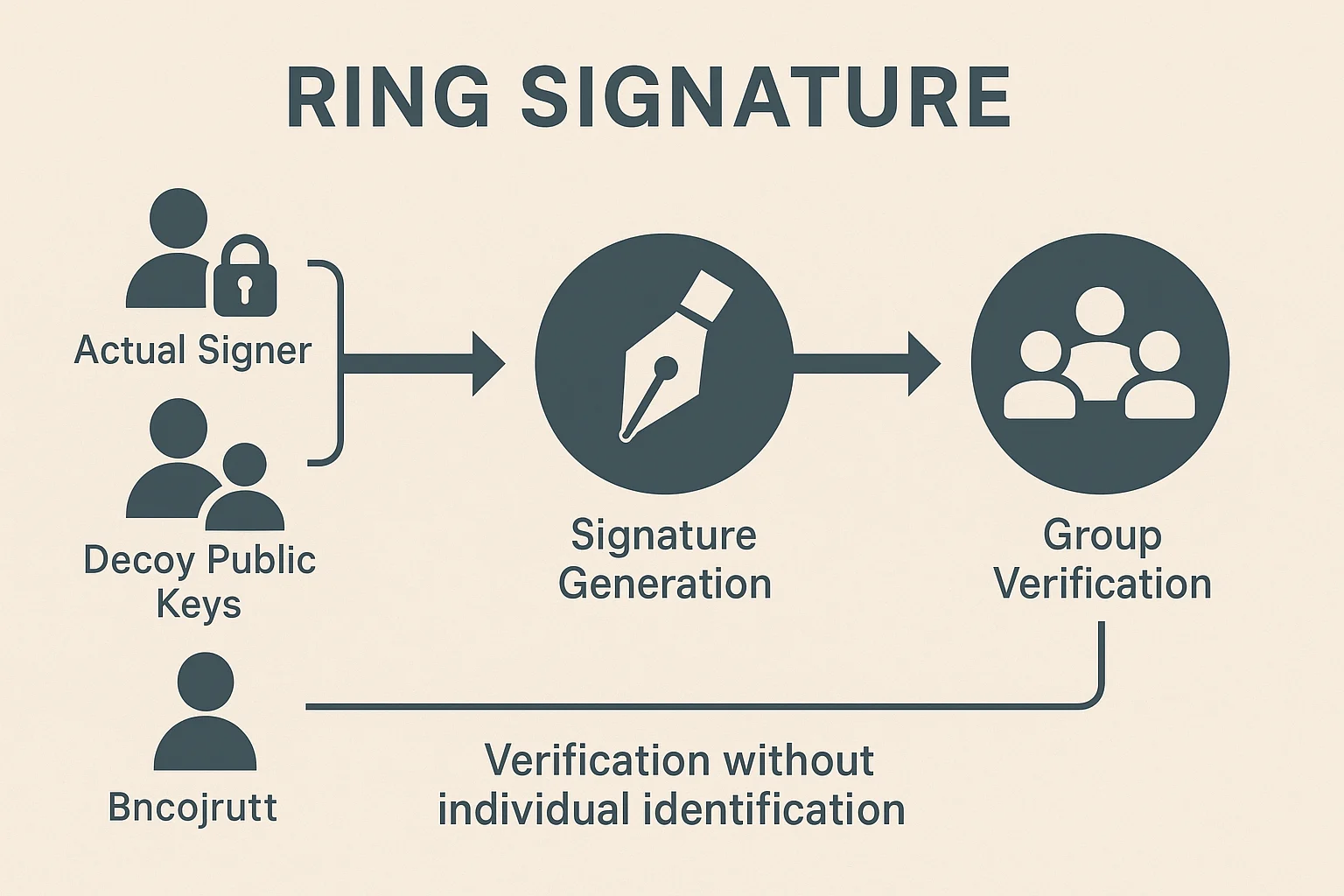
Infographic showing the ring signature process with actual signer and decoy public keys used to generate a group signature that is verifiable without revealing the individual signer

Real-World Examples

  • Monero transactions use ring signatures to hide which outputs are being spent in each transaction
  • Cryptonote protocol family implements ring signatures for privacy-focused cryptocurrencies
  • Political dissidents could use ring signatures for anonymous group statements without revealing individual identities

Why Beginners Should Care

Financial privacy benefits from ring signatures by making it impossible to determine which specific wallet outputs were spent in transactions.

Plausible deniability exists since any group member could have created the signature, protecting individual privacy even if group membership is known.

Computational overhead makes ring signatures more expensive than regular signatures, requiring balance between privacy levels and transaction costs.

Related Terms: Privacy Coin, Monero, Mixing, Anonymity Set

Back to Crypto Glossary

Similar Posts

  • Atomic Transaction

    Atomic Transaction: All-or-Nothing OperationsAn atomic transaction either completes entirely or fails completely, with no partial execution possible. It's like a package deal where you get everything or nothing at all.An atomic transaction is an operation that either succeeds completely or fails entirely, ensuring that all components of a complex transaction execute together or none execute…

  • CoinJoin

    CoinJoin: Bitcoin Transaction MixingCoinJoin combines multiple Bitcoin transactions into single transactions to obscure the connection between inputs and outputs. It's like mixing your laundry with other people's to make it harder to tell which clothes belong to whom.CoinJoin is a Bitcoin privacy technique that combines multiple transactions from different users into a single transaction, making…

  • Token Allocation

    Token Allocation: Distributing Digital AssetsToken allocation determines how cryptocurrency tokens are distributed among different stakeholders like teams, investors, and communities. It's the blueprint for who gets what in crypto projects.Token allocation refers to the distribution plan for cryptocurrency tokens among various stakeholder groups including development teams, early investors, community members, and ecosystem development funds. This distribution…

  • Impermanent Loss

    Impermanent Loss: The Hidden Cost of Liquidity Providing Impermanent loss is the sneaky tax on liquidity providers. Your tokens can lose value even when the pool is profitable. It’s math, not magic – but it feels like getting robbed. Impermanent loss occurs when the price ratio of tokens in a liquidity pool changes compared to…

  • Cold Wallet

    Cold Wallet Backup: Securing Your Security Cold wallet backup ensures you can recover your cryptocurrency even if your hardware wallet is lost, stolen, or destroyed. It’s like having spare keys to your safe deposit box. Cold wallet backup refers to secure storage methods for seed phrases and recovery information that enable restoring access to hardware…

  • Network Governance

    Network Governance: Blockchain Decision MakingNetwork governance encompasses the processes and mechanisms for making decisions about blockchain protocol changes and upgrades. It's like the constitutional system that determines how a digital nation changes its laws.Network governance refers to the systems and processes through which blockchain networks make decisions about protocol upgrades, parameter changes, and strategic direction. This…