
Tornado Cash

Tornado Cash: The Controversial Privacy Protocol

Tornado Cash was Ethereum’s most popular mixing service until U.S. sanctions shut it down. It used zero-knowledge proofs to enable private transactions on a transparent blockchain.

Tornado Cash was a decentralized mixing protocol on Ethereum that used zero-knowledge proofs to enable private transactions by breaking the link between sender and receiver addresses. Users could deposit ETH or tokens and later withdraw equivalent amounts from different addresses.

How Tornado Cash Worked

Smart contract pools held deposits of fixed amounts (0.1, 1, 10, or 100 ETH) where users could deposit funds and receive cryptographic commitments proving their deposit without revealing identity.

Zero-knowledge proofs allowed users to prove they had made a valid deposit without revealing which specific deposit was theirs, enabling private withdrawals to fresh addresses.

Anonymity sets grew larger with more users, improving privacy as it became harder to correlate deposits and withdrawals through timing or amount analysis.
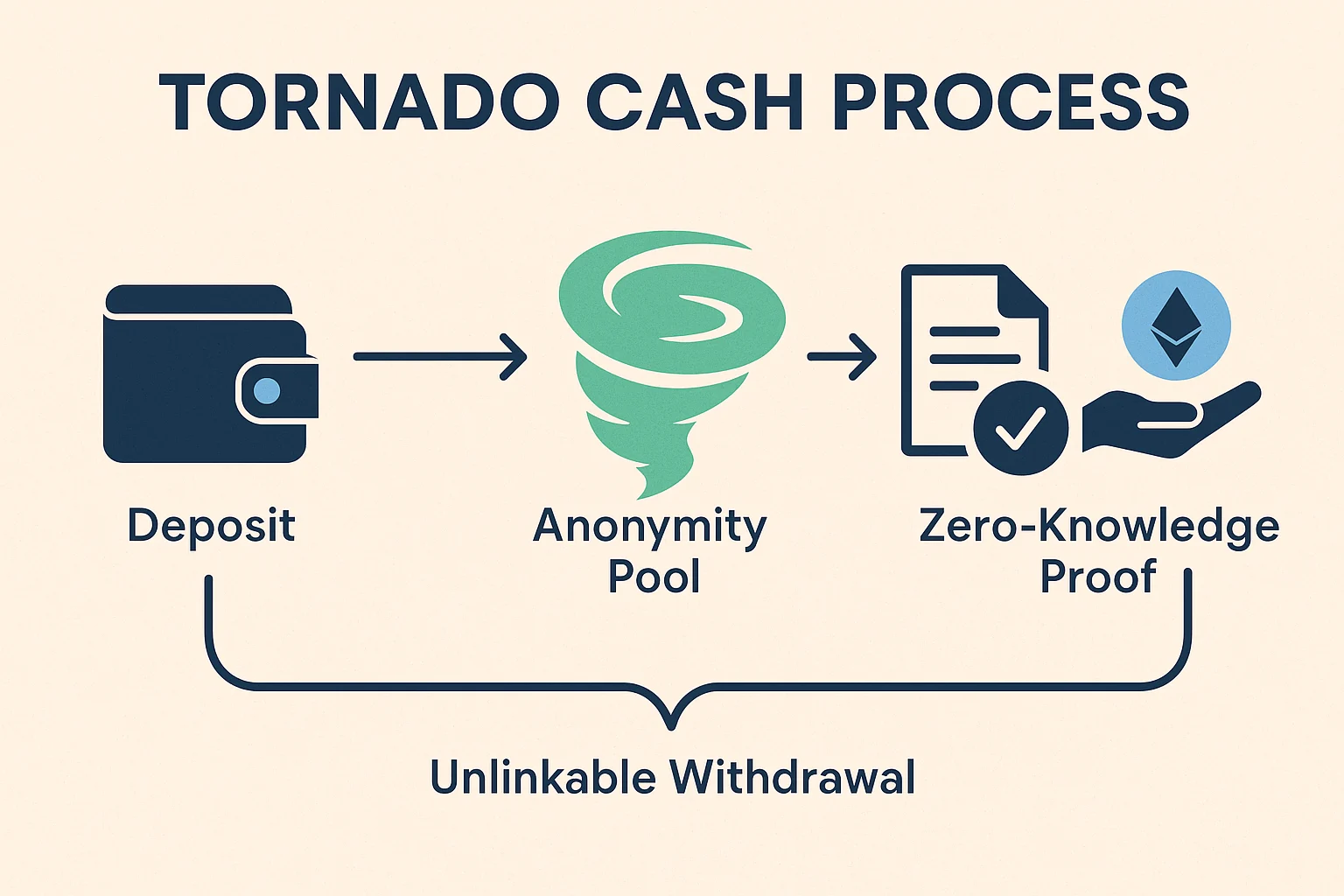
Infographic showing Tornado Cash process: deposit, anonymity pool, zero-knowledge proof, and unlinkable withdrawal

Real-World Examples

  • Privacy-conscious users mixed legitimate funds to prevent transaction surveillance and protect financial privacy
  • Criminal activity also used the service, leading to regulatory scrutiny and eventual sanctions
  • North Korean hackers reportedly used Tornado Cash to launder stolen cryptocurrency

Why Beginners Should Care

Regulatory precedent from Tornado Cash sanctions affects the entire crypto privacy space, potentially criminalizing privacy-enhancing technologies regardless of legitimate use cases.

Code vs. usage debates center on whether privacy tools themselves should be banned or only their illegal applications should be prosecuted.

Chilling effects on privacy development may result as developers avoid creating tools that could face similar regulatory action, reducing financial privacy options for law-abiding users.

Related Terms: Mixing Service, Zero-Knowledge Proof, Privacy Coin, Sanctions

Back to Crypto Glossary

Similar Posts

  • Ring Signatures

    Ring Signatures: Anonymous Signatures in Groups Ring signatures let any member of a group sign a message without revealing which specific member created the signature. It’s like having a family photo where you know someone took it, but can’t tell who. A ring signature is a cryptographic signature scheme where any member of a group…

  • Value Capture

    Value Capture: Extracting Economic BenefitsValue capture refers to mechanisms that extract and redirect economic value from ecosystem activity to specific stakeholders or protocols. It's like having toll booths that collect fees from traffic flowing through valuable infrastructure.Value capture describes mechanisms that extract economic value from ecosystem activity and redirect it to token holders, protocols, or…

  • Oracle

    Oracle: Connecting Blockchains to Reality Oracles are the bridges between blockchain smart contracts and real-world data. Without them, DeFi would be a closed system talking only to itself. An oracle is a service that provides external data to blockchain networks, enabling smart contracts to access real-world information like prices, weather, sports scores, or any off-chain…

  • Scalability

    Scalability: Handling Growing Network DemandScalability refers to a blockchain network's ability to handle increasing transaction volumes without degrading performance or significantly increasing costs. It's like building highways that don't get congested as more cars use them.Scalability describes how well blockchain networks can accommodate growing user bases and transaction volumes while maintaining reasonable fees and confirmation…

  • Gaming Token

    Gaming Token: In-Game Digital CurrencyGaming tokens are cryptocurrencies designed specifically for use within video games and virtual worlds. They enable player ownership, trading, and monetization of in-game assets and achievements.Gaming tokens are cryptocurrencies created for specific video games or gaming ecosystems, enabling player ownership of in-game assets, rewards, and economic participation. These tokens bridge traditional gaming…

  • Token Allocation

    Token Allocation: Distributing Digital AssetsToken allocation determines how cryptocurrency tokens are distributed among different stakeholders like teams, investors, and communities. It's the blueprint for who gets what in crypto projects.Token allocation refers to the distribution plan for cryptocurrency tokens among various stakeholder groups including development teams, early investors, community members, and ecosystem development funds. This distribution…