
Autonomous World (AW)

Autonomous World (AW): Persistent Virtual Realities

Autonomous worlds are persistent virtual environments that continue existing and evolving even when no players are actively participating. They’re like having a Minecraft world that keeps running and changing forever.

An Autonomous World (AW) is a virtual environment that operates independently through blockchain infrastructure, maintaining state and enabling interactions without requiring central servers or active management. These worlds persist and evolve according to their programmed rules.

How Autonomous Worlds Work

Blockchain persistence ensures the virtual world continues existing as long as the underlying blockchain operates, independent of any company or server infrastructure.

Player-driven evolution allows inhabitants to modify the world through their actions, with changes permanently recorded on-chain.

Economic sovereignty enables native economies with real value exchange, ownership rights, and governance systems controlled by world inhabitants.
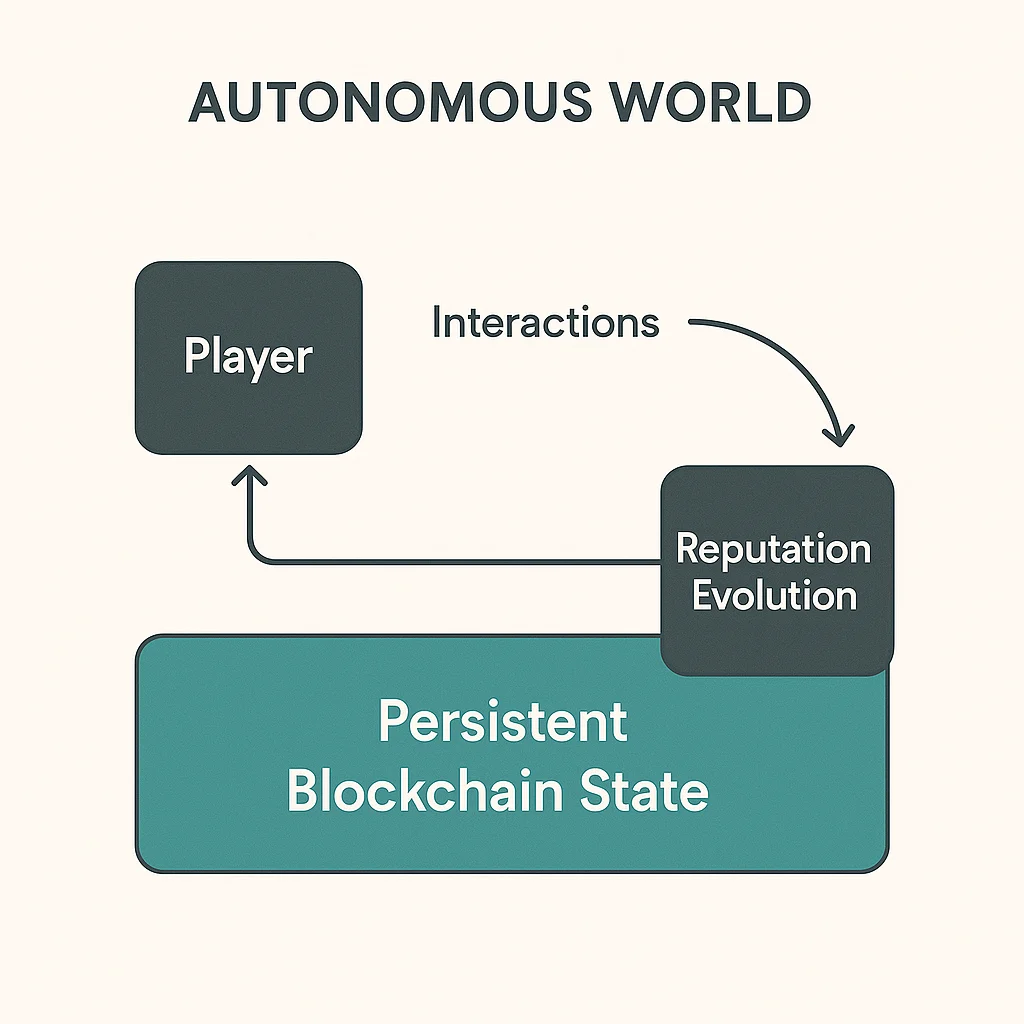
Autonomous world architecture showing player interactions, reputation evolution, and persistent blockchain state enabling independent system behavior.

Real-World Examples

  • Dark Forest – Space exploration game that runs entirely on-chain with hidden information
  • Loot derivatives creating persistent fantasy worlds based on text-based NFTs
  • MUD engine provides infrastructure for building complex autonomous worlds

Why Beginners Should Care

True ownership of virtual assets and land that can’t be taken away by game companies going out of business or changing policies.

Persistent value creation where time and effort invested in virtual worlds retains value indefinitely through blockchain permanence.

Experimental economics as autonomous worlds become laboratories for testing new forms of governance, economics, and social organization.

Related Terms: Metaverse, On-Chain Gaming, Virtual Real Estate, Persistence

Back to Crypto Glossary

Similar Posts

  • Fractional Ownership

    Fractional Ownership: Shared Asset OwnershipFractional ownership enables multiple people to own portions of expensive assets that would be difficult to purchase individually. It's like buying a slice of expensive real estate instead of the whole property.Fractional ownership refers to dividing ownership of assets into smaller portions that can be owned by multiple parties, typically enabled…

  • Asset Rehypothecation

    Asset Rehypothecation: Reusing Collateral for Multiple PurposesAsset rehypothecation involves using the same collateral for multiple financial purposes simultaneously. It's like using your house as collateral for multiple loans at the same time.Asset rehypothecation refers to the practice of using deposited or pledged assets as collateral for additional financial activities beyond their original purpose. This can multiply…

  • Seed Phrase

    Seed Phrase: Your Crypto Recovery Backup Your seed phrase is your crypto’s ultimate backup. More important than passwords, more valuable than the device itself. A seed phrase is a list of 12-24 words that can restore access to all your cryptocurrency wallets and funds. It’s your master key – lose it and your crypto is…

  • Dusting Attack

    Dusting Attack: Tracking Through Tiny Transactions Dusting attacks send tiny amounts of cryptocurrency to addresses to track user behavior and deanonymize transactions. It’s like sprinkling digital breadcrumbs to follow where people go. A dusting attack sends small amounts of cryptocurrency (dust) to many addresses to track users’ transaction patterns and potentially identify wallet owners. Attackers…

  • Inter Chain Protocol

    Inter Chain Protocol: Cross-Blockchain CommunicationInter-chain protocols enable different blockchain networks to communicate and exchange data or assets securely. They're like universal translators that help different blockchain languages understand each other.Inter-chain protocols are standardized communication systems that enable different blockchain networks to exchange information, transfer assets, and coordinate actions across network boundaries. These protocols create interoperability between…

  • Proof of History

    Proof of History: Solana’s Time Innovation Proof of History creates a cryptographic timestamp that proves events occurred in a specific sequence. It’s like having an unforgeable clock built into the blockchain. Proof of History (PoH) is a consensus mechanism that creates a historical record proving that events occurred at specific moments in time. It uses…