
Data Availability Layer

Data Availability Layer: Ensuring Information Access

Data availability layers ensure that blockchain data remains accessible for verification without requiring full nodes to store everything. It’s like having a library system where you can verify any book exists without storing them all.

A data availability layer guarantees that blockchain transaction data is published and remains accessible for verification, even if not all nodes store complete copies. This enables scalable architectures while maintaining security guarantees.

How Data Availability Works

Data publication requires block producers to make transaction data publicly available, even if execution happens elsewhere or in summarized form.

Availability proofs use cryptographic techniques like data availability sampling to verify data accessibility without downloading complete datasets.

Fraud prevention ensures malicious actors cannot hide transaction data that would enable verification of incorrect state transitions or invalid blocks.
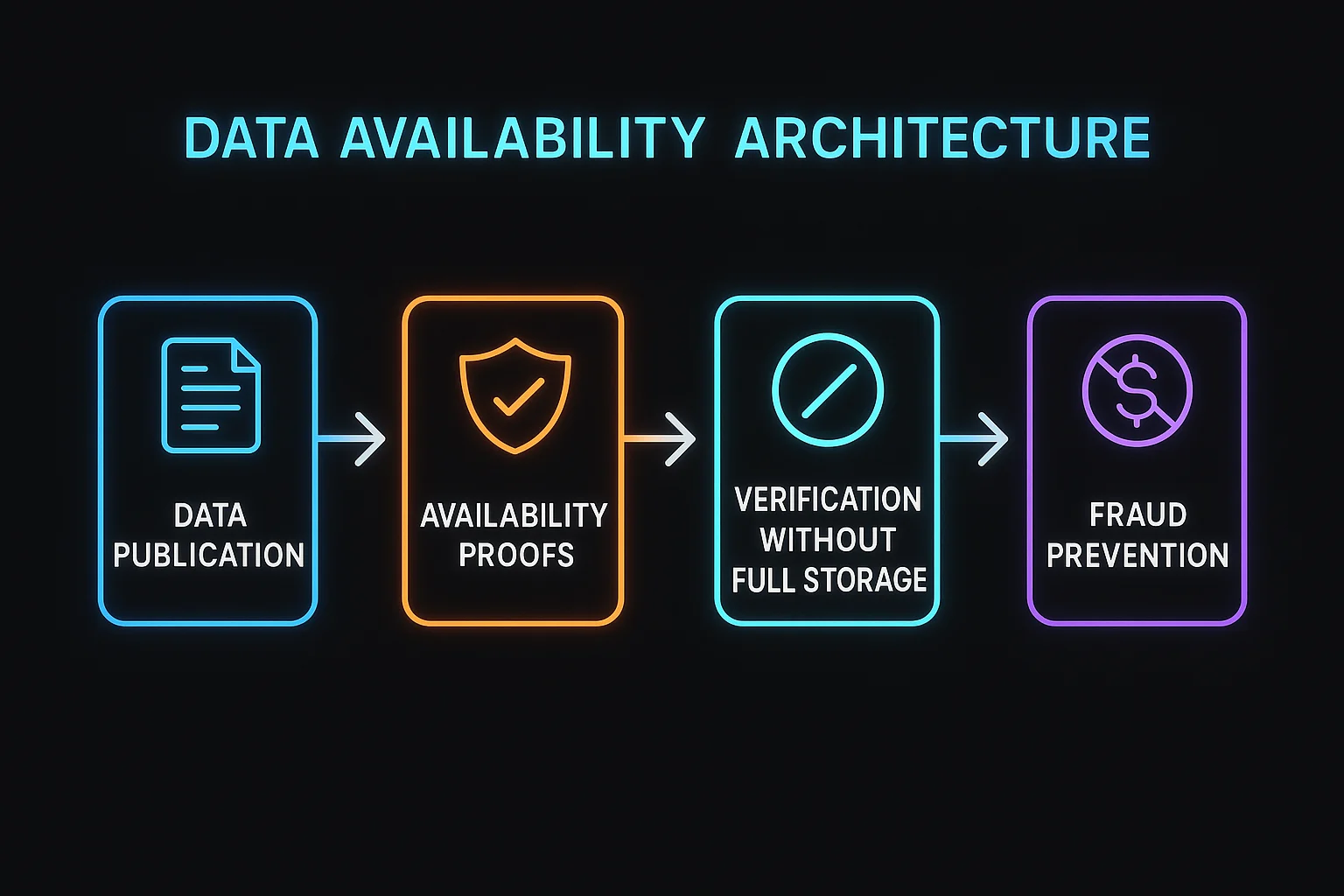
Data availability architecture showing data publication, availability proofs, verification without full storage, and fraud prevention

Real-World Examples

  • Celestia provides dedicated data availability services for modular blockchain architectures
  • Ethereum serves as a data availability layer for various Layer 2 rollup solutions
  • Polygon Avail offers scalable data availability for sovereign blockchain networks

Why Beginners Should Care

Scalability enablement through data availability layers that support much higher transaction throughput than traditional blockchain architectures.

Security preservation maintains verification capabilities and fraud detection without requiring all participants to store complete blockchain histories.

Technical complexity in understanding how data availability relates to overall blockchain security and decentralization properties.

Related Terms: Modular Blockchain, Data Sampling, Fraud Proof, Scalability

Back to Crypto Glossary

Similar Posts

  • Capitulation

    Capitulation: Market Surrender and Mass SellingCapitulation occurs when investors give up hope and sell their holdings en masse, often marking market bottoms. It's like throwing in the towel when everything seems hopeless.Capitulation refers to the point where investors abandon hope and sell their cryptocurrency holdings in large volumes, typically occurring near market bottoms after prolonged…

  • Optimistic Rollup

    Optimistic Rollup: Trust but Verify Scaling Optimistic rollups assume transactions are valid by default but allow challenges during dispute periods. It’s like innocent until proven guilty for blockchain transactions. An optimistic rollup is a Layer 2 scaling solution that assumes transactions are valid by default and only verifies them if someone submits a fraud proof…

  • Consensus Rules

    Consensus Rules: Network Agreement ProtocolsConsensus rules define how blockchain networks validate transactions and maintain agreement about the ledger state. They're like the constitution for digital money systems.Consensus rules are the specific protocols and requirements that all network participants must follow to validate transactions, create blocks, and maintain agreement about the blockchain's current state. These rules ensure…

  • Go

    Go: Programming Language for BlockchainGo is a programming language widely used for building blockchain infrastructure and cryptocurrency applications. It's like the construction language for digital money systems.Go (also called Golang) is a programming language developed by Google that's popular for blockchain development due to its performance, simplicity, and excellent concurrency support. Many major cryptocurrency projects use…

  • Liquidity Pool

    Liquidity Pool: The Fuel That Powers DEX Trading Liquidity pools are why decentralized exchanges work. They’re shared pots of tokens that enable trading without traditional buyers and sellers. A liquidity pool is a collection of tokens locked in a smart contract that provides liquidity for decentralized trading. Instead of matching buy and sell orders, traders…

  • Price Feed

    Price Feed: Real-Time Market DataPrice feeds provide real-time cryptocurrency market data to applications and smart contracts that need current asset values. They're like financial news tickers that continuously update with the latest stock prices, but for digital assets and automated systems.Price feed refers to continuous streams of current market prices and trading data that supply…