
Bull Market

Bull Market: When Everything Goes Up

Bull markets are when crypto investors feel like geniuses. Prices rise, optimism soars, and everyone becomes a trading expert. Until they don’t.

A bull market is a sustained period of rising cryptocurrency prices accompanied by widespread investor optimism. During bull runs, even terrible projects can see massive gains as speculation overtakes fundamentals.

How Bull Markets Work

Bull markets feed on themselves. Rising prices attract new investors, whose buying drives prices higher, attracting even more investors. This creates positive feedback loops that can last months or years.

Media attention amplifies bull markets. Mainstream coverage brings retail investors who have never owned crypto, providing new money to fuel further price increases.

“This time is different” becomes the prevailing sentiment. New investors believe prices will keep rising indefinitely, leading to increasingly risky behavior.
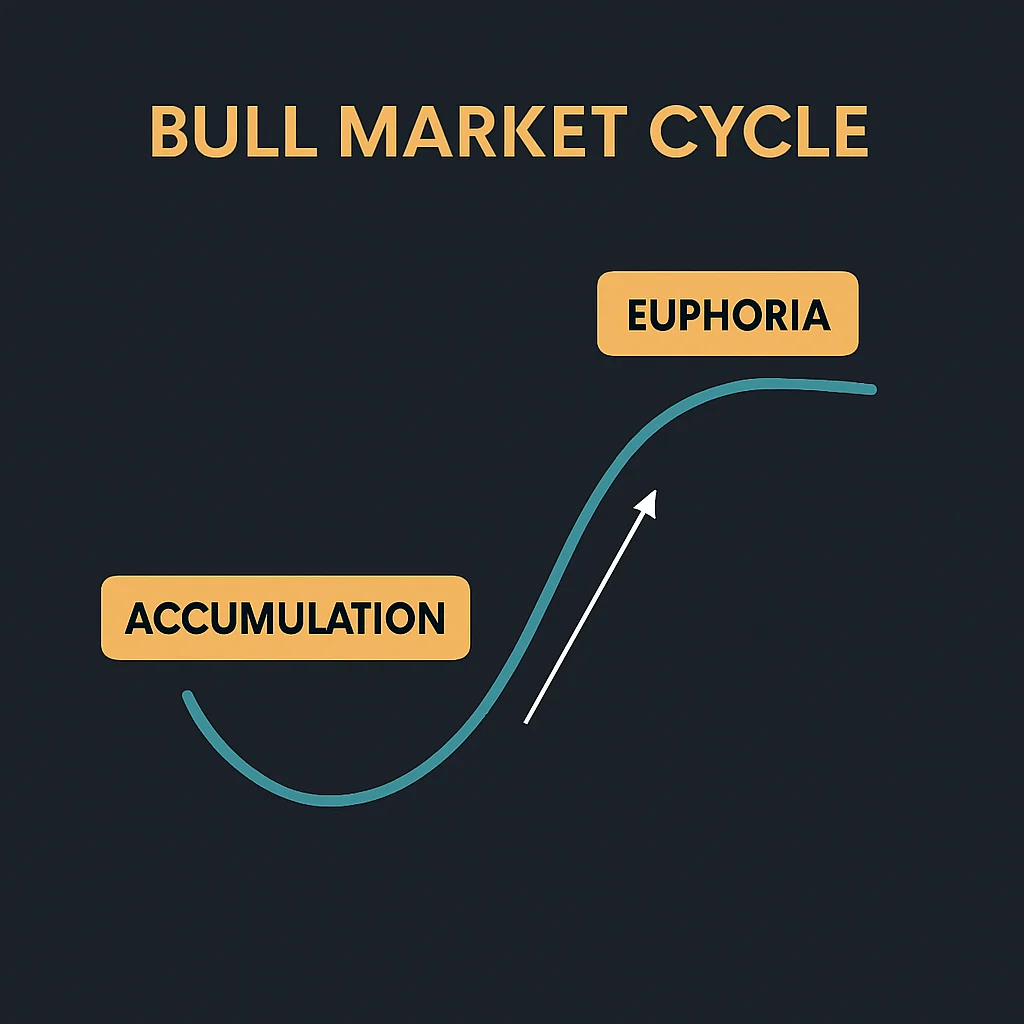
Bull market cycle chart showing phases: accumulation, euphoria, and distribution

Real-World Examples

  • 2017 Bull Run – Bitcoin went from $1,000 to $20,000 in one year
  • 2021 Bull Run – Total crypto market cap reached $3 trillion
  • DeFi Summer 2020 – Decentralized finance tokens gained 1000%+

Why Beginners Should Care

Bull markets create life-changing wealth but also devastating losses. The same psychological forces that drive prices up eventually reverse, often violently.

Smart strategies include taking profits systematically, avoiding leverage, and remembering that bull markets always end. The time to be greedy is when others are fearful, not when everyone’s celebrating.

Related Terms: Bear Market, FOMO, ATH, Market Cycle

Back to Crypto Glossary

Similar Posts

  • Gaming Token

    Gaming Token: In-Game Digital CurrencyGaming tokens are cryptocurrencies designed specifically for use within video games and virtual worlds. They enable player ownership, trading, and monetization of in-game assets and achievements.Gaming tokens are cryptocurrencies created for specific video games or gaming ecosystems, enabling player ownership of in-game assets, rewards, and economic participation. These tokens bridge traditional gaming…

  • Back Running

    Back Running: Following Profitable TransactionsBack running involves placing transactions immediately after profitable transactions to capture secondary opportunities. It's like following successful traders to pick up the crumbs they leave behind.Back running is a MEV extraction strategy where bots place transactions immediately after profitable transactions to capture residual value or secondary opportunities. This technique exploits the predictable…

  • Consensus Rules

    Consensus Rules: Network Agreement ProtocolsConsensus rules define how blockchain networks validate transactions and maintain agreement about the ledger state. They're like the constitution for digital money systems.Consensus rules are the specific protocols and requirements that all network participants must follow to validate transactions, create blocks, and maintain agreement about the blockchain's current state. These rules ensure…

  • L2 Sequencer

    L2 Sequencer: Transaction Ordering Engine L2 sequencers determine transaction order on Layer 2 networks, controlling which transactions get included and how they’re arranged. They’re like traffic controllers for blockchain highways. An L2 sequencer is a specialized node that collects, orders, and batches transactions for Layer 2 networks before submitting them to the main blockchain. Sequencers…

  • Proof of Humanity

    Proof of Humanity: Verifying Human Uniqueness Proof of Humanity creates registries of verified unique humans to prevent Sybil attacks in voting and distribution systems. It’s like having a bouncer who knows everyone isn’t wearing a disguise. Proof of Humanity is a system for creating verifiable registries of unique human beings to prevent individuals from claiming…

  • Gwei

    Gwei: Ethereum’s Gas Price Unit Gwei is the denomination used for Ethereum gas prices. Understanding gwei helps you avoid overpaying for transactions when the network gets congested. Gwei (gigawei) is a unit of Ethereum’s native currency equal to one billionth of an ETH (10^-9 ETH). It’s the standard unit for expressing gas prices, making it…