
Dust

Dust: Tiny Amounts That Clog Networks

Dust refers to cryptocurrency amounts so small they’re not economically viable to spend due to transaction fees exceeding their value. It’s like having pennies that cost dollars to use.

Dust consists of very small amounts of cryptocurrency that cost more in transaction fees to send than their actual value. These tiny balances accumulate in wallets over time and can clog network resources if moved.

How Dust Accumulates

Change outputs from transactions often leave small remainders that aren’t worth the gas fees to consolidate or spend separately.

Airdrop residuals may distribute tiny token amounts that become worthless after market prices decline below transaction costs.

Spam attacks deliberately send dust to many addresses to clog networks or track user behavior through forced interactions.
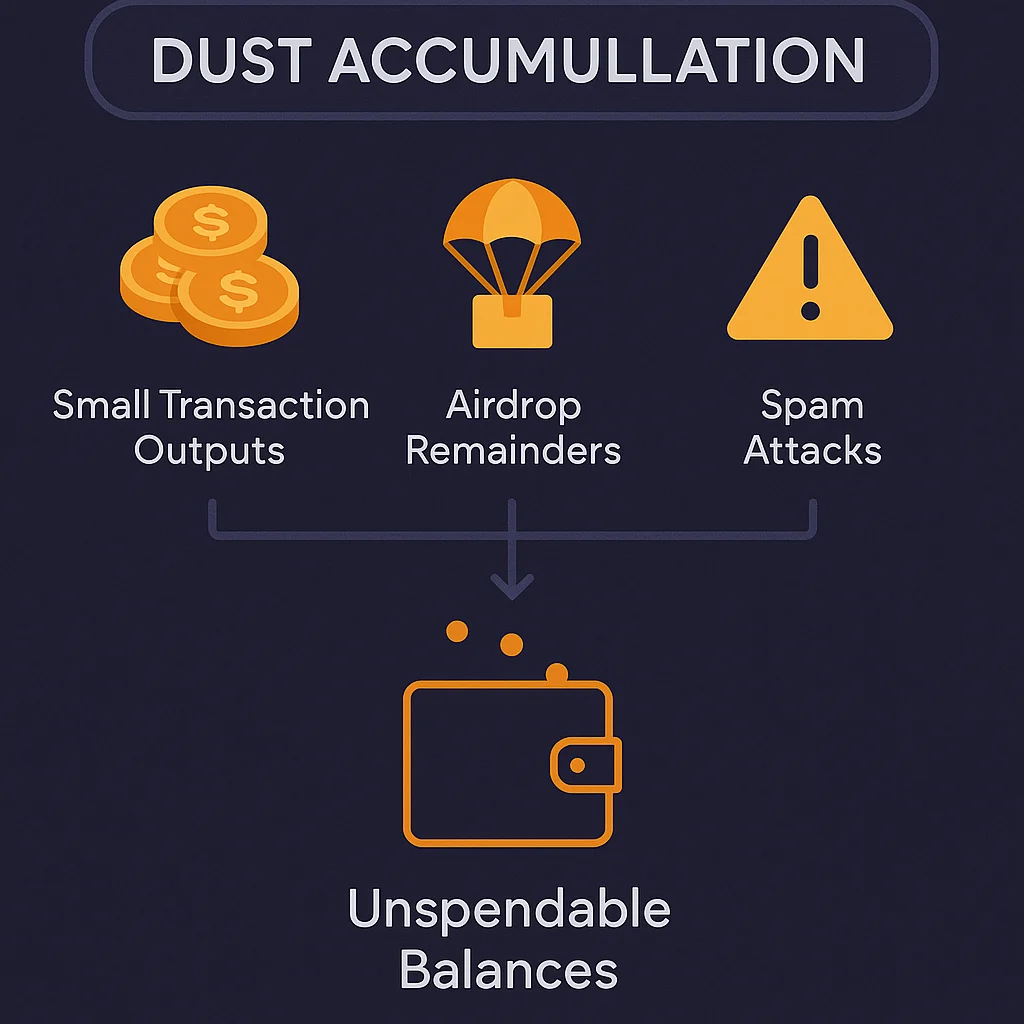
Dust accumulation diagram showing how small transaction outputs, airdrop remainders, and spam attacks lead to unspendable balances in crypto wallets.

Real-World Examples

  • Bitcoin dust limit is around 546 satoshis – amounts below this may be rejected by nodes
  • Ethereum gas fees can make sub-$10 token amounts uneconomical to move during network congestion
  • BSC spam tokens often leave dust amounts that users can’t profitably remove

Why Beginners Should Care

Wallet clutter from dust makes portfolio tracking difficult and can hide significant balances among dozens of worthless token remnants.

Privacy implications exist since dust can be used for tracking purposes when users consolidate small amounts with larger balances.

Network efficiency suffers when dust gets moved, consuming block space for economically insignificant transactions that could handle larger value transfers.

Related Terms: Transaction Fees, UTXO, Dusting Attack, Spam

Back to Crypto Glossary

Similar Posts

  • Transaction

    Transaction: Moving Value on the BlockchainA cryptocurrency transaction transfers value from one address to another on a blockchain network. It's like writing a check, but with mathematical guarantees instead of trust.A transaction is a digitally signed transfer of cryptocurrency from one wallet address to another, recorded permanently on the blockchain. Every transaction includes sender information, recipient…

  • Transaction Privacy

    Transaction Privacy: Protecting Financial InformationTransaction privacy keeps cryptocurrency transaction details confidential while maintaining network security. It's like having private bank accounts in a transparent financial system.Transaction privacy refers to techniques that conceal cryptocurrency transaction information such as sender addresses, recipient addresses, and transaction amounts from public observation. This enables financial privacy while maintaining blockchain functionality.How Transaction…

  • Community Governance

    Community Governance: Collective Decision MakingCommunity governance enables token holders and participants to collectively make decisions about project direction and protocol changes. It's like a democracy where community members vote on important issues.Community governance refers to decision-making systems where project participants have input and voting rights over protocol changes, resource allocation, and strategic direction. This distributes control…

  • Wallet Security

    Wallet Security: Protecting Cryptocurrency AccessWallet security encompasses all measures taken to protect cryptocurrency wallets from theft, loss, or unauthorized access. It's like comprehensive security for your digital bank account.Wallet security refers to practices, technologies, and procedures used to protect cryptocurrency wallets and their contents from various threats including hacking, phishing, and user error. Proper security is…

  • Digital Securities

    Digital Securities: Blockchain-Based Financial InstrumentsDigital securities are traditional financial instruments like stocks and bonds represented as tokens on blockchain networks. They're like digitizing paper stock certificates to work on the internet.Digital securities are blockchain-based tokens that represent ownership in traditional financial instruments such as stocks, bonds, or real estate, subject to securities regulations. These bridge conventional…

  • Transaction Verification

    Transaction Verification: Confirming Payment ValidityTransaction verification is the process of confirming that cryptocurrency transactions are valid before adding them to the blockchain. It's like having bank tellers check that signatures match and accounts have sufficient funds before processing checks.Transaction verification refers to the systematic process where network participants validate cryptocurrency transactions by checking digital signatures,…