
Flash Mint

Flash Mint: Temporary Token Creation

Flash mints create tokens temporarily within single transactions that must be returned or burned before the transaction completes. It’s like borrowing inventory that must be returned instantly.

Flash minting allows creating large amounts of tokens temporarily within a single transaction, provided they are burned or properly backed before the transaction ends. This enables capital-efficient arbitrage and liquidation strategies.

How Flash Mints Work

Temporary creation mints tokens at the beginning of a transaction without requiring upfront collateral or reserves.

Transaction atomicity ensures that either the entire transaction succeeds (including token burning) or fails completely, preventing permanent token creation without backing.

Use case optimization enables arbitrage, liquidation, and other strategies that require temporary access to large token amounts without permanent supply expansion.
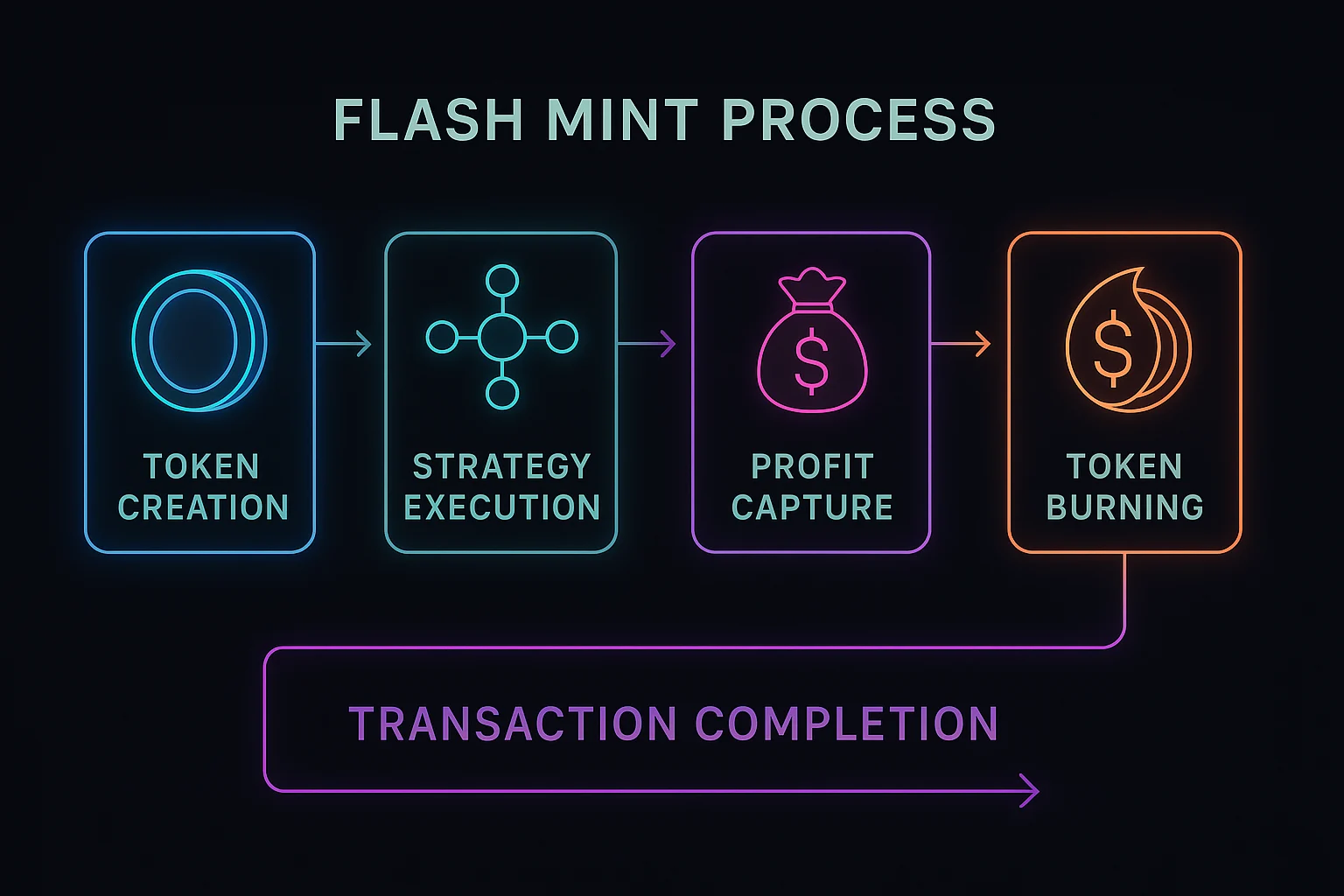
Flash mint process showing token creation, strategy execution, profit capture, token burning, and transaction completion

Real-World Examples

  • MakerDAO allows flash minting DAI for liquidations and arbitrage opportunities
  • Various stablecoins implement flash minting for improved capital efficiency
  • Arbitrage strategies use flash minting to execute large trades without holding capital

Why Beginners Should Care

Capital efficiency enables profitable strategies that would otherwise require significant upfront capital to execute.

Protocol risks from flash mint functionality that could be exploited if not implemented correctly or if economic models are flawed.

Market impact as flash minting can enable larger arbitrage trades that help maintain protocol stability and fair pricing.

Related Terms: Flash Loan, Arbitrage, Atomic Transaction, Capital Efficiency

Back to Crypto Glossary

Similar Posts

  • Transaction Cost

    Transaction Cost: The Price of Blockchain OperationsTransaction cost refers to the total expense of executing operations on blockchain networks, including fees, gas, and opportunity costs. It's the price you pay for using decentralized financial infrastructure.Transaction cost encompasses all expenses associated with executing blockchain operations, including network fees, gas costs, slippage, and time value. Understanding total transaction…

  • Token Distribution

    Token Distribution: Allocating Digital AssetsToken distribution refers to how cryptocurrency tokens are allocated among different stakeholders and released into circulation. It's like deciding how to divide up a pie among various groups of people.Token distribution encompasses the initial allocation and ongoing release of cryptocurrency tokens to various stakeholder groups including founders, investors, community members, and…

  • Bonding Curve

    Bonding Curve: Algorithmic Token Pricing Bonding curves use mathematical formulas to automatically price tokens based on supply. As more tokens get bought, prices increase predictably according to the curve’s formula. A bonding curve is an algorithmic pricing mechanism that determines token price based on token supply through a mathematical function. Prices increase as supply grows…

  • Preconfirmation (Pre-confirm)

    Preconfirmation (Pre-confirm): Faster Transaction Guarantees Preconfirmations provide early guarantees that transactions will be included in upcoming blocks before final confirmation. It’s like getting a reservation confirmation before the restaurant officially opens. Preconfirmation is a mechanism where validators or sequencers provide early commitments to include specific transactions in future blocks. This reduces user-perceived latency by providing…

  • Compliance

    Compliance: Following Regulatory RequirementsCompliance involves adhering to laws, regulations, and industry standards that govern cryptocurrency activities. It's like following traffic laws, but for digital money and blockchain businesses.Compliance refers to conforming with applicable laws, regulations, licensing requirements, and industry standards for cryptocurrency operations. This includes financial regulations, tax obligations, and consumer protection measures.How Crypto Compliance WorksRegulatory…

  • Peer-to-Peer (P2P)

    Peer-to-Peer (P2P): Direct Network Communication Peer-to-peer networks enable direct communication between participants without central intermediaries. It’s like having a telephone system where everyone connects directly instead of going through switchboard operators. Peer-to-peer (P2P) refers to network architectures where participants communicate directly with each other rather than through centralized servers or intermediaries. This creates decentralized systems…