
Node Operator

Node Operator: Network Infrastructure Providers

Node operators run the computers that power blockchain networks. They’re the internet service providers of crypto – invisible but essential infrastructure.

A node operator is an individual or organization that runs blockchain network infrastructure by maintaining nodes that validate transactions, store data, and relay information. They provide the computational backbone that keeps decentralized networks running.

How Node Operations Work

Hardware requirements vary by network but typically include reliable internet, adequate storage, and sufficient processing power to handle network demands.

Uptime responsibility requires 24/7 operation with backup systems and monitoring to ensure consistent network participation and avoid penalties.

Economic incentives reward node operators through block rewards, transaction fees, or token emissions, though costs must be balanced against rewards.
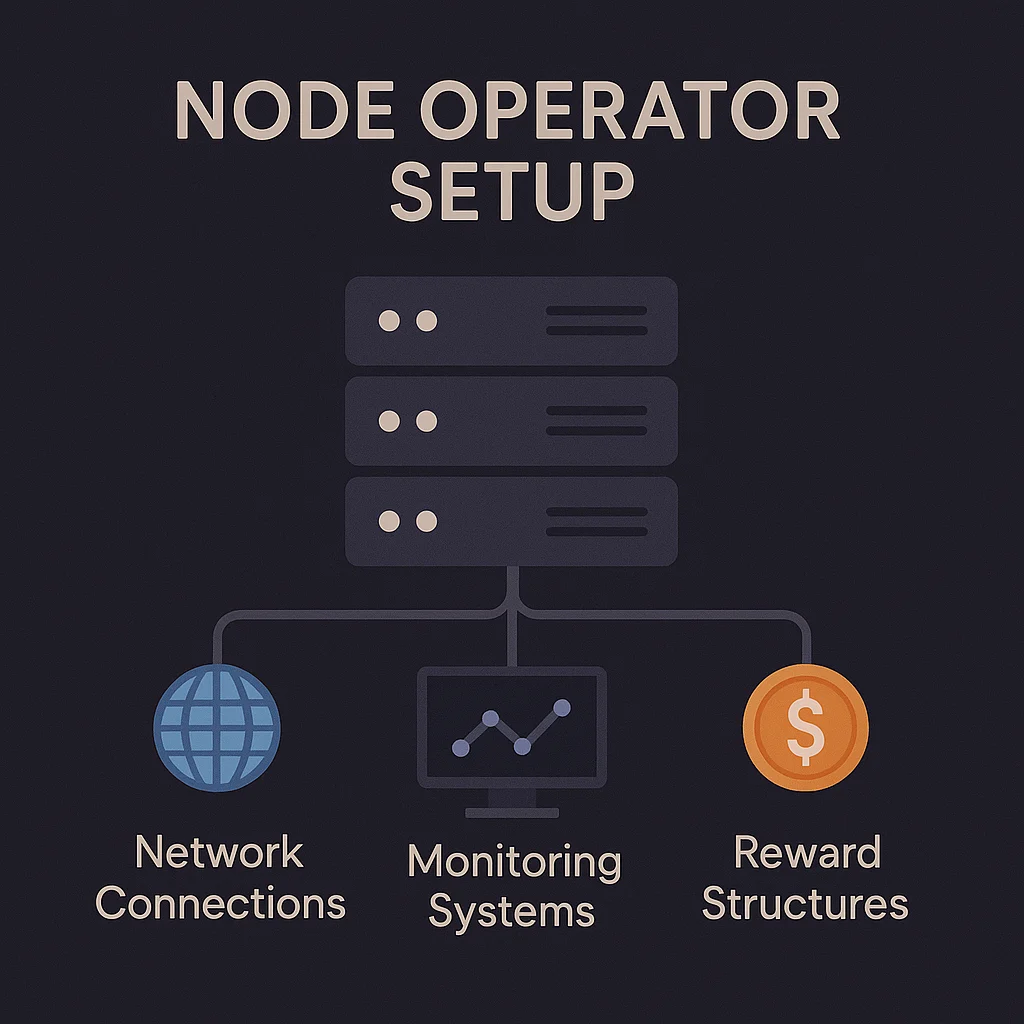
Node operator setup diagram showing server stack connected to network infrastructure, monitoring systems, and reward structures.

Real-World Examples

  • Ethereum validators run nodes that require 32 ETH stakes and earn ~6% annual rewards
  • Bitcoin full nodes provide network security and validation without direct rewards
  • Chainlink oracle nodes earn LINK tokens for providing external data to smart contracts

Why Beginners Should Care

Network decentralization depends on having many independent node operators rather than concentration among a few large entities or cloud providers.

Investment opportunity exists for those with technical skills and capital to earn rewards by providing network infrastructure services.

Technical barriers make node operation challenging for most users, leading to delegation services and node-as-a-service providers.

Related Terms: Validator, Full Node, Staking

Back to Crypto Glossary

Similar Posts

  • Hash Rate

    Hash Rate: Network Security Measurement Hash rate measures how much computational power secures a blockchain network. Higher hash rates mean stronger security against attacks and manipulation. Hash rate is the total computational power used by miners to process transactions and secure a proof-of-work blockchain network. It’s measured in hashes per second – calculations attempting to…

  • Staking

    Staking: Earning Rewards by Holding Crypto Staking turns your crypto into a money-making machine. Hold tokens, earn more tokens – it’s that simple. But the devil’s in the details. Staking is the process of locking up cryptocurrency tokens to support a blockchain network’s operations and earning rewards in return. Think of it as earning interest…

  • Native Interop

    Native Interop: Built-in Cross-Chain CommunicationNative interoperability refers to blockchain networks designed from the ground up to communicate with other chains without requiring external bridges or intermediaries. It's like speaking multiple languages fluently.Native interoperability describes blockchain architectures that include cross-chain communication capabilities as core features rather than external additions. These systems can interact with other networks through…

  • AMM

    AMM: Automated Market MakingAutomated Market Makers use mathematical formulas to price assets and facilitate trading without traditional order books. They're like vending machines for cryptocurrency trading.An Automated Market Maker (AMM) is a decentralized exchange mechanism that uses mathematical algorithms to price assets and facilitate trading through liquidity pools instead of order books. AMMs enable constant liquidity…

  • Cross Chain Communication

    Cross Chain Communication: Blockchain Network MessagingCross-chain communication enables different blockchain networks to exchange information and coordinate actions. It's like having universal translators that help different blockchain languages understand each other.Cross-chain communication refers to protocols and technologies that enable different blockchain networks to exchange data, verify states, and coordinate actions across network boundaries. This enables interoperability and…

  • Wallet Connect

    Wallet Connect: Universal dApp Connection Standard WalletConnect is an open protocol that enables secure connections between mobile wallets and desktop applications. It’s like Bluetooth for crypto wallets and dApps. WalletConnect is a communication protocol that allows cryptocurrency wallets to interact with decentralized applications across different devices and platforms. It enables secure, encrypted connections without exposing…