
Tokenomics

Tokenomics: The Economics of Digital Assets

Tokenomics determines how cryptocurrencies create, distribute, and maintain value over time. It’s the difference between digital money and digital monopoly money.

Tokenomics refers to the economic design and mechanics of a cryptocurrency token, including supply schedules, distribution methods, utility functions, and incentive structures. Good tokenomics align stakeholder interests while bad tokenomics create unsustainable systems that collapse.

How Tokenomics Work

Supply mechanics control how many tokens exist, how fast new ones are created, and whether the total supply is fixed, inflationary, or deflationary over time.

Distribution methods determine who gets tokens and when – through mining, staking, airdrops, team allocations, or public sales. Fair distribution prevents excessive concentration.

Utility design gives tokens practical uses beyond speculation, such as governance voting, fee payments, staking rewards, or access to platform features.
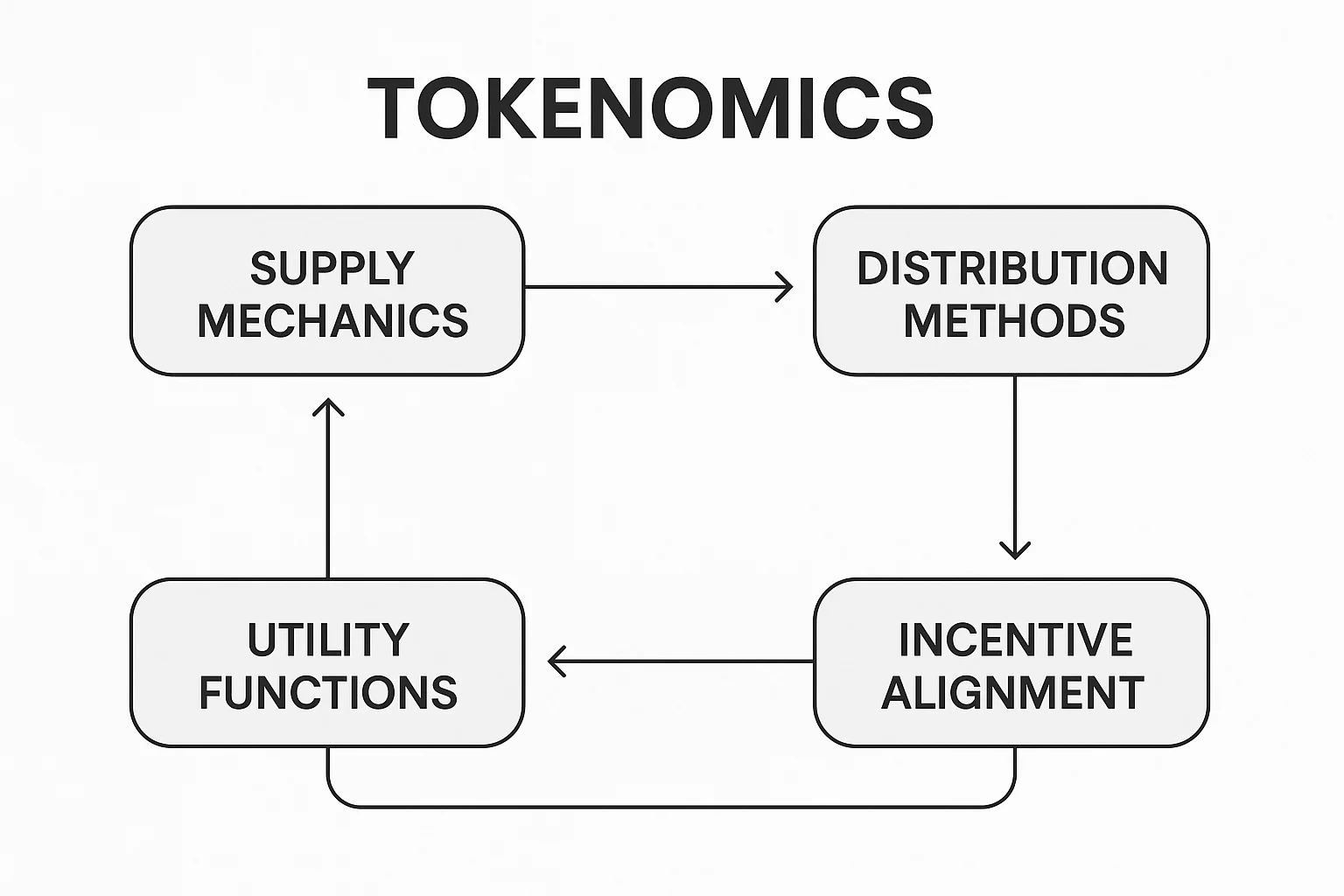
Tokenomics diagram showing interconnected components: supply mechanics, distribution methods, utility functions, and incentive alignment.

Real-World Examples

  • Bitcoin’s fixed supply of 21 million creates scarcity and deflationary pressure
  • Ethereum’s fee burning through EIP-1559 makes ETH deflationary during high usage
  • Failed ICO tokens from 2017-2018 had poor tokenomics with no real utility

Why Beginners Should Care

Investment success depends heavily on tokenomics since tokens with sustainable economics tend to hold value better than those with flawed incentive structures.

Red flags include excessive team allocations, infinite inflation, no clear utility, or mechanics that only benefit early adopters at the expense of later participants.

Long-term viability requires tokenomics that encourage participation, reward value creation, and maintain network security as projects mature and market conditions change.

Related Terms: Token Supply, Inflation, Utility Token, Token Distribution

Back to Crypto Glossary

Similar Posts

  • Ring Signatures

    Ring Signatures: Anonymous Group AuthorizationRing signatures enable one member of a group to create signatures on behalf of the group without revealing which specific member signed. It's like having a group of people where any one can speak for the group anonymously, but observers know the statement came from a legitimate group member.Ring signatures are…

  • Smart Contract Risk

    Smart Contract Risk: Code-Based VulnerabilitiesSmart contract risk encompasses all potential vulnerabilities and failures in automated blockchain programs. It's like the risk that the software controlling your digital money might have bugs or be exploited.Smart contract risk refers to potential losses from bugs, vulnerabilities, exploits, or unexpected behavior in smart contract code that controls cryptocurrency assets…

  • Protocol Security

    Protocol Security: Protecting Blockchain InfrastructureProtocol security involves designing and maintaining blockchain networks to resist attacks, prevent exploits, and ensure reliable operation. It's like building a fortress with multiple defensive layers.Protocol security encompasses all measures taken to protect blockchain networks from technical attacks, economic manipulation, and operational failures. This includes consensus security, smart contract auditing, and network…

  • DeFi Lending

    DeFi Lending: Decentralized Borrowing and LendingDeFi lending enables cryptocurrency borrowing and lending without traditional financial intermediaries through smart contracts. It's like peer-to-peer banking powered by code instead of humans.DeFi lending refers to decentralized finance protocols that enable users to lend and borrow cryptocurrencies through smart contracts without requiring traditional banks or credit checks. These systems operate…

  • Reentrancy Attack

    Reentrancy Attack: Exploiting Function Recursion Reentrancy attacks exploit smart contracts by repeatedly calling functions before previous executions complete. It’s like withdrawing money from an ATM that forgets to update your balance between transactions. A reentrancy attack is a smart contract exploit where malicious contracts repeatedly call vulnerable functions before state changes are finalized, potentially draining…

  • Cross Chain Communication

    Cross Chain Communication: Blockchain Network MessagingCross-chain communication enables different blockchain networks to exchange information and coordinate actions. It's like having universal translators that help different blockchain languages understand each other.Cross-chain communication refers to protocols and technologies that enable different blockchain networks to exchange data, verify states, and coordinate actions across network boundaries. This enables interoperability and…