
Wallet Drainer

Wallet Drainer: Malicious Fund Extraction

Wallet drainers are malicious smart contracts or applications designed to steal all assets from connected wallets through deceptive transaction approvals. They’re digital pickpockets with smart contract superpowers.

A wallet drainer is malicious software that tricks users into signing transactions that grant unlimited access to their cryptocurrency holdings. These attacks often disguise themselves as legitimate applications or NFT mints to gain user trust.

How Wallet Drainers Work

Social engineering presents fake websites, NFT mints, or airdrops that appear legitimate to trick users into connecting their wallets.

Malicious approvals request permissions that seem reasonable but actually grant unlimited access to users’ token holdings across multiple assets.

Automated extraction immediately drains approved tokens once users sign the malicious transactions, often faster than users can realize what happened.
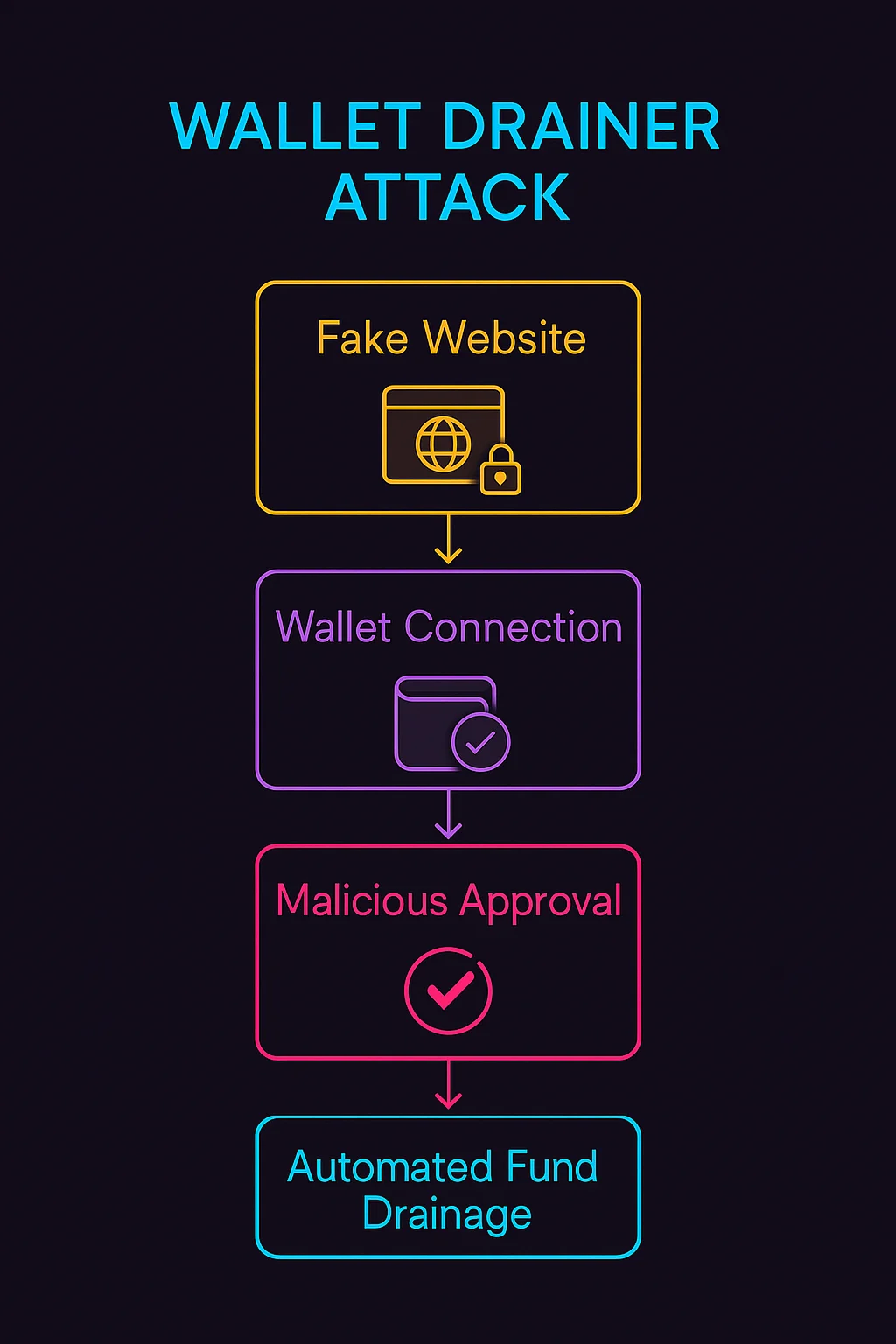
Infographic showing wallet drainer attack sequence: fake website, wallet connection, malicious approval, and automated fund drainage

Real-World Examples

  • Fake NFT mint sites that drain wallets when users attempt to mint seemingly legitimate collections
  • Phishing websites mimicking popular DeFi protocols to steal user approvals
  • Malicious browser extensions that inject drainer code into legitimate websites

Why Beginners Should Care

Irreversible losses since blockchain transactions cannot be reversed once confirmed, making wallet drainer attacks permanently damaging.

Prevention strategies include carefully verifying website URLs, understanding transaction approvals, and using hardware wallets for additional security.

Growing sophistication as drainer attacks become more convincing and harder to detect, requiring increased vigilance from all crypto users.

Related Terms: Phishing Attack, Transaction Approval, Social Engineering, Hardware Wallet

Back to Crypto Glossary

Similar Posts

  • Transaction Fees

    Transaction Fees: Network Processing CostsTransaction fees are payments made to network validators for processing and confirming cryptocurrency transactions. They're like postage stamps that you need to attach to letters, except the cost varies depending on how quickly you want your mail delivered.Transaction fees refer to payments made to miners, validators, or network operators who process…

  • Multi-Chain

    Multi-Chain: Using Multiple Blockchain Networks Multi-chain refers to applications, strategies, or ecosystems that operate across multiple different blockchain networks simultaneously. It’s like being multilingual in the blockchain world. Multi-chain describes systems that utilize multiple different blockchain networks rather than being limited to a single chain. This approach leverages the unique strengths of different blockchains while…

  • Merkle Tree

    Merkle Tree: Efficient Data Verification Merkle trees enable efficient verification of large datasets without downloading everything. They’re like having a fingerprint for an entire library that proves any book belongs. A Merkle tree is a binary tree structure where each leaf represents a data element and each branch contains cryptographic hashes of its children. The…

  • AMM

    AMM: Automated Market MakingAutomated Market Makers use mathematical formulas to price assets and facilitate trading without traditional order books. They're like vending machines for cryptocurrency trading.An Automated Market Maker (AMM) is a decentralized exchange mechanism that uses mathematical algorithms to price assets and facilitate trading through liquidity pools instead of order books. AMMs enable constant liquidity…

  • Message Relay

    Message Relay: Cross-Chain Communication HubMessage relay systems transport data and instructions between different blockchain networks. They're like postal services for blockchain messages, ensuring information gets delivered across network boundaries.Message relay refers to infrastructure that enables communication between different blockchain networks by transporting data, transaction proofs, and execution instructions across chain boundaries. These systems enable cross-chain applications…

  • Verification

    Verification: Confirming Accuracy and AuthenticityVerification is the process of confirming that information, transactions, or claims are accurate and authentic without requiring trust in the information source. It's like being able to personally test that a diamond is real using scientific instruments instead of just believing the jeweler's word.Verification refers to the mathematical and cryptographic processes…