
Wallet Signature Spoofing

Wallet Signature Spoofing: Fake Authorization Attacks

Wallet signature spoofing tricks users into signing malicious transactions that appear legitimate but actually authorize harmful actions. It’s like signing a contract where the fine print changes after you sign.

Wallet signature spoofing involves presenting misleading information about transaction contents to trick users into signing authorizations for unintended actions. Attackers exploit user interface vulnerabilities or social engineering to gain unauthorized access.

How Signature Spoofing Works

UI manipulation displays fake transaction details while the actual signature authorizes completely different actions than what users believe they’re approving.

Contract switching presents legitimate contracts for inspection but substitutes malicious contracts at signature time before users can detect the change.

Social engineering combines technical deception with psychological manipulation to pressure users into quickly signing without careful verification.
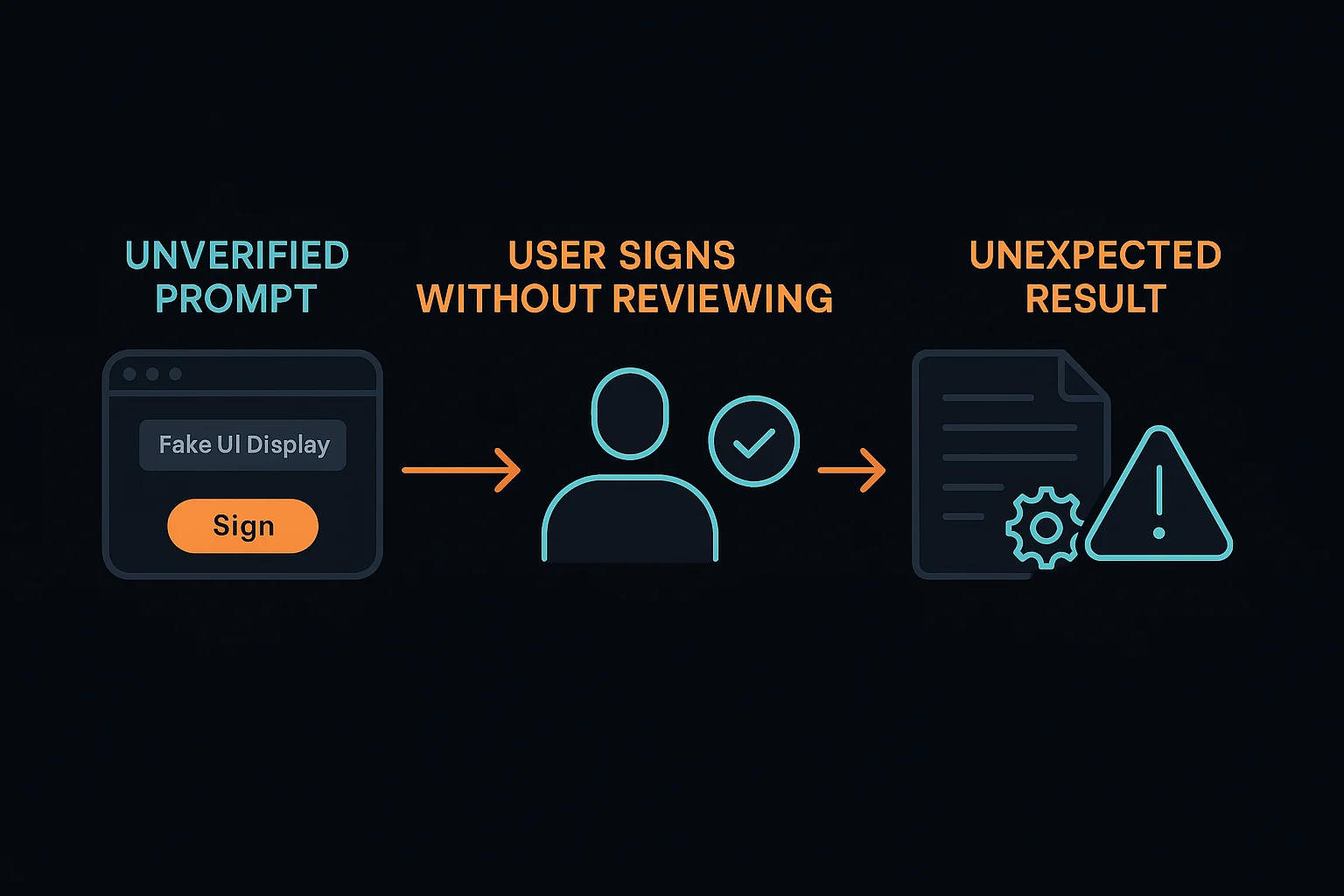
Infographic showing how an unverified prompt can lead to a user signing an unintended transaction

Real-World Examples

  • Fake NFT marketplace signatures that actually approve unlimited token spending
  • Phishing websites that spoof popular DeFi protocols to steal user authorizations
  • Malicious browser extensions that modify transaction data after users review but before signing

Why Beginners Should Care

Verification importance requires carefully checking all transaction details, contract addresses, and permissions before signing any wallet transactions.

Hardware wallet benefits provide additional verification steps that make signature spoofing attacks more difficult to execute successfully.

Recovery challenges since spoofed signatures can grant extensive permissions that enable ongoing fund theft until manually revoked.

Related Terms: Phishing Attack, Transaction Verification, Hardware Wallet

Back to Crypto Glossary

Similar Posts

  • Yield Optimization

    Yield Optimization: Maximizing Investment ReturnsYield optimization involves strategically managing cryptocurrency investments to maximize returns through automated rebalancing and strategy switching. It's like having a financial advisor that works 24/7 to find the best returns.Yield optimization refers to automated strategies and protocols that maximize returns on cryptocurrency investments by continuously monitoring and switching between different yield-generating…

  • Difficulty

    Difficulty: Mining Competition AdjustmentDifficulty refers to how hard it is to mine new blocks in proof-of-work cryptocurrencies, automatically adjusting to maintain consistent block times. It's like a video game that gets harder when you're doing too well and easier when you're struggling.Difficulty describes the measure of how computationally challenging it is to find valid proof-of-work…

  • Transaction Cost

    Transaction Cost: The Price of Blockchain OperationsTransaction cost refers to the total expense of executing operations on blockchain networks, including fees, gas, and opportunity costs. It's the price you pay for using decentralized financial infrastructure.Transaction cost encompasses all expenses associated with executing blockchain operations, including network fees, gas costs, slippage, and time value. Understanding total transaction…

  • FOMO (Fear of Missing Out)

    FOMO: The Psychology That Drives Crypto Markets FOMO (Fear of Missing Out) is responsible for more bad crypto decisions than any technical analysis could prevent. It’s the emotional trap that turns rational people into panic buyers. FOMO is the anxiety that others are experiencing rewarding experiences from which one is absent. In crypto, it manifests…

  • Verifiable Randomness

    Verifiable Randomness: Provably Fair Random NumbersVerifiable randomness provides cryptographically secure random numbers that can be independently verified for fairness. It's like having dice that everyone can mathematically confirm are not loaded.Verifiable randomness refers to random number generation systems that produce unpredictable outputs while providing cryptographic proofs that the randomness is fair and unbiased. This enables trustless…

  • Multi-Chain

    Multi-Chain: Using Multiple Blockchain Networks Multi-chain refers to applications, strategies, or ecosystems that operate across multiple different blockchain networks simultaneously. It’s like being multilingual in the blockchain world. Multi-chain describes systems that utilize multiple different blockchain networks rather than being limited to a single chain. This approach leverages the unique strengths of different blockchains while…