
Halving

Halving: Cutting Block Rewards in Half

Halving events reduce block rewards by 50%, creating artificial scarcity that historically triggers major bull markets. It’s like cutting gold mining output in half overnight.

Halving is a pre-programmed event that reduces block rewards by half, typically occurring every four years or after a specific number of blocks. This mechanism controls inflation and maintains scarcity as networks mature and adoption grows.

How Halving Works

Scheduled reductions follow predetermined algorithms rather than human decisions, ensuring predictable monetary policy that can’t be manipulated by central authorities.

Supply shock occurs as new token creation suddenly drops by 50% while demand often remains constant or increases, creating upward pressure on prices.

Miner economics get disrupted as revenue cuts in half overnight. Less efficient miners may shut down, temporarily reducing network hash rate until difficulty adjusts.
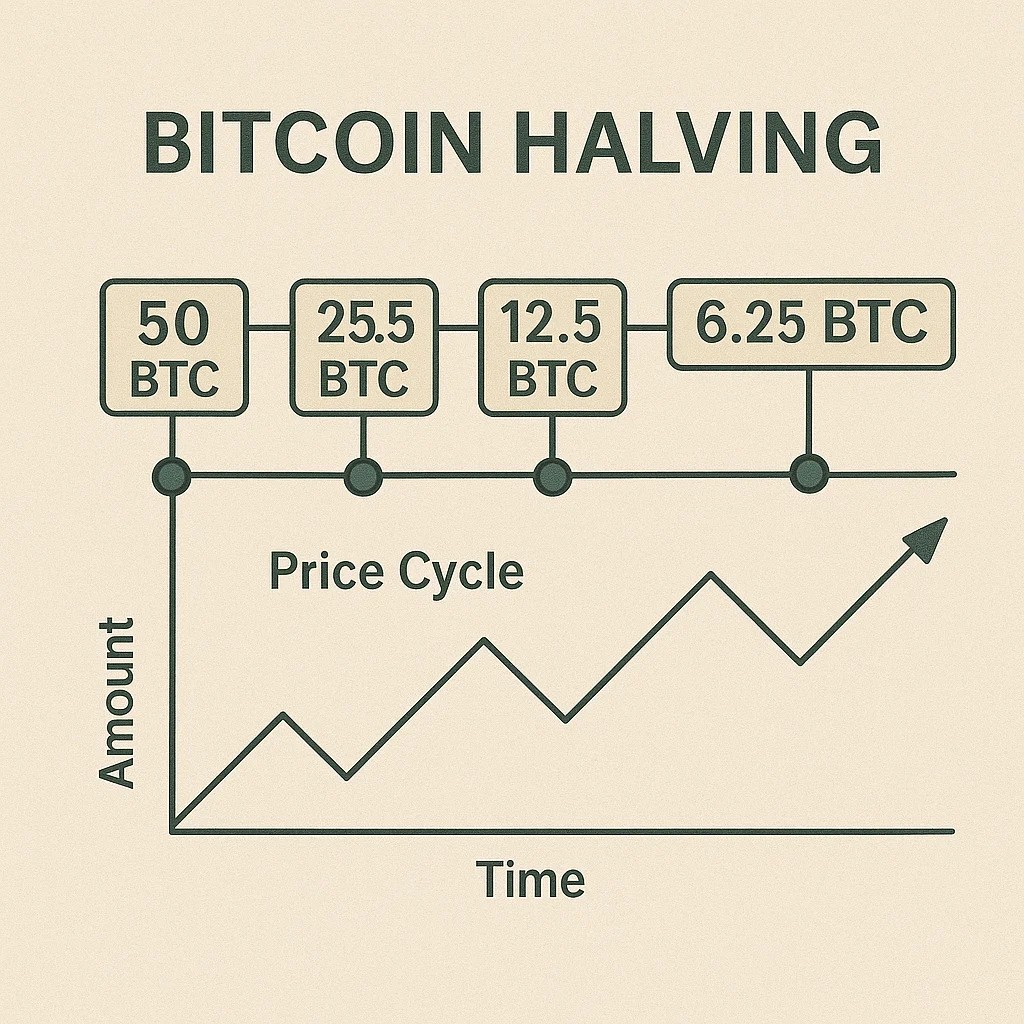
Infographic showing Bitcoin halving events with block rewards dropping from 50 to 25 to 12.5 to 6.25 BTC, along with a rising price cycle chart

Real-World Examples

  • Bitcoin halvings in 2012, 2016, and 2020 each preceded major bull markets with 10-100x price increases
  • Litecoin halving events follow similar patterns with smaller market impact due to lower adoption
  • Bitcoin Cash inherited Bitcoin’s halving schedule after the 2017 fork

Why Beginners Should Care

Price speculation often surrounds halving events as reduced supply meets existing demand, though past performance doesn’t guarantee future results.

Market timing strategies attempt to position for halving-driven price increases, but timing markets remains extremely difficult even with predictable supply changes.

Long-term scarcity increases through halving until block rewards become negligible and transaction fees become the primary miner incentive.

Related Terms: Block Reward, Mining, Supply Shock, Bull Market

Back to Crypto Glossary

Similar Posts

  • Blockchain Trilemma

    Blockchain Trilemma: The Impossible TrinityThe blockchain trilemma describes the challenge of simultaneously achieving decentralization, security, and scalability in blockchain networks. It's like trying to be fast, cheap, and high-quality all at the same time.The blockchain trilemma refers to the fundamental trade-off between three key properties: decentralization, security, and scalability, where optimizing for two typically requires…

  • Transaction Privacy

    Transaction Privacy: Protecting Financial InformationTransaction privacy involves keeping cryptocurrency transaction details confidential while maintaining network security and functionality. It's like having a private bank account in a transparent financial system.Transaction privacy refers to techniques and technologies that protect the confidentiality of cryptocurrency transaction details including amounts, participants, and transaction history. This enables financial privacy while maintaining…

  • Yield Stacking

    Yield Stacking: Combining Multiple Income StreamsYield stacking involves combining multiple yield-generating strategies to maximize returns on cryptocurrency investments. It's like having several part-time jobs that all pay into the same bank account.Yield stacking refers to the strategy of combining multiple yield-generating opportunities across different protocols, assets, and mechanisms to maximize overall returns. This approach leverages various…

  • Public Key

    Public Key: Your Crypto Receiving Address Your public key is like your email address for crypto – you can share it freely without security concerns. A public key is cryptographically derived from your private key and generates your wallet addresses where others can send you cryptocurrency. It’s mathematically linked to your private key but reveals…

  • Fee Sharing

    Fee Sharing: Distributing Protocol RevenueFee sharing distributes a portion of protocol revenues to token holders, stakers, or other participants. It's like getting dividends from a company you own shares in.Fee sharing refers to mechanisms that distribute portions of protocol fees, transaction costs, or other revenues to token holders or network participants. This creates direct financial incentives…

  • Paper Hands

    Paper Hands: Quick to Sell, Quick to Regret Paper hands describes investors who sell at the first sign of trouble or take profits too early. It’s crypto’s version of weak stomach syndrome. Paper hands refers to investors who sell their cryptocurrency holdings quickly due to fear, panic, or impatience rather than holding through volatility. The…