
Liquidity

Liquidity: How Easily You Can Buy or Sell

Liquidity determines whether you can actually trade your crypto at fair prices. High liquidity means smooth trading. Low liquidity means getting rekt by slippage.

Liquidity refers to how easily an asset can be bought or sold without significantly affecting its price. In crypto markets, liquidity comes from active buyers and sellers providing depth to order books or automated market makers.

How Liquidity Works

Order book depth shows how many buy and sell orders exist at different price levels. Deep order books allow large trades without major price impact.

Market makers provide liquidity by continuously offering to buy and sell at slightly different prices, earning the spread between bid and ask prices.

Liquidity pools in DeFi protocols replace traditional order books with algorithmic market making, allowing trades against pooled assets rather than specific counterparties.
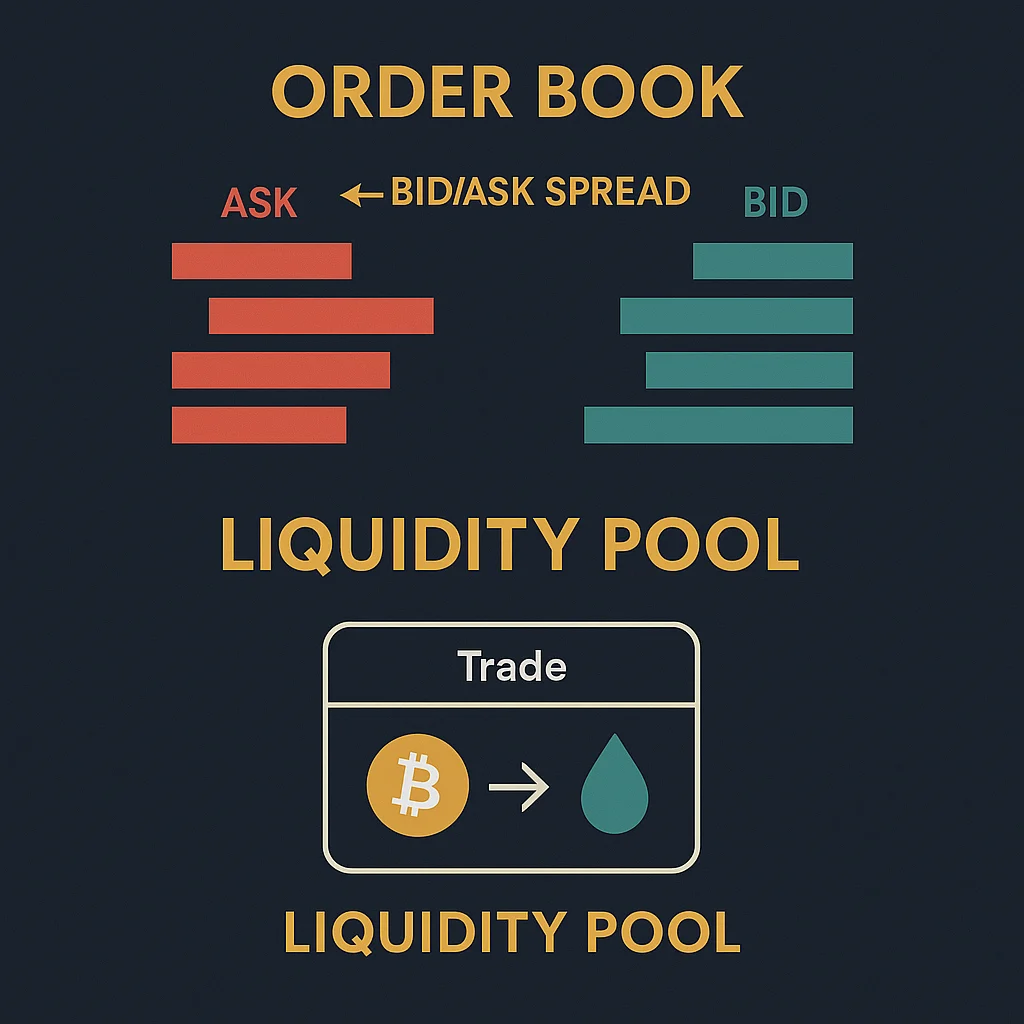
Comparison chart showing order book bid/ask depth and liquidity pool trading interface

Real-World Examples

  • Bitcoin/USD pairs have deep liquidity on major exchanges with tight spreads
  • Small altcoins often have wide spreads and high slippage on trades
  • Uniswap pools provide 24/7 liquidity through automated market makers

Why Beginners Should Care

Poor liquidity means you can’t exit positions quickly without losing money to slippage. A 10% price move might cost you 15% if there’s insufficient liquidity to absorb your trade.

Check spreads before trading smaller coins. Wide bid-ask spreads indicate poor liquidity that will cost you money on every trade.

Major exchanges like Kraken typically offer better liquidity for popular trading pairs than smaller platforms.

Related Terms: Slippage, Market Maker, Order Book, Liquidity Pool

Back to Crypto Glossary

Similar Posts

  • DEX

    DEX: Decentralized ExchangeA DEX is a cryptocurrency exchange that operates without central authority through smart contracts. It's like a marketplace where buyers and sellers trade directly without a middleman.A decentralized exchange (DEX) is a cryptocurrency trading platform that facilitates peer-to-peer trading through smart contracts without requiring a central operator or intermediary. Users maintain control of their…

  • Pump and Dump

    Pump and Dump: Coordinated Market Manipulation Pump and dump schemes are crypto’s version of old-school stock manipulation. Coordinated groups artificially inflate prices, then dump on unsuspecting victims. A pump and dump is a form of market manipulation where a group artificially inflates an asset’s price through coordinated buying and false promotion, then sells at peak…

  • Price Stability

    Price Stability: Maintaining Consistent ValuePrice stability refers to maintaining consistent cryptocurrency values over time with minimal volatility. It enables practical use as medium of exchange and store of value.Price stability describes the characteristic of maintaining relatively constant value over time with limited price fluctuations. This stability is essential for practical cryptocurrency adoption in payments and savings.How…

  • Atomic Transaction

    Atomic Transaction: All-or-Nothing OperationsAn atomic transaction either completes entirely or fails completely, with no partial execution possible. It's like a package deal where you get everything or nothing at all.An atomic transaction is an operation that either succeeds completely or fails entirely, ensuring that all components of a complex transaction execute together or none execute…

  • Protocol

    Protocol: Blockchain Network RulesA protocol is the set of rules and standards that govern how a blockchain network operates. It's like the constitution of a country that defines how the government works, what's allowed, and how decisions are made.A protocol refers to the comprehensive set of rules, standards, and procedures that define how a blockchain…

  • Sunk Cost

    Sunk Cost: Irretrievable Past InvestmentsSunk cost refers to money already spent that cannot be recovered, which shouldn't influence future investment decisions. It's like refusing to leave a terrible movie halfway through just because you already paid for the ticket.Sunk cost describes past investments or expenditures that cannot be recovered and should not factor into future…