
On-Chain Gaming

On-Chain Gaming: Fully Decentralized Games

On-chain gaming runs game logic entirely on blockchain networks rather than traditional servers. It’s like having board games where the rules are enforced by mathematics instead of human referees.

On-chain gaming executes all game logic, state management, and interactions through smart contracts on blockchain networks. Unlike traditional games with centralized servers, on-chain games operate through decentralized infrastructure that players cannot manipulate.

How On-Chain Gaming Works

Smart contract logic handles all game rules, player actions, and state transitions through deterministic code that executes identically for all players.

Transparent mechanics make all game rules publicly visible and verifiable, preventing hidden advantages or manipulation by game operators.

Composable assets enable game items and characters to be used across different games and applications that support the same standards.
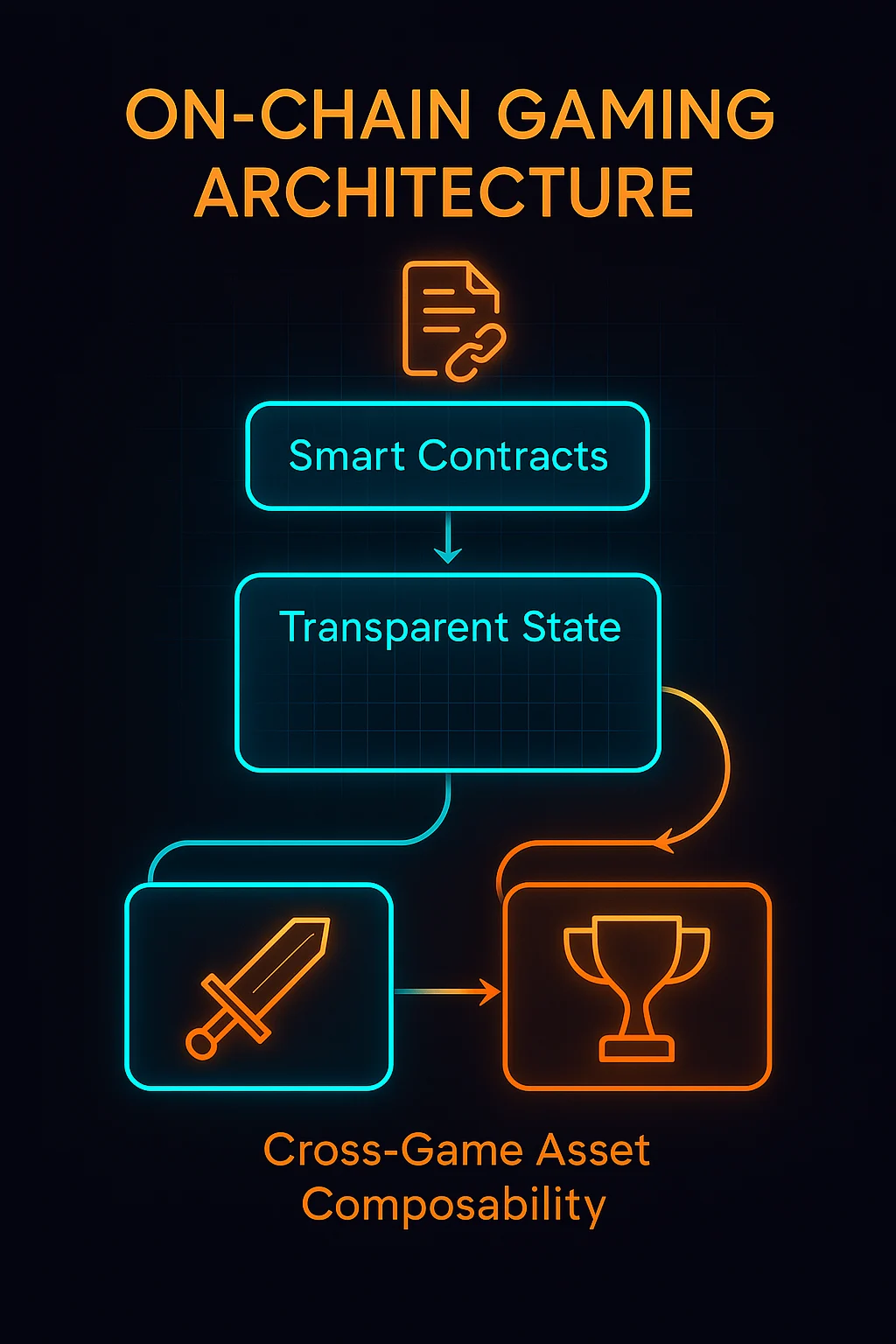
Illustration of on-chain gaming architecture, featuring smart contracts, transparent state management, and asset composability across multiple games.

Real-World Examples

  • Chess on-chain with provably fair random events and permanent game records
  • Strategy games where all moves and outcomes are cryptographically verifiable
  • Trading card games with truly scarce digital cards that work across multiple game implementations

Why Beginners Should Care

Provably fair gameplay eliminates concerns about rigged random number generation or hidden advantages for certain players.

Asset portability allows taking game items between different implementations and derivative games built by various developers.

Permanent records of achievements and gameplay history that persist even if original game developers stop supporting their games.

Related Terms: Smart Contract, Autonomous World, NFT Gaming, Verifiable Randomness

Back to Crypto Glossary

Similar Posts

  • Persistence

    Persistence: Maintaining Data Across TimePersistence refers to data storage that survives system restarts, crashes, or power failures. In blockchain, it ensures transaction history remains permanently accessible and unalterable.Persistence describes the characteristic of data storage systems that maintain information across system interruptions, ensuring data survives restarts, failures, or other disruptions. Blockchain networks achieve persistence through distributed storage…

  • Satoshi

    Satoshi: Bitcoin's Smallest UnitA satoshi is the smallest unit of bitcoin, equal to 0.00000001 BTC. It's named after Bitcoin's pseudonymous creator and makes bitcoin divisible for everyday transactions.A satoshi (sat) is the smallest divisible unit of bitcoin, representing one hundred millionth of a bitcoin. This granular divisibility enables bitcoin to function as digital cash for transactions…

  • Network Congestion

    Network Congestion: Blockchain Traffic JamsNetwork congestion occurs when cryptocurrency networks become overloaded with transaction requests, causing delays and increased fees. It's like rush hour traffic that slows everyone down and costs more to navigate.Network congestion refers to periods when cryptocurrency networks receive more transaction requests than they can process efficiently, resulting in delayed confirmations and…

  • Token Allocation

    Token Allocation: Distributing Digital AssetsToken allocation determines how cryptocurrency tokens are distributed among different stakeholders like teams, investors, and communities. It's the blueprint for who gets what in crypto projects.Token allocation refers to the distribution plan for cryptocurrency tokens among various stakeholder groups including development teams, early investors, community members, and ecosystem development funds. This distribution…

  • Systemic Risk

    Systemic Risk: Widespread System FailureSystemic risk refers to the potential for localized failures to cascade throughout the entire cryptocurrency ecosystem. It's like how one falling domino can knock down all the others in a chain reaction.Systemic risk describes the possibility that failure in one part of the cryptocurrency ecosystem could trigger widespread failures across multiple…

  • Batch Verification

    Batch Verification: Efficient Bulk ProcessingBatch verification processes multiple transactions or proofs together to improve efficiency and reduce computational costs. It's like grading a stack of tests all at once instead of one by one.Batch verification refers to techniques that verify multiple cryptographic proofs, transactions, or operations simultaneously rather than processing each individually. This approach significantly improves…