
Synthetic Yield

Synthetic Yield: Engineered Return Products

Synthetic yield creates artificial return streams through derivatives and structured products rather than underlying asset productivity. It’s like manufacturing dividends through financial engineering.

Synthetic yield refers to returns generated through derivative strategies, structured products, or financial engineering rather than from the underlying asset’s inherent productivity. These products create yield where none naturally exists.

How Synthetic Yield Works

Derivative construction uses options, futures, or swaps to create income streams from assets that don’t naturally produce yield.

Structured products combine multiple financial instruments to engineer specific risk-return profiles that meet investor yield requirements.

Risk transformation converts one type of exposure into yield-generating positions through sophisticated trading strategies and financial instruments.
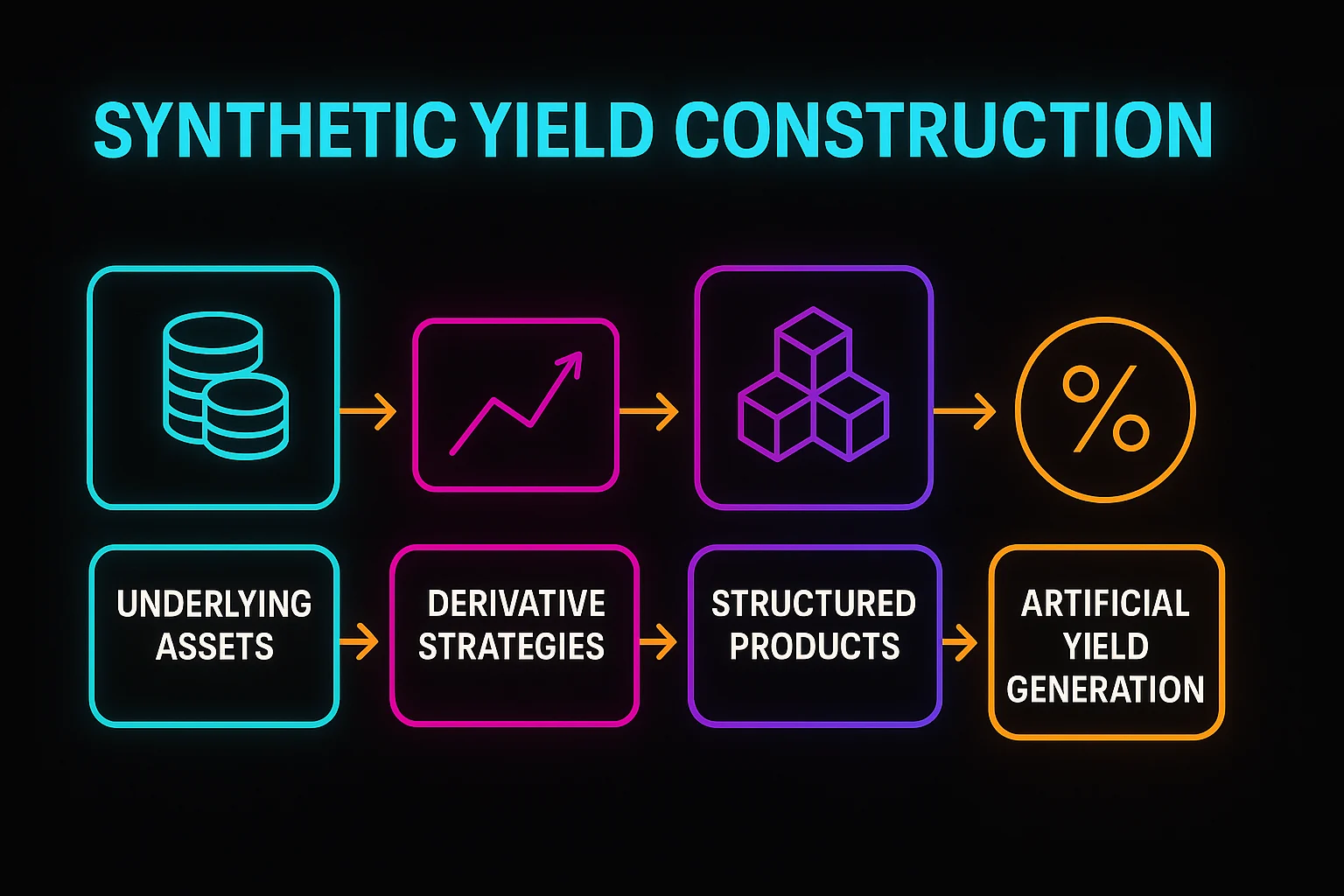
Synthetic yield construction flow showing underlying assets, derivative strategies, structured products, and artificial yield generation

Real-World Examples

  • Covered call strategies on Bitcoin that generate yield by selling call options
  • Structured products that provide yield on non-productive assets like gold or commodities
  • Yield tokens that split assets into principal and yield components for separate trading

Why Beginners Should Care

Yield availability on assets that don’t naturally produce returns, expanding income opportunities beyond traditional yield-bearing investments.

Complexity risks as synthetic products often involve multiple moving parts that can behave unexpectedly during market stress.

Understanding requirements for evaluating the true risks and potential returns of engineered yield products versus natural yield sources.

Related Terms: Derivatives, Structured Products, Yield Engineering

Back to Crypto Glossary

Similar Posts

  • Exchange

    Exchange: Where Crypto Gets Bought and Sold Crypto exchanges are the on-ramps to digital money. But not all exchanges are created equal – some prioritize security, others prioritize profits. A cryptocurrency exchange is a platform where you can buy, sell, and trade cryptocurrencies using traditional money or other digital assets. Think of it as a…

  • Sovereignty

    Sovereignty: Independent Control and GovernanceSovereignty in blockchain refers to independent control over governance, economics, and technical decisions without external interference. It's like having your own country with its own rules.Sovereignty refers to complete independence and self-governance for blockchain networks, applications, or communities without requiring permission from or dependence on external authorities. This includes technical, economic, and…

  • Yield Farming

    Yield Farming: Crypto’s High-Risk, High-Reward Game Yield farming is DeFi’s answer to traditional investing – except the yields are higher, the risks are bigger, and the game changes daily. Yield farming is the practice of lending, staking, or providing liquidity with your cryptocurrency to earn maximum returns across multiple DeFi protocols. It’s like playing musical…

  • Anti-Sybil Mechanism

    Anti-Sybil Mechanism: Preventing Fake Identity Attacks Anti-Sybil mechanisms prevent individuals from creating multiple fake identities to gain unfair advantages in voting, airdrops, or governance systems. They’re like requiring photo ID to prevent ballot stuffing. Anti-Sybil mechanisms are systems designed to prevent or detect when single entities create multiple fake identities to manipulate voting, governance, or…

  • Blockchain Trilemma

    Blockchain Trilemma: The Impossible TrinityThe blockchain trilemma describes the challenge of simultaneously achieving decentralization, security, and scalability in blockchain networks. It's like trying to be fast, cheap, and high-quality all at the same time.The blockchain trilemma refers to the fundamental trade-off between three key properties: decentralization, security, and scalability, where optimizing for two typically requires…

  • Decentralization

    Decentralization: Power to the People Decentralization distributes control away from single authorities across many independent participants. It’s the difference between having one king versus a thousand voters making decisions. Decentralization refers to the distribution of power, control, and decision-making away from central authorities to a network of independent participants. In blockchain systems, this means no…