
Slippage

Slippage: The Cost of Market Impact

Slippage is the difference between expected and actual trade prices. It’s the tax you pay for moving markets when your trade is large relative to available liquidity.

Slippage occurs when the execution price of a trade differs from the expected price due to market movement or insufficient liquidity. Large trades relative to available liquidity create more slippage as they consume multiple price levels.

How Slippage Works

Order book depth determines slippage for traditional exchanges. Large trades consume multiple price levels, with each level offering worse prices than the previous one.

AMM slippage follows mathematical curves where larger trades cause more price impact. A $1000 swap might have 0.1% slippage while a $100,000 swap has 5% slippage.

Market volatility can cause slippage even on small trades when prices move significantly between order submission and execution.
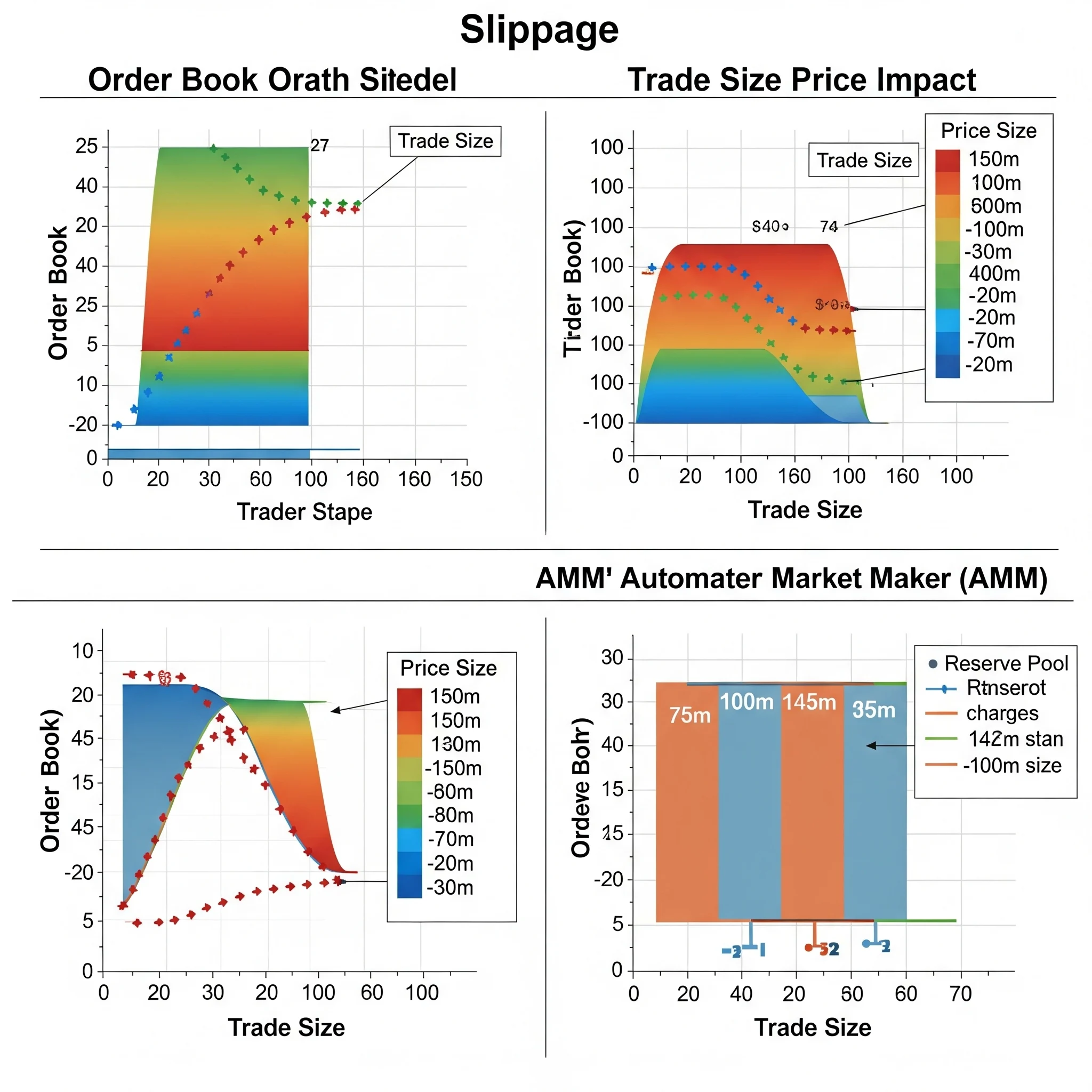
Visualization showing slippage in crypto trading, comparing price impact on order book and AMM models for different trade sizes.

Real-World Examples

  • Large DEX trades on Uniswap can face 5-10% slippage during low liquidity periods
  • Memecoin trading often has extreme slippage due to shallow liquidity pools
  • Front-running bots can increase slippage by trading ahead of pending transactions

Why Beginners Should Care

Hidden costs from slippage can exceed visible trading fees, especially for larger trades or illiquid token pairs with shallow liquidity.

Slippage tolerance settings protect against excessive price impact but may cause transaction failures if markets move beyond acceptable ranges.

Timing matters for reducing slippage – trading during high liquidity periods or splitting large orders into smaller chunks can minimize price impact.

Related Terms: Liquidity, AMM, Price Impact, MEV

Back to Crypto Glossary

Similar Posts

  • Digital Securities

    Digital Securities: Blockchain-Based Financial InstrumentsDigital securities are traditional financial instruments like stocks and bonds represented as tokens on blockchain networks. They're like digitizing paper stock certificates to work on the internet.Digital securities are blockchain-based tokens that represent ownership in traditional financial instruments such as stocks, bonds, or real estate, subject to securities regulations. These bridge conventional…

  • Network Governance

    Network Governance: Blockchain Decision MakingNetwork governance encompasses the processes and mechanisms for making decisions about blockchain protocol changes and upgrades. It's like the constitutional system that determines how a digital nation changes its laws.Network governance refers to the systems and processes through which blockchain networks make decisions about protocol upgrades, parameter changes, and strategic direction. This…

  • Staking

    Staking: Earning Rewards by Holding Crypto Staking turns your crypto into a money-making machine. Hold tokens, earn more tokens – it’s that simple. But the devil’s in the details. Staking is the process of locking up cryptocurrency tokens to support a blockchain network’s operations and earning rewards in return. Think of it as earning interest…

  • Inflation

    Inflation: Currency Value ErosionInflation in cryptocurrency refers to the decrease in purchasing power when token supply increases faster than demand. It's like having your slice of pizza get smaller when the pizza is cut into more pieces, even though the whole pizza stays the same size.Inflation describes the reduction in purchasing power of cryptocurrency tokens…

  • Order Book

    Order Book: Market Trading QueueAn order book displays all buy and sell orders for a trading pair, showing market depth and price discovery. It's like a transparent auction house where everyone can see all bids and offers.An order book is a real-time list of buy and sell orders for a specific trading pair, organized by…

  • Transaction Verification

    Transaction Verification: Confirming Payment ValidityTransaction verification is the process of confirming that cryptocurrency transactions are valid before adding them to the blockchain. It's like having bank tellers check that signatures match and accounts have sufficient funds before processing checks.Transaction verification refers to the systematic process where network participants validate cryptocurrency transactions by checking digital signatures,…