
Single-Sided Staking

Single-Sided Staking: Simplified Yield Farming

Single-sided staking lets you earn yield on individual tokens without providing liquidity pairs or facing impermanent loss. It’s like earning interest on a savings account without loan risk.

Single-sided staking allows users to stake individual tokens to earn rewards without needing to provide paired assets or manage liquidity pool positions. This eliminates impermanent loss while still generating yield from token holdings.

How Single-Sided Staking Works

Protocol rewards come from token emissions, revenue sharing, or other sources that don’t require users to provide trading liquidity.

No pairing requirements mean users can stake popular tokens like ETH or BTC without needing to acquire and manage secondary tokens for liquidity provision.

Simplified risk eliminates impermanent loss concerns since users maintain exposure to only their chosen token rather than token pairs.
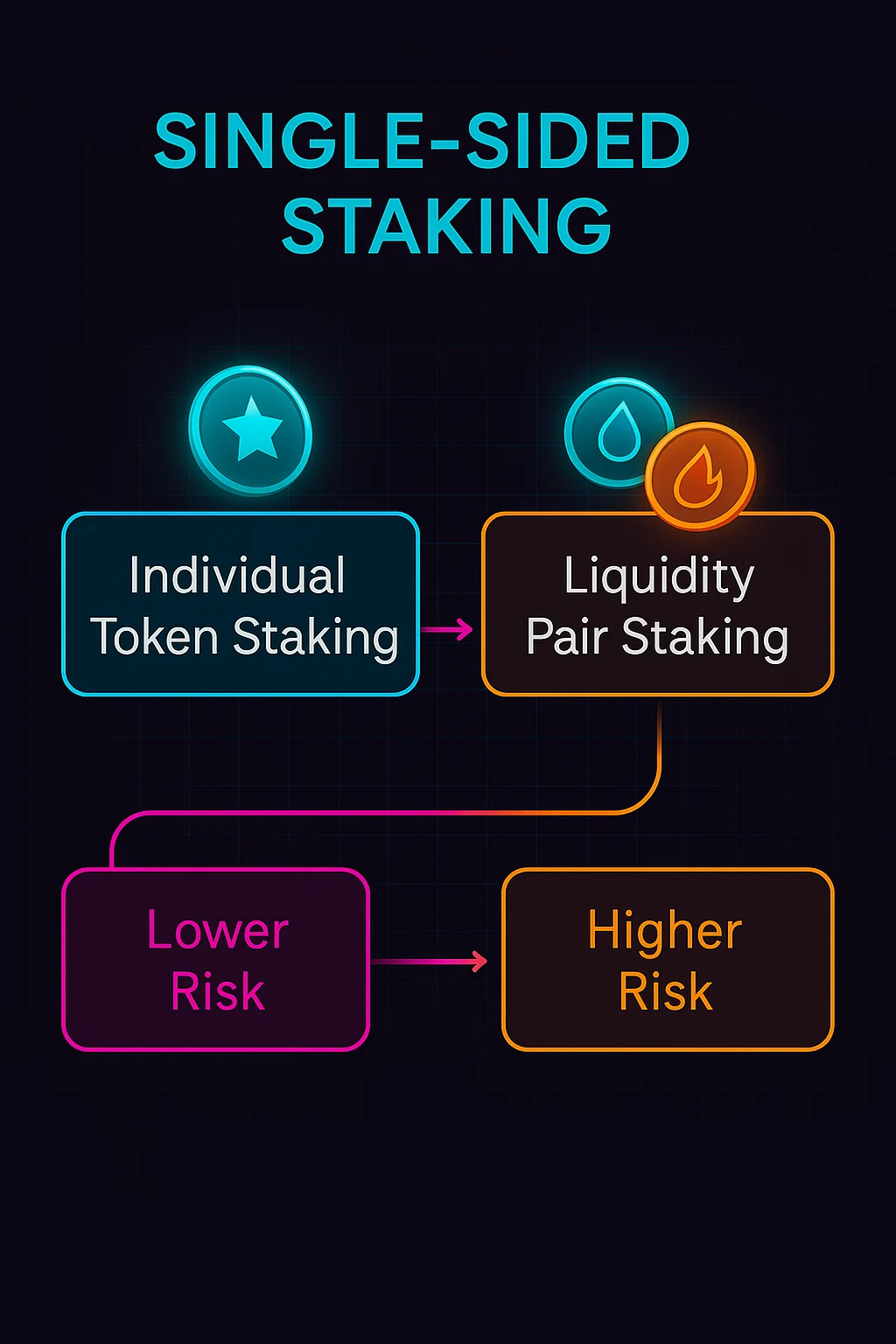
Infographic comparing individual token staking with liquidity pair staking, highlighting the difference in risk levels between the two methods

Real-World Examples

  • Ethereum 2.0 staking provides ~6% APY for holding ETH without impermanent loss risks
  • Lido liquid staking enables ETH staking with tradeable stETH tokens
  • Rocket Pool offers decentralized ETH staking with rETH liquid staking tokens

Why Beginners Should Care

Lower complexity makes single-sided staking more accessible than complex DeFi strategies requiring multiple tokens and risk management.

Predictable exposure maintains your chosen token allocation without the price ratio risks inherent in liquidity pool strategies.

Generally lower yields compared to liquidity mining since protocols don’t need to incentivize users to provide trading infrastructure.

Related Terms: Staking, Liquid Staking, Impermanent Loss, Yield Farming

Back to Crypto Glossary

Similar Posts

  • Smart Order Routing

    Smart Order Routing: Optimal Trade Execution Smart order routing automatically finds the best prices across multiple exchanges and liquidity sources for each trade. It’s like having a shopping bot that checks every store for the best deal. Smart order routing is an algorithmic system that automatically splits and routes orders across multiple trading venues to…

  • Team Doxxing

    Team Doxxing: Revealing Anonymous IdentitiesTeam doxxing involves revealing the real identities of previously anonymous cryptocurrency project team members. It's like unmasking superheroes to show who's really behind the project.Team doxxing refers to the disclosure of real identities, backgrounds, and personal information of cryptocurrency project team members who were previously anonymous or pseudonymous. This can be voluntary…

  • ZK Proof Aggregation

    ZK Proof Aggregation: Scaling Zero-Knowledge Systems ZK proof aggregation combines multiple zero-knowledge proofs into single, more efficient proofs. It’s like having one master key that proves you have access to multiple locked boxes. ZK proof aggregation is a technique that combines multiple zero-knowledge proofs into a single proof that verifies all the original statements simultaneously….

  • Parabolic

    Parabolic: Exponential Price MovementParabolic describes extremely rapid price increases that follow exponential growth curves, often unsustainable in the long term. It's like a rocket shooting straight up into the sky – impressive to watch but likely to come back down eventually.Parabolic refers to price movements that follow exponential growth patterns, characterized by accelerating increases that…

  • Liquid Restaking

    Liquid Restaking: Flexible High-Yield Staking Liquid restaking combines the capital efficiency of liquid staking with additional yield from securing multiple networks. It’s like having your cake and eating it too, but with slashing risks. Liquid restaking allows staked assets to secure additional protocols while remaining liquid through tokenized representations. Users can earn enhanced yields from…

  • Pump and Dump

    Pump and Dump: Coordinated Market Manipulation Pump and dump schemes are crypto’s version of old-school stock manipulation. Coordinated groups artificially inflate prices, then dump on unsuspecting victims. A pump and dump is a form of market manipulation where a group artificially inflates an asset’s price through coordinated buying and false promotion, then sells at peak…