
Liquidity Pool

Liquidity Pool: The Fuel That Powers DEX Trading

Liquidity pools are why decentralized exchanges work. They’re shared pots of tokens that enable trading without traditional buyers and sellers.

A liquidity pool is a collection of tokens locked in a smart contract that provides liquidity for decentralized trading. Instead of matching buy and sell orders, traders swap against these pools using automated market maker (AMM) algorithms.

How Liquidity Pools Work

Liquidity providers deposit equal values of two tokens (like ETH and USDC) into a pool. When traders want to swap ETH for USDC, they trade against this pool rather than with another person.

The pool maintains balance using mathematical formulas. As one token gets scarce, its price automatically increases to encourage arbitrageurs to rebalance the pool.

Liquidity providers earn trading fees proportional to their share of the pool. More trading volume means more fees for providers.
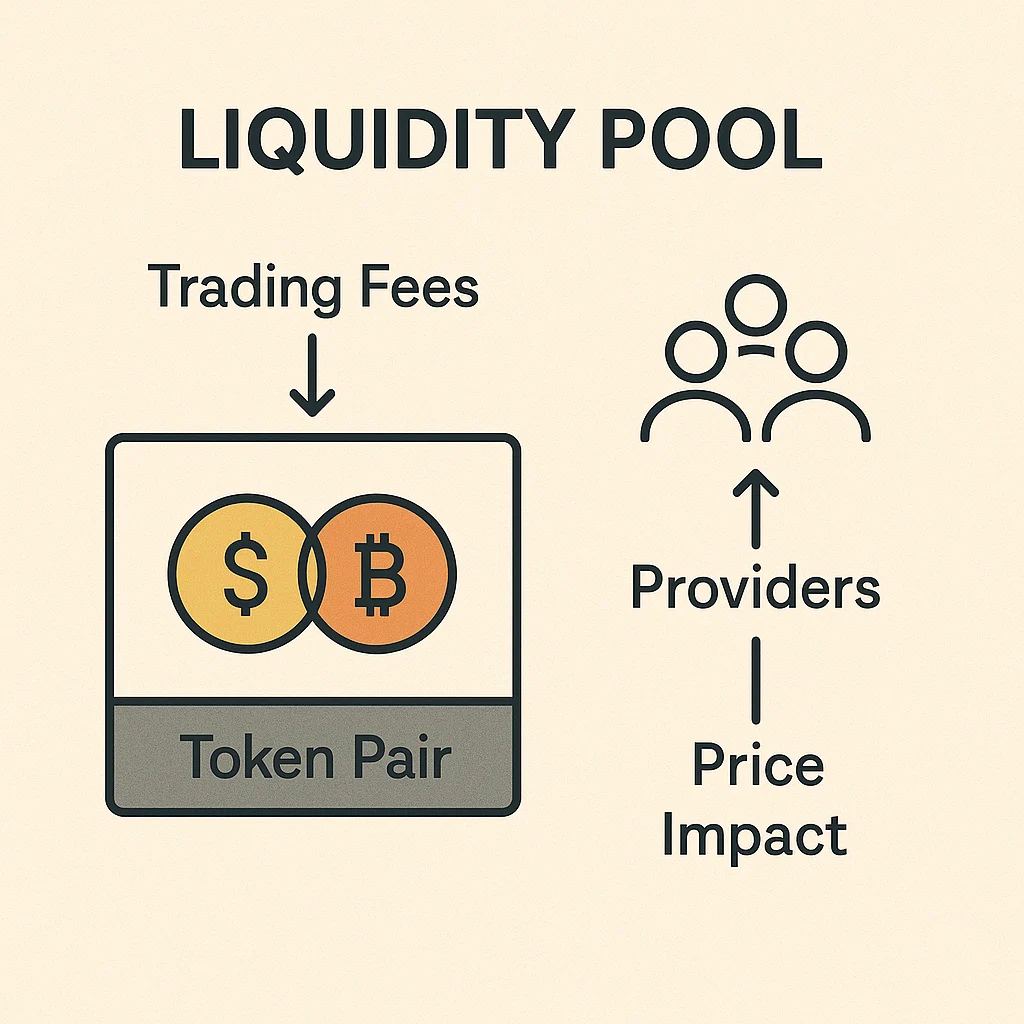
Infographic showing a liquidity pool with token pairs, trading fees flowing to providers, and price impact mechanics

Real-World Examples

  • ETH/USDC pools on Uniswap earn steady fees from high trading volume
  • Stablecoin pools offer lower risk but smaller returns
  • New token pools can be highly profitable but extremely risky

Why Beginners Should Care

Liquidity pools let you earn passive income from your crypto holdings. Instead of holding tokens that do nothing, you can put them to work earning trading fees.

But understand impermanent loss first – if token prices diverge significantly, you might end up with less value than just holding the tokens separately.

Related Terms: DEX, Impermanent Loss, Yield Farming, AMM

Back to Crypto Glossary

Similar Posts

  • Hardware Wallet

    Hardware Wallet: Your Crypto’s Personal Vault If you’re serious about crypto, you need a hardware wallet. It’s the difference between keeping cash in your wallet versus storing it in a bank vault. A hardware wallet is a physical device that stores your cryptocurrency private keys offline, away from internet hackers. Think of it as a…

  • Digital Signature

    Digital Signature: Cryptographic Identity ProofDigital signatures provide mathematical proof of message authenticity and sender identity using cryptographic techniques. They're like unforgeable electronic signatures that prove who sent what.A digital signature is a cryptographic mechanism that verifies the authenticity of digital messages or documents and confirms the identity of the sender. Digital signatures are fundamental to blockchain…

  • Security Token

    Security Token: Regulated Digital AssetsSecurity tokens are cryptocurrency tokens that represent ownership in real-world assets and are subject to securities regulations. They're like digital stock certificates that comply with financial laws.Security tokens are cryptocurrency tokens that represent ownership stakes in real-world assets and are subject to securities regulations and compliance requirements. These bridge traditional finance with…

  • Phishing Attack

    Phishing Attack: How Scammers Steal Your Crypto Phishing attacks are the #1 way people lose crypto. Scammers create fake websites that look identical to real ones, then steal your login credentials and private keys. A phishing attack is a fraudulent attempt to obtain sensitive information by impersonating a trustworthy entity through fake websites, emails, or…

  • Crypto Vesting Schedule

    Crypto Vesting Schedule: Gradual Token Release Vesting schedules control when team members, investors, or community members can access their allocated tokens. It’s like having a time-locked savings account that prevents dumping. A crypto vesting schedule defines when and how allocated tokens become available for use, typically spreading releases over months or years to prevent market…

  • Regulatory Risk

    Regulatory Risk: Government Policy UncertaintyRegulatory risk refers to potential losses from government policy changes affecting cryptocurrency legality, taxation, or usage restrictions. It's like the risk that traffic laws might change and make your car illegal to drive.Regulatory risk encompasses potential negative impacts from government actions including bans, restrictions, taxation changes, or new compliance requirements affecting…