
Smart Contract Royalties

Smart Contract Royalties: Automated Creator Payments

Smart contract royalties automatically pay creators a percentage every time their NFTs are resold. It’s like having a永続 commission that follows your work forever.

Smart contract royalties are automated payment mechanisms built into NFT contracts that send a percentage of each resale back to the original creator. These payments happen automatically through code, ensuring creators benefit from secondary market appreciation.

How Smart Contract Royalties Work

Embedded logic in NFT smart contracts specifies royalty percentages and recipient addresses that execute automatically during transfers or sales.

Marketplace integration enables platforms like OpenSea to read royalty information and automatically deduct payments during transactions.

Perpetual payments continue for as long as the NFT exists and gets traded, providing ongoing income streams for creators beyond initial sales.
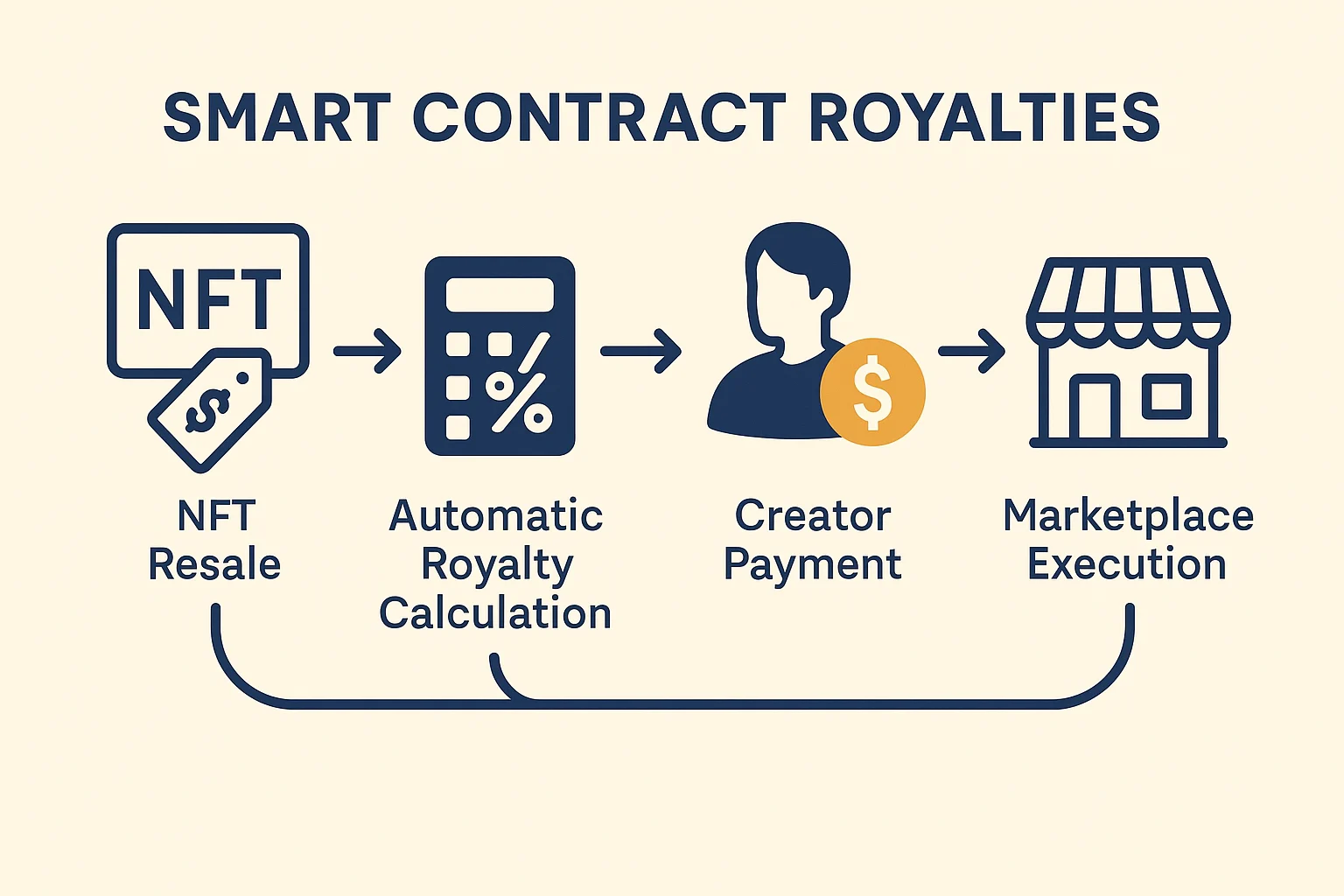
Infographic showing smart contract royalties process: NFT resale, automatic royalty calculation, creator payment, and marketplace execution

Real-World Examples

  • Art NFTs typically include 5-10% royalties that pay artists on every resale
  • Music NFTs enable musicians to earn from secondary market trading of their work
  • Gaming assets provide ongoing revenue to developers when players trade items

Why Beginners Should Care

Creator sustainability enables artists and developers to build long-term businesses rather than relying only on initial sales revenue.

Buyer transparency as royalty information is visible before purchase, allowing collectors to understand the full cost structure.

Enforcement challenges since some marketplaces have started making royalties optional, potentially undermining creator income expectations.

Related Terms: NFT, Smart Contract, Secondary Market

Back to Crypto Glossary

Similar Posts

  • Ledger

    Ledger: Hardware Wallet Security Leader Ledger is a leading hardware wallet company that provides secure offline storage for cryptocurrency private keys. They’re like the Fort Knox of crypto storage devices. Ledger is a hardware wallet manufacturer that creates secure devices for storing cryptocurrency private keys offline, protecting them from online threats and hacking attempts. These…

  • Exchange

    Exchange: Where Crypto Gets Bought and Sold Crypto exchanges are the on-ramps to digital money. But not all exchanges are created equal – some prioritize security, others prioritize profits. A cryptocurrency exchange is a platform where you can buy, sell, and trade cryptocurrencies using traditional money or other digital assets. Think of it as a…

  • Hash Function

    Hash Function: One-Way Mathematical TransformationHash functions are mathematical algorithms that convert input data into fixed-size output strings in a way that's easy to compute forward but practically impossible to reverse. They're like digital fingerprints for data.A hash function is a mathematical algorithm that takes input data of any size and produces a fixed-size output (hash)…

  • Digital Currency

    Digital Currency: Electronic Money SystemsDigital currency refers to money that exists only in electronic form, including both centralized and decentralized varieties. It's like having money that lives entirely in computers and phones instead of physical bills and coins in your wallet.Digital currency encompasses all forms of money that exist exclusively in electronic format, including cryptocurrencies,…

  • Stable Yield

    Stable Yield: Predictable DeFi Returns Stable yield refers to DeFi strategies that provide consistent returns with lower volatility than traditional yield farming. It’s like finding the boring but reliable investment in a casino full of slot machines. Stable yield strategies focus on generating consistent returns from DeFi protocols with lower risk and volatility than high-APY…

  • Security

    Security: Protecting Digital Assets and InformationSecurity in cryptocurrency encompasses all measures taken to protect digital assets, private keys, and personal information from theft or compromise. It's the foundation that makes cryptocurrency ownership safe and reliable.Security refers to the comprehensive protection of cryptocurrency assets, private keys, wallet access, and personal information through technical measures and careful…