
Gas Limit

Gas Limit: Setting Your Transaction Budget

Gas limit is the maximum amount of gas you’re willing to spend on a transaction. Set it too low and your transaction fails. Set it too high and you overpay for simple operations.

Gas limit is the maximum amount of computational work (measured in gas units) that a user is willing to pay for when submitting a transaction to the Ethereum network. It acts as a safety mechanism preventing runaway smart contracts from draining your wallet.

How Gas Limit Works

Computational budgeting ensures transactions can’t consume unlimited resources. Each operation in smart contracts has a predefined gas cost, and the total can’t exceed your set limit.

Transaction failure occurs if operations require more gas than your limit allows. You still pay for gas consumed up to the failure point, but the transaction doesn’t complete.

Estimation tools in wallets automatically suggest appropriate gas limits based on transaction complexity, though users can adjust these recommendations manually.
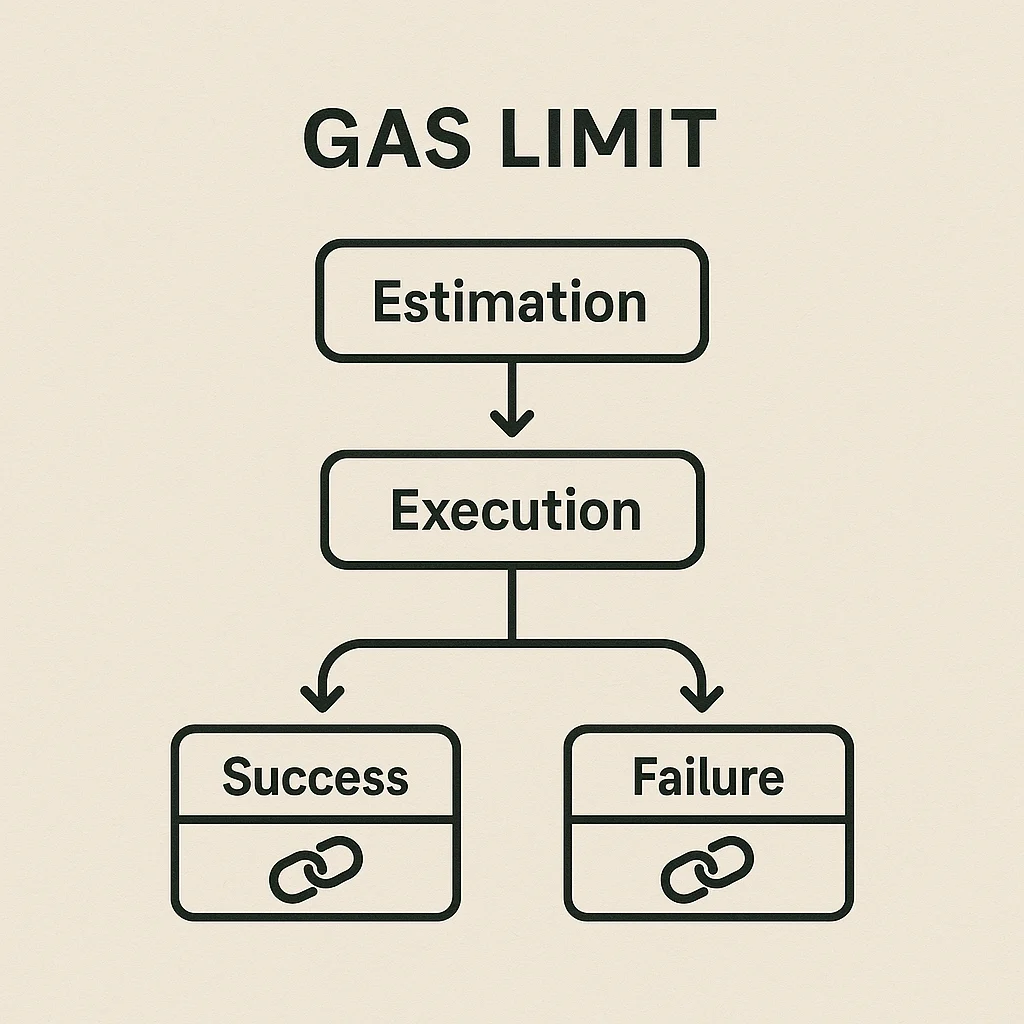
Infographic showing gas limit transaction flow from estimation to execution and outcome of success or failure

Real-World Examples

  • Simple ETH transfers typically need 21,000 gas limit
  • DEX swaps might require 150,000-300,000 gas depending on complexity
  • Complex DeFi operations can need 500,000+ gas for multi-step transactions

Why Beginners Should Care

Failed transactions still cost money if they run out of gas, so understanding appropriate limits prevents wasted fees on unsuccessful operations.

Overpaying happens when gas limits are set much higher than needed. Unused gas gets refunded, but setting reasonable limits prevents tying up excess funds.

Network congestion affects optimal gas limit strategies. During high demand, slightly higher limits can prevent failures when network conditions change between submission and execution.

Related Terms: Gas Fees, Gas Price, Smart Contract, Transaction

Back to Crypto Glossary

Similar Posts

  • Fair Distribution

    Fair Distribution: Equitable Token AllocationFair distribution refers to token allocation methods that avoid excessive concentration among founders, early investors, or privileged groups. It's like ensuring everyone gets an equal chance to participate in a community project rather than giving all the benefits to insiders.Fair distribution describes token allocation strategies that provide broad, equitable access to…

  • Timelock

    Timelock: Time-Based Access ControlTimelock mechanisms prevent access to funds or functions until predetermined time conditions are met. It's like having a safe that only opens at specific times.A timelock is a smart contract feature that restricts access to funds, functions, or actions until a specified time period has elapsed. These mechanisms provide security through delayed execution…

  • Order Book

    Order Book: Market Trading QueueAn order book displays all buy and sell orders for a trading pair, showing market depth and price discovery. It's like a transparent auction house where everyone can see all bids and offers.An order book is a real-time list of buy and sell orders for a specific trading pair, organized by…

  • Bridge Aggregator

    Bridge Aggregator: Cross-Chain Route OptimizationBridge aggregators find the best routes for moving assets between blockchain networks by comparing multiple bridge options. They're like travel booking sites that find the cheapest flights across different airlines.A bridge aggregator is a service that compares multiple cross-chain bridge options to find optimal routes for transferring assets between different blockchain…

  • Application Layer

    Application Layer: User-Facing Blockchain AppsThe application layer consists of user-facing applications and services built on top of blockchain infrastructure. It's where users actually interact with blockchain technology.The application layer comprises decentralized applications (dApps), user interfaces, and services that provide end-user functionality built on blockchain infrastructure. This layer makes blockchain technology accessible and useful for everyday users.How…

  • zk-SNARKs

    zk-SNARKs: Zero-Knowledge Proof Technologyzk-SNARKs are cryptographic proofs that verify information without revealing the underlying data. They're like proving you know a secret without telling anyone what the secret actually is.zk-SNARKs (Zero-Knowledge Succinct Non-Interactive Arguments of Knowledge) are cryptographic proofs that allow verification of computations without revealing the inputs or intermediate steps. This enables privacy and scalability…