
51% Attack

51% Attack: When Consensus Gets Hijacked

A 51% attack occurs when a single entity controls the majority of a network’s mining power or stake, allowing them to manipulate transactions and double-spend coins.

A 51% attack is when an individual or group controls more than half of a blockchain network’s mining hash rate or staking power, giving them the ability to reverse transactions and manipulate the blockchain. It’s the digital equivalent of hijacking the entire banking system.

How 51% Attacks Work

Majority control allows attackers to mine or validate blocks faster than the honest network, eventually creating a longer chain that becomes the “true” blockchain according to consensus rules.

Double spending becomes possible when attackers reverse their own transactions after receiving goods or services, effectively spending the same coins twice.

Network disruption can halt transaction processing as attackers refuse to include certain transactions in blocks or reorganize the blockchain to exclude them.
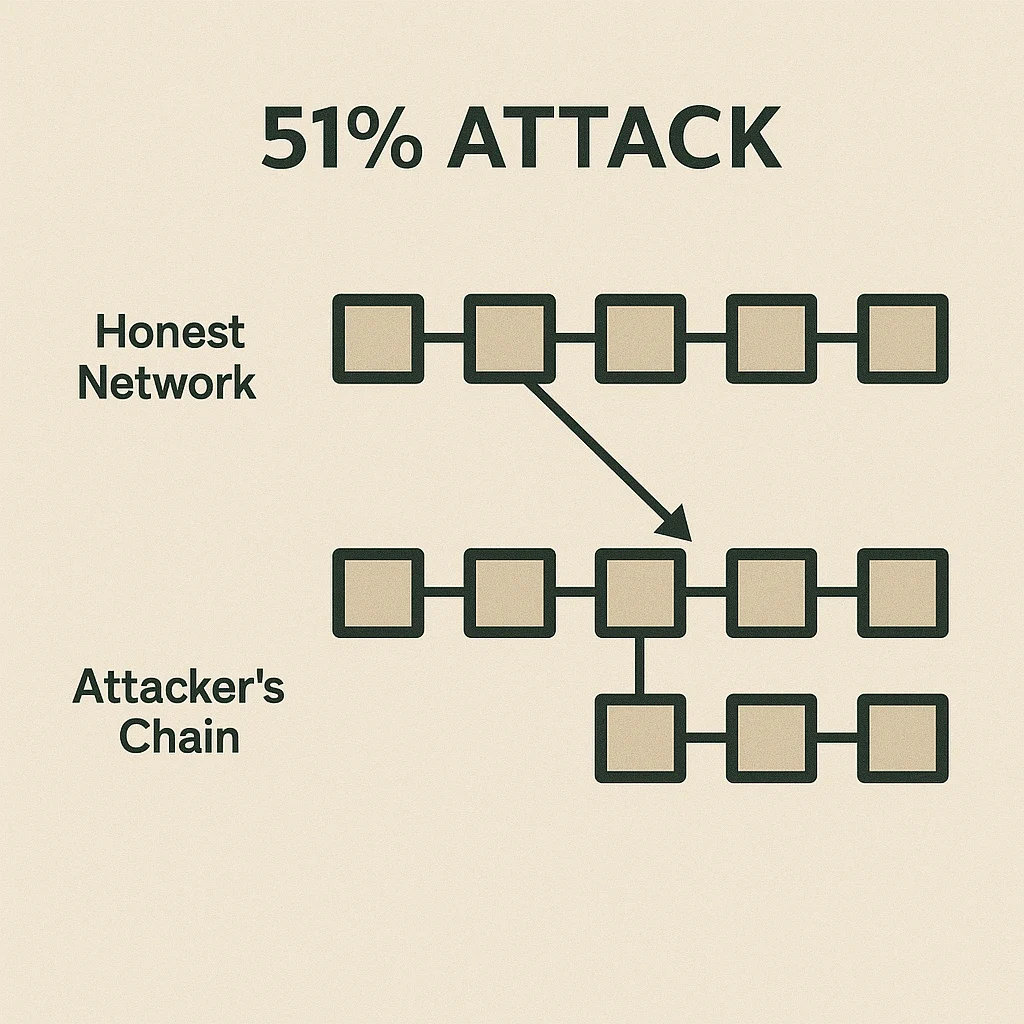
Infographic showing a 51% attack with an honest network and an attacker’s chain that eventually overtakes the main chain

Real-World Examples

  • Bitcoin Gold suffered multiple 51% attacks resulting in millions in double-spent coins
  • Ethereum Classic experienced several attacks after major miners moved to Ethereum mainnet
  • Smaller altcoins are frequent targets due to lower hash rates and cheaper attack costs

Why Beginners Should Care

Network size matters for security. Bitcoin’s massive hash rate makes 51% attacks prohibitively expensive, while smaller networks remain vulnerable to well-funded attackers.

Exchange risks increase during 51% attacks as attackers often target high-value transactions on exchanges through double-spending schemes.

Recovery challenges exist after successful attacks. Networks must decide whether to reverse attacker transactions, which can undermine immutability principles.

Related Terms: Hash Rate, Mining, Consensus Mechanism, Double Spending

Back to Crypto Glossary

Similar Posts

  • Sidechain

    Sidechain: Independent Chains with Main Chain Connections Sidechains operate independently while maintaining bridges to main blockchains. They’re like having a separate express lane that connects back to the main highway when needed. A sidechain is an independent blockchain that runs parallel to a main blockchain and is connected through a two-way bridge allowing asset transfers….

  • Proof of Humanity

    Proof of Humanity: Verifying Human Uniqueness Proof of Humanity creates registries of verified unique humans to prevent Sybil attacks in voting and distribution systems. It’s like having a bouncer who knows everyone isn’t wearing a disguise. Proof of Humanity is a system for creating verifiable registries of unique human beings to prevent individuals from claiming…

  • Validator Set Rotation

    Validator Set Rotation: Dynamic Network Security Validator set rotation periodically changes which nodes validate transactions, preventing long-term centralization and maintaining network security through diversity. It’s like jury rotation for blockchain consensus. Validator set rotation is a mechanism that periodically changes which validators are active in securing a blockchain network. This prevents permanent centralization and ensures…

  • Token Allocation

    Token Allocation: Distributing Digital AssetsToken allocation determines how cryptocurrency tokens are distributed among different stakeholders like teams, investors, and communities. It's the blueprint for who gets what in crypto projects.Token allocation refers to the distribution plan for cryptocurrency tokens among various stakeholder groups including development teams, early investors, community members, and ecosystem development funds. This distribution…

  • Reputation System

    Reputation System: Building Digital TrustReputation systems track and score user behavior to enable trust and coordination in decentralized environments. They're like credit scores but for overall trustworthiness and competence.A reputation system records and evaluates user actions, contributions, and behavior to create trustworthiness scores that enable cooperation in decentralized systems. These systems help identify reliable participants without…

  • Stable Yield

    Stable Yield: Predictable DeFi Returns Stable yield refers to DeFi strategies that provide consistent returns with lower volatility than traditional yield farming. It’s like finding the boring but reliable investment in a casino full of slot machines. Stable yield strategies focus on generating consistent returns from DeFi protocols with lower risk and volatility than high-APY…