
Zero-Knowledge Proof (ZKP)

Zero-Knowledge Proof (ZKP): Proving Without Revealing

Zero-knowledge proofs let you prove you know something without revealing what you know. It’s like proving you’re over 21 without showing your birth date, address, or any other personal information.

A zero-knowledge proof (ZKP) is a cryptographic method that allows one party to prove they possess certain information without revealing the information itself. The verifier learns nothing except that the prover’s claim is true.

How Zero-Knowledge Proofs Work

Mathematical magic creates proofs that are computationally infeasible to fake but easy to verify. The prover demonstrates knowledge through complex calculations that would be impossible without the secret information.

Three properties define valid zero-knowledge proofs: completeness (honest provers can convince verifiers), soundness (dishonest provers cannot convince verifiers), and zero-knowledge (verifiers learn nothing beyond claim validity).

Practical applications include proving account balances without revealing amounts, demonstrating identity without sharing personal data, or validating transaction history without exposing details.
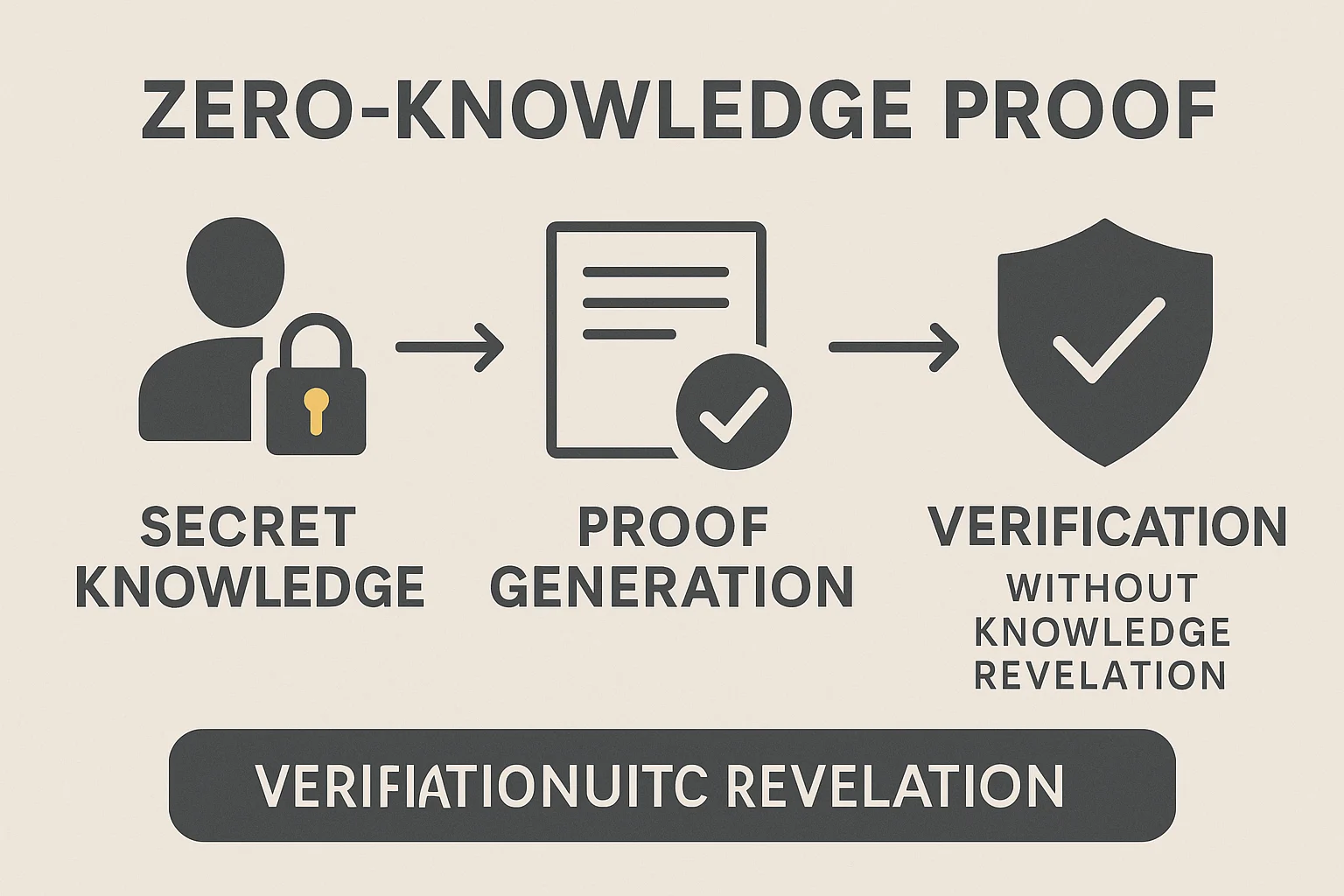
Infographic showing the zero-knowledge proof process: secret knowledge, proof generation, and verification without revealing the underlying data

Real-World Examples

  • Zcash transactions use zk-SNARKs to prove transaction validity without revealing amounts or addresses
  • Polygon Hermez uses zero-knowledge rollups for scalable Ethereum transactions
  • Age verification systems prove you’re over 18 without revealing your exact age or birthday

Why Beginners Should Care

Privacy revolution potential exists as ZKPs enable verification systems that don’t require sharing sensitive personal or financial information.

Scalability solutions like zk-rollups use zero-knowledge proofs to batch thousands of transactions while maintaining security and reducing costs.

Technical complexity makes ZKPs challenging to implement correctly, but user-facing applications hide this complexity behind simple interfaces.

Related Terms: Privacy Coin, zk-SNARKs, zk-STARKs, Rollups

Back to Crypto Glossary

Similar Posts

  • Go

    Go: Programming Language for BlockchainGo is a programming language widely used for building blockchain infrastructure and cryptocurrency applications. It's like the construction language for digital money systems.Go (also called Golang) is a programming language developed by Google that's popular for blockchain development due to its performance, simplicity, and excellent concurrency support. Many major cryptocurrency projects use…

  • |

    zkEVM

    zkEVM: Zero-Knowledge Ethereum Virtual Machine zkEVM provides Ethereum compatibility with zero-knowledge proof validation, enabling existing dApps to run on faster, cheaper networks while maintaining security. It’s like having Ethereum that’s been turbocharged with privacy and speed. zkEVM is a zero-knowledge virtual machine that executes Ethereum transactions and smart contracts while generating cryptographic proofs of correct…

  • Sandwich Attack

    Sandwich Attack: Extracting Value from Your Trades Sandwich attacks place trades before and after your transaction to manipulate prices and extract profit from your slippage. It’s like cutting in line twice – once in front of you and once behind you. A sandwich attack involves placing a buy order immediately before a victim’s trade and…

  • Launchpad

    Launchpad: The Crypto Startup Accelerator Launchpads are platforms that help new crypto projects raise funds and launch tokens. They’re like Kickstarter for cryptocurrencies, but with more speculation and less product delivery. A launchpad is a platform that facilitates fundraising and token launches for new cryptocurrency projects. They provide infrastructure, marketing, and community access to help…

  • Token Incentives

    Token Incentives: Rewarding Desired BehaviorToken incentives use cryptocurrency rewards to encourage specific behaviors or participation in networks and protocols. They're like loyalty points that actually have real value and utility.Token incentives refer to mechanisms that distribute cryptocurrency tokens to users who perform desired actions or contribute value to networks and protocols. These align user behavior with…

  • Meta Transactions

    Meta Transactions: Gasless User InteractionsMeta transactions enable users to interact with blockchain applications without paying gas fees directly. It's like having someone else pay your transaction fees while you control the actual operations.Meta transactions are blockchain transactions where the gas fees are paid by a third party (relayer) while the user maintains control over the…