
Sybil Attack

Sybil Attack: Fake Identity Manipulation

Sybil attacks involve creating multiple fake identities to gain disproportionate influence in networks that assume one person equals one vote. It’s like stuffing the ballot box with imaginary voters.

A Sybil attack is when an individual or entity creates multiple fake identities to gain unfair influence over a network, voting system, or resource allocation mechanism. These attacks exploit systems that rely on identity-based participation without proper verification.

How Sybil Attacks Work

Identity proliferation involves creating numerous fake accounts, wallets, or profiles to appear as many different participants in the system.

Influence amplification uses multiple identities to vote multiple times, claim multiple rewards, or gain disproportionate network power.

Detection evasion requires making fake identities appear legitimate through activity patterns, social connections, or other verification requirements.
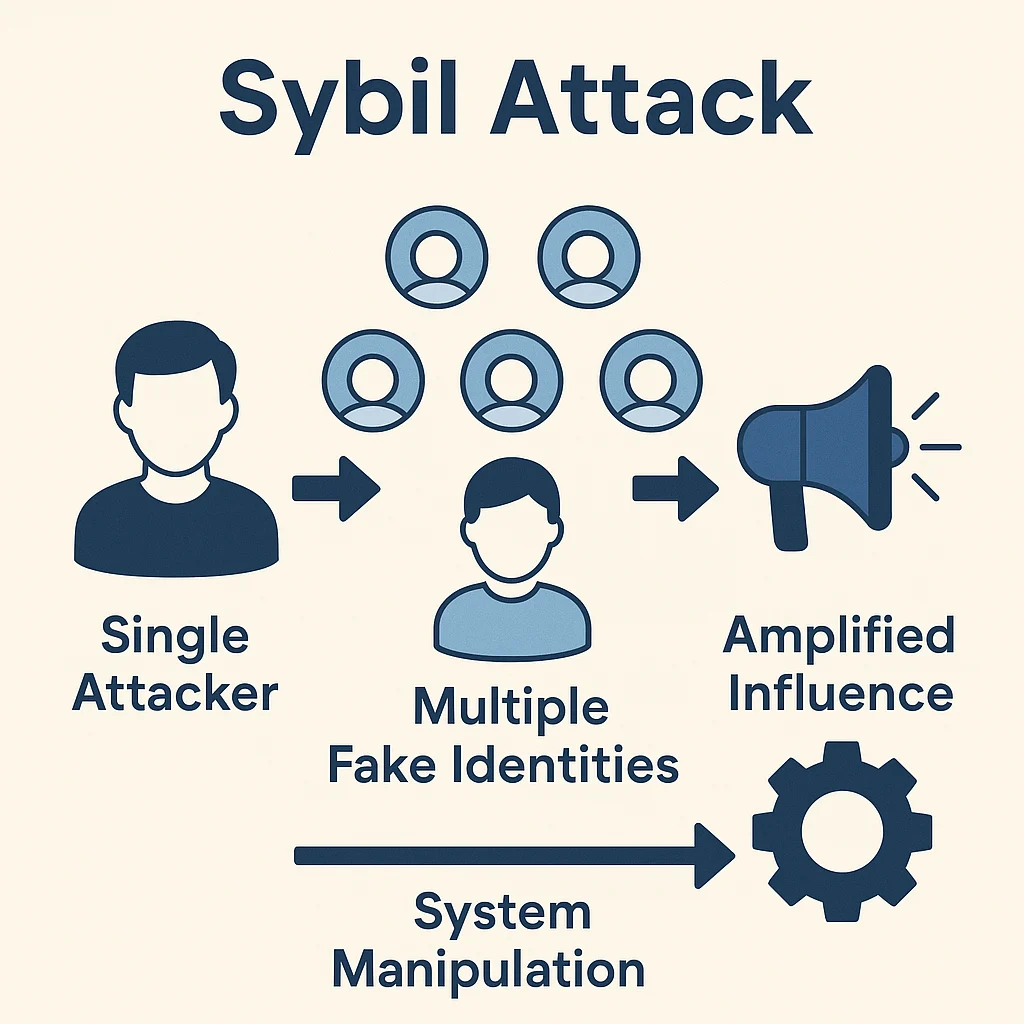
Infographic showing a Sybil attack process: one attacker creates multiple fake identities to amplify influence and manipulate a decentralized system

Real-World Examples

  • Airdrop farming using multiple wallets to claim the same airdrop many times
  • Governance attacks creating multiple voting accounts to influence DAO decisions
  • Review manipulation using fake accounts to boost ratings or reputation scores

Why Beginners Should Care

System integrity depends on preventing Sybil attacks to maintain fair participation and democratic decision-making processes.

Detection mechanisms like proof of humanity, stake-weighting, or social verification help identify and prevent fake identities.

Participation fairness ensures that resources and influence are distributed based on legitimate participation rather than identity manipulation.

Related Terms: Anti-Sybil Mechanism, Proof of Humanity, Governance Attack

Back to Crypto Glossary

Similar Posts

  • Token Economy

    Token Economy: Digital Asset EcosystemsToken economies are systems where digital tokens serve as medium of exchange, store of value, and incentive mechanisms within specific ecosystems. They're like creating your own mini-economy with digital money.A token economy refers to an ecosystem where cryptocurrency tokens facilitate economic activity, incentivize participation, and coordinate behavior among participants. These economies can…

  • Oracle

    Oracle: Connecting Blockchains to Reality Oracles are the bridges between blockchain smart contracts and real-world data. Without them, DeFi would be a closed system talking only to itself. An oracle is a service that provides external data to blockchain networks, enabling smart contracts to access real-world information like prices, weather, sports scores, or any off-chain…

  • Dynamic NFTs (dNFTs)

    Dynamic NFTs (dNFTs): Evolving Digital Assets Dynamic NFTs can change their metadata, appearance, or properties based on external data or on-chain events. They’re like digital collectibles that grow and evolve over time. Dynamic NFTs (dNFTs) are non-fungible tokens that can modify their metadata, attributes, or visual appearance in response to external data feeds, user actions,…

  • Gaming Token

    Gaming Token: In-Game Digital CurrencyGaming tokens are cryptocurrencies designed specifically for use within video games and virtual worlds. They enable player ownership, trading, and monetization of in-game assets and achievements.Gaming tokens are cryptocurrencies created for specific video games or gaming ecosystems, enabling player ownership of in-game assets, rewards, and economic participation. These tokens bridge traditional gaming…

  • Flash Loan

    Flash Loan: Borrowing Millions Without Collateral Flash loans let you borrow millions of dollars without putting up collateral, but you must pay it back in the same transaction. It’s DeFi’s most mind-bending innovation. A flash loan is an uncollateralized loan that must be borrowed and repaid within a single blockchain transaction. If you can’t repay…

  • Liquidation Bot

    Liquidation Bot: Automated Debt Collection Liquidation bots monitor lending protocols for undercollateralized positions and automatically liquidate them for profit. They’re like repo men but for DeFi loans. A liquidation bot is an automated program that monitors DeFi lending protocols for loans that fall below required collateral ratios and triggers liquidations to earn rewards. These bots…