
Anti-Sybil Mechanism

Anti-Sybil Mechanism: Preventing Fake Identity Attacks

Anti-Sybil mechanisms prevent individuals from creating multiple fake identities to gain unfair advantages in voting, airdrops, or governance systems. They’re like requiring photo ID to prevent ballot stuffing.

Anti-Sybil mechanisms are systems designed to prevent or detect when single entities create multiple fake identities to manipulate voting, governance, or reward distribution systems. These defenses ensure one person equals one vote or allocation.

How Anti-Sybil Mechanisms Work

Identity verification through various means like social graphs, proof of humanity protocols, or proof of unique human presence that’s difficult to fake.

Economic barriers require significant stake or cost to participate, making it expensive to create multiple identities for attacks.

Behavioral analysis identifies patterns suggesting coordinated fake accounts through timing, transaction history, or interaction patterns.
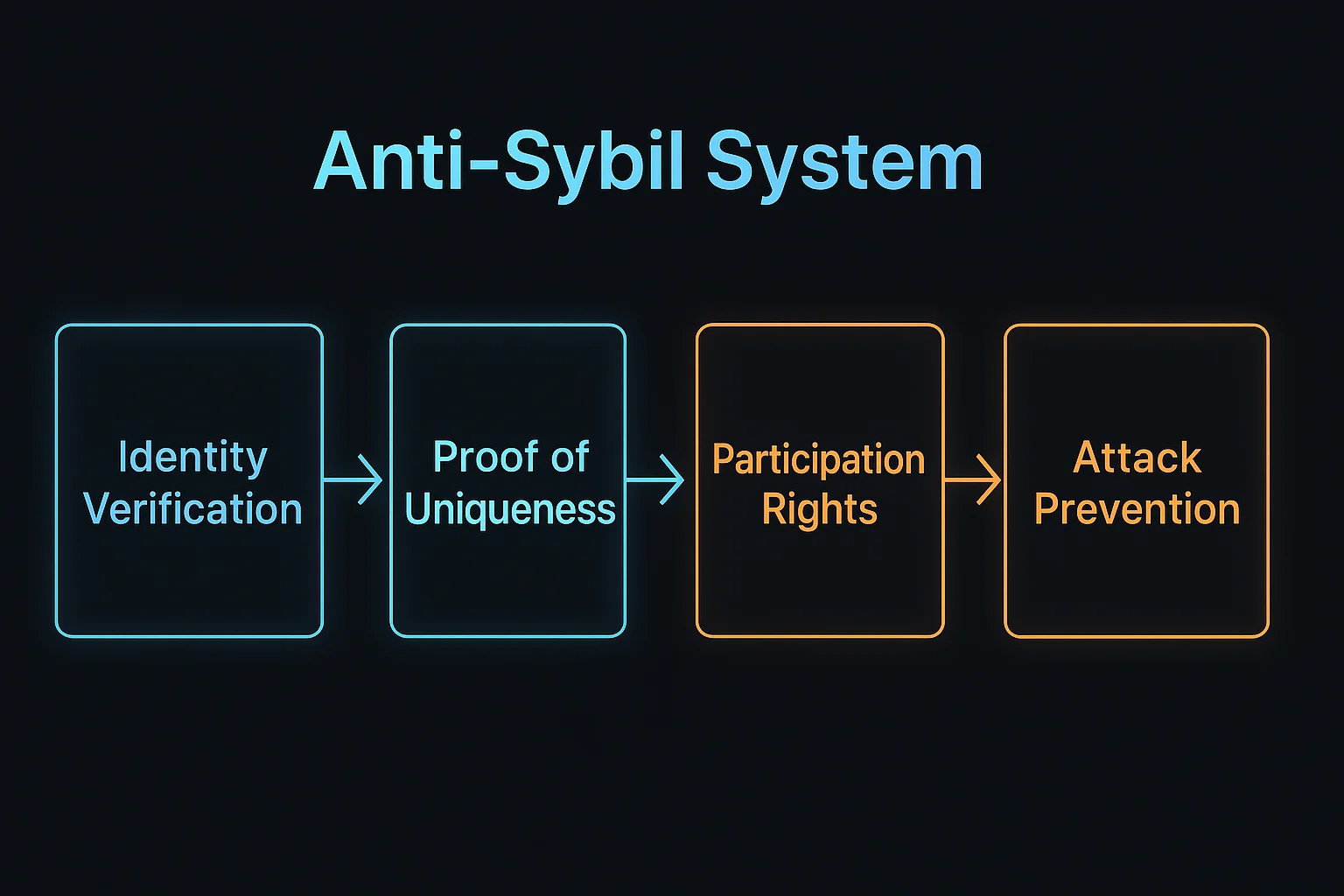
Anti-Sybil system diagram showing identity verification, uniqueness proof, participation rights, and attack prevention

Real-World Examples

  • Gitcoin Grants uses Gitcoin Passport to verify unique human participants in quadratic funding
  • Proof of Humanity creates registries of verified unique humans for various applications
  • BrightID provides decentralized identity verification through social graph analysis

Why Beginners Should Care

Fair distribution depends on anti-Sybil measures to prevent wealthy actors from claiming multiple shares of airdrops or governance power.

Privacy trade-offs as effective anti-Sybil systems often require revealing personal information or social connections.

System integrity for democratic governance and fair resource allocation across crypto protocols and DAOs.

Related Terms: Sybil Attack, Quadratic Funding, Governance

Back to Crypto Glossary

Similar Posts

  • Token Launch

    Token Launch: Cryptocurrency Project DebutA token launch is the initial release of a new cryptocurrency token to the public market. It's like a product launch where a company introduces a new product, but for digital currencies instead of physical goods.Token launch refers to the process of introducing a new cryptocurrency token to the market, including…

  • Session Keys

    Session Keys: Temporary Wallet Permissions Session keys provide temporary, limited permissions for applications to perform specific actions without exposing main wallet private keys. It’s like giving valet keys instead of your full car keys. Session keys are temporary cryptographic keys that grant limited permissions to applications for specific time periods or transaction types. They enable…

  • Profit Taking

    Profit Taking: Realizing Investment GainsProfit taking involves selling cryptocurrency holdings to lock in gains and convert unrealized profits into actual cash or other assets. It's like cashing out your casino chips while you're ahead.Profit taking refers to the strategic sale of cryptocurrency positions to realize gains and reduce exposure when investments have appreciated in value. This…

  • Lockup Period

    Lockup Period: Temporary Access RestrictionsLockup periods prevent token holders from selling or transferring their holdings for specified time frames. It's like having a certificate of deposit that you can't cash out early.A lockup period is a predetermined time frame during which cryptocurrency holders cannot sell, transfer, or access their tokens. These restrictions are typically enforced through…

  • Dusting Attack

    Dusting Attack: Tracking Through Tiny Transactions Dusting attacks send tiny amounts of cryptocurrency to addresses to track user behavior and deanonymize transactions. It’s like sprinkling digital breadcrumbs to follow where people go. A dusting attack sends small amounts of cryptocurrency (dust) to many addresses to track users’ transaction patterns and potentially identify wallet owners. Attackers…

  • |

    zkEVM

    zkEVM: Zero-Knowledge Ethereum Virtual Machine zkEVM provides Ethereum compatibility with zero-knowledge proof validation, enabling existing dApps to run on faster, cheaper networks while maintaining security. It’s like having Ethereum that’s been turbocharged with privacy and speed. zkEVM is a zero-knowledge virtual machine that executes Ethereum transactions and smart contracts while generating cryptographic proofs of correct…