
Consensus Mechanism

Consensus Mechanism: How Networks Agree

Consensus mechanisms solve the fundamental problem of getting thousands of independent computers to agree on a single version of truth without central authority.

A consensus mechanism is the process by which a distributed network of nodes agrees on the validity of transactions and the current state of the blockchain. It ensures all participants have the same version of the ledger without needing to trust each other.

How Consensus Mechanisms Work

Byzantine Fault Tolerance addresses the challenge of reaching agreement when some network participants might be malicious or unreliable. Consensus protocols must work even with bad actors present.

Economic incentives encourage honest behavior through rewards for following protocol rules and penalties for attempting to cheat or attack the network.

Different approaches trade off between security, speed, and energy consumption. No consensus mechanism is perfect – each makes compromises based on network priorities.
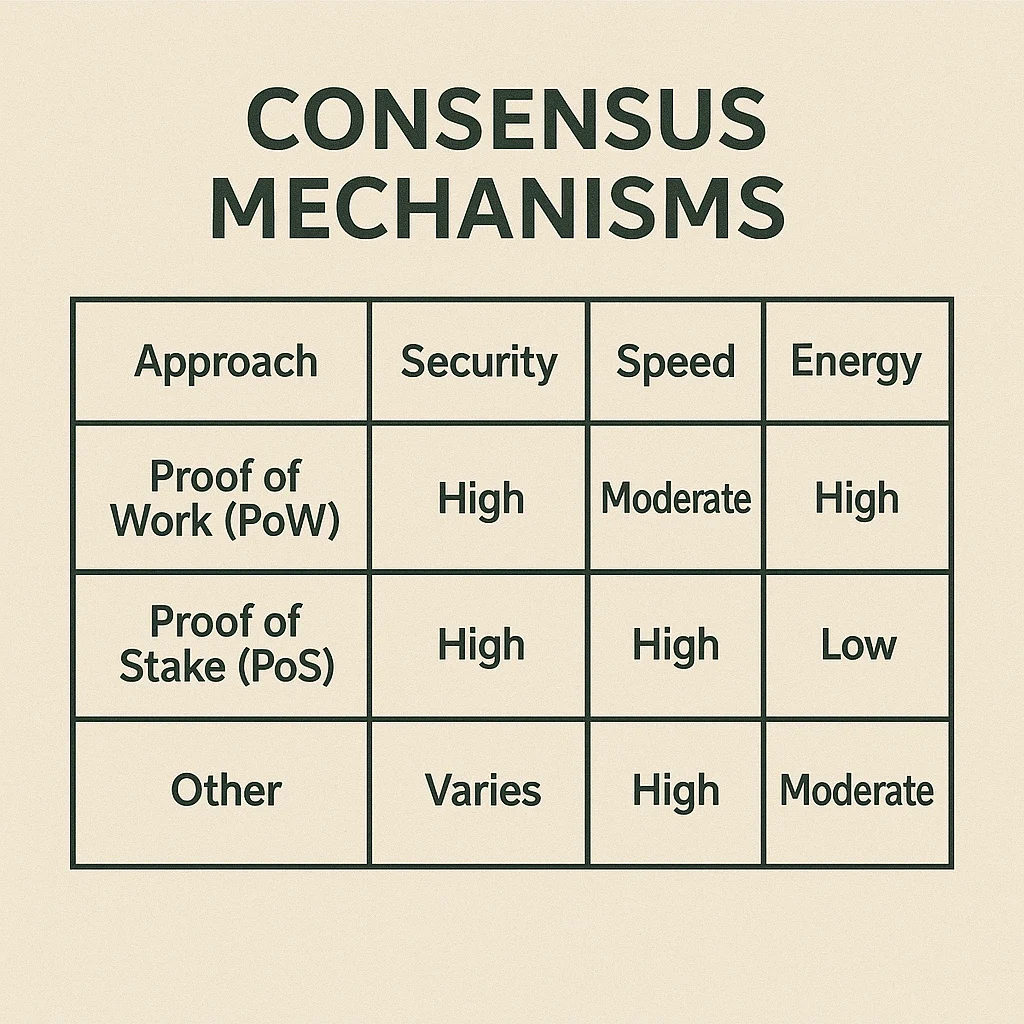
Infographic table comparing Proof of Work (PoW), Proof of Stake (PoS), and Other consensus mechanisms by security, speed, and energy usage

Real-World Examples

  • Proof of Work – Bitcoin’s energy-intensive but proven secure consensus mechanism
  • Proof of Stake – Ethereum’s switch to more energy-efficient validation through economic staking
  • Delegated Proof of Stake – EOS and other networks using representative validation systems

Why Beginners Should Care

Consensus choice fundamentally affects a blockchain’s security, decentralization, and environmental impact. Understanding these trade-offs helps evaluate different cryptocurrency projects.

Network security depends on consensus mechanism design and adoption. Newer or experimental consensus methods may have undiscovered vulnerabilities.

Energy debates often center on consensus mechanisms, with Proof of Work consuming significant electricity while alternatives use far less energy but have different security assumptions.

Related Terms: Proof of Work, Proof of Stake, Validator, Mining

Back to Crypto Glossary

Similar Posts

  • Regulatory Compliance

    Regulatory Compliance: Following Government RulesRegulatory compliance involves adhering to government laws and regulations that apply to cryptocurrency activities. It's like following traffic laws, but for digital money.Regulatory compliance refers to conforming with applicable laws, regulations, and supervisory requirements for cryptocurrency businesses, transactions, and activities. Compliance requirements vary significantly between jurisdictions and continue evolving.How Crypto Compliance WorksKnow…

  • Circulating Supply

    Circulating Supply: Tokens Available for TradingCirculating supply represents the number of cryptocurrency tokens currently available for public trading and use. It's like counting how much money is actually in circulation versus locked away.Circulating supply refers to the number of cryptocurrency tokens that are publicly available and actively trading in the market. This excludes tokens that are…

  • Leverage

    Leverage: Borrowing Money to Amplify TradesLeverage lets you control larger positions than your actual capital by borrowing funds from exchanges or platforms. It's like using a lever to lift heavy objects – small movements create big effects.Leverage in cryptocurrency trading allows borrowing funds to increase position sizes beyond available capital, amplifying both potential profits and…

  • Algorithmic Stablecoin

    Algorithmic Stablecoin: Code-Controlled Price StabilityAlgorithmic stablecoins maintain price stability through automated mechanisms rather than asset backing. They're like self-driving cars for currency stability – controlled by code instead of human intervention.An algorithmic stablecoin is a cryptocurrency that maintains price stability through automated protocols and market mechanisms rather than collateral backing. These systems use smart contracts to…

  • Risk Management

    Risk Management: Protecting Your InvestmentsRisk management involves identifying, assessing, and controlling potential losses in cryptocurrency investments and activities. It's like wearing a seatbelt while driving through volatile markets.Risk management encompasses strategies and practices used to minimize potential losses and protect capital while participating in cryptocurrency markets. Effective risk management balances potential returns with acceptable loss levels.How…

  • Layer 2

    Layer 2: Scaling Solutions for Expensive Blockchains Layer 2 networks solve Ethereum’s biggest problem – ridiculous gas fees. They process transactions cheaply and quickly while inheriting Ethereum’s security. Layer 2 is a separate blockchain or protocol built on top of a main blockchain (Layer 1) to improve scalability and reduce transaction costs. These solutions handle…