
Delegated Proof of Stake (DPoS)

Delegated Proof of Stake (DPoS): Democratic Validation

DPoS lets token holders vote for validators who secure the network on their behalf. It’s like electing representatives to Congress, but for blockchain consensus.

Delegated Proof of Stake (DPoS) is a consensus mechanism where token holders vote for a limited number of delegates who validate transactions and secure the network. This creates a more scalable system than pure Proof of Stake while maintaining democratic participation.

How DPoS Works

Voting power corresponds to token holdings, allowing larger stakeholders to have more influence over delegate selection while still enabling smaller holders to participate.

Fixed validator sets typically include 21-101 elected delegates who take turns producing blocks, creating faster consensus than systems with thousands of validators.

Continuous elections let token holders change their votes at any time, removing poorly performing delegates and encouraging good behavior through threat of replacement.
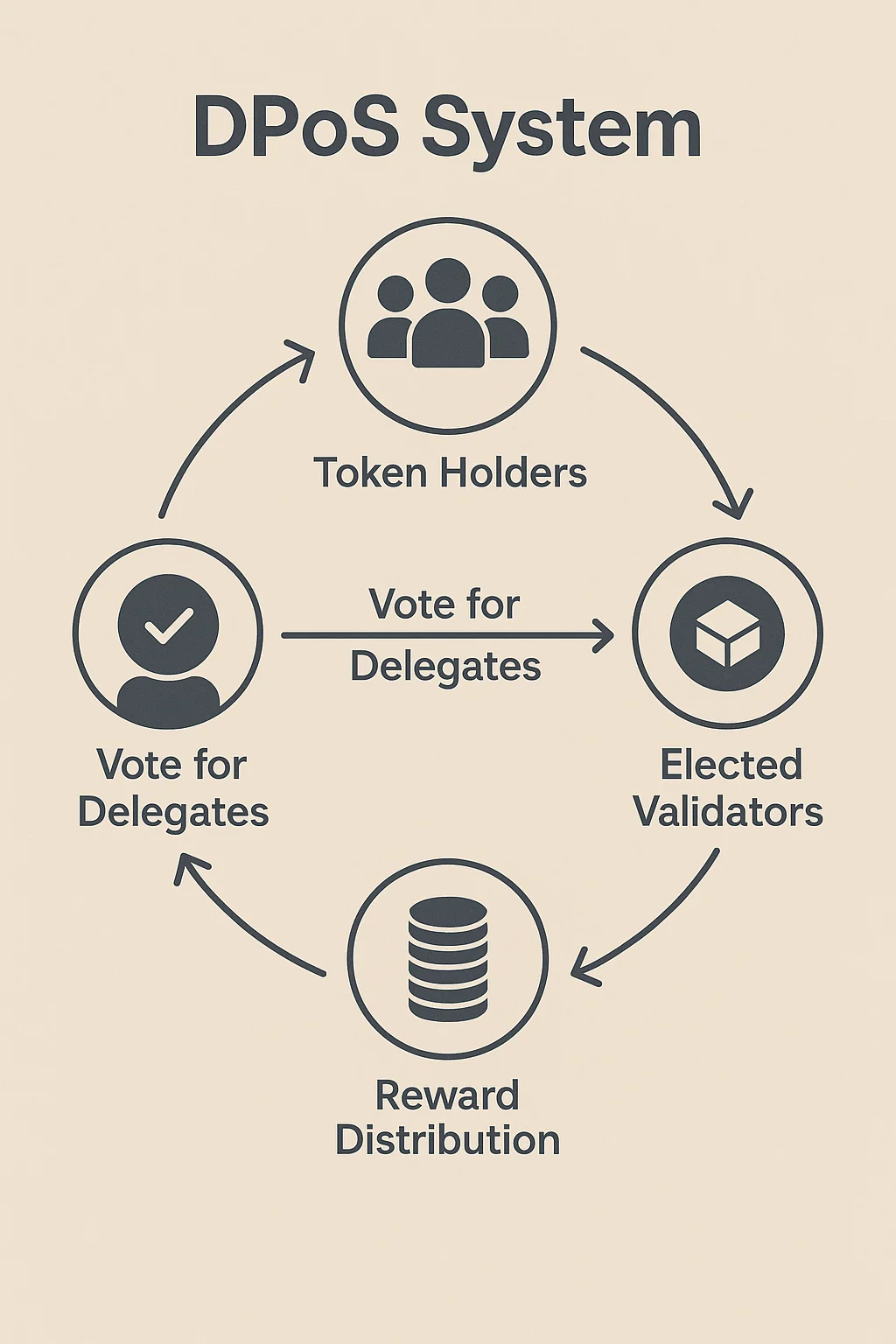
Infographic showing how Delegated Proof of Stake works, with token holders voting for delegates who become validators, produce blocks, and distribute rewards

Real-World Examples

  • EOS blockchain uses 21 elected block producers chosen by token holder voting
  • Tron (TRX) employs 27 Super Representatives elected through continuous voting
  • Lisk uses 101 delegates selected by stakeholder voting for network validation

Why Beginners Should Care

Faster transactions result from smaller validator sets that can reach consensus more quickly than systems requiring agreement from thousands of nodes.

Political dynamics emerge as delegates campaign for votes, form alliances, and compete for positions, sometimes leading to centralization concerns.

Voter apathy can concentrate power among a few large stakeholders if smaller token holders don’t actively participate in delegate selection.

Related Terms: Proof of Stake, Validator, Consensus Mechanism, Governance

Back to Crypto Glossary

Similar Posts

  • Peg Mechanism

    Peg Mechanism: Maintaining Price StabilityPeg mechanisms are systems designed to maintain stable exchange rates between cryptocurrencies and reference assets like fiat currencies. They're like autopilot systems that keep stablecoins flying at steady altitudes.A peg mechanism is a system that maintains the exchange rate of one asset relative to another through automatic adjustments, reserves, or market…

  • Rug Detector

    Rug Detector: Automated Scam Identification Rug detectors are tools that analyze token contracts and trading patterns to identify potential rug pulls before they happen. They’re like having a fraud investigator built into your trading interface. A rug detector is software that automatically analyzes cryptocurrency projects for red flags that indicate potential rug pulls or exit…

  • Security Token

    Security Token: Regulated Digital AssetsSecurity tokens are cryptocurrency tokens that represent ownership in real-world assets and are subject to securities regulations. They're like digital stock certificates that comply with financial laws.Security tokens are cryptocurrency tokens that represent ownership stakes in real-world assets and are subject to securities regulations and compliance requirements. These bridge traditional finance with…

  • Gas Optimization

    Gas Optimization: Reducing Transaction CostsGas optimization involves techniques to minimize the computational cost of blockchain transactions and smart contracts. It's like finding the most fuel-efficient route for your digital transactions.Gas optimization refers to practices and techniques used to reduce the gas consumption of blockchain transactions and smart contract operations. This minimizes transaction costs and improves application…

  • On-Chain Gaming

    On-Chain Gaming: Fully Decentralized Games On-chain gaming runs game logic entirely on blockchain networks rather than traditional servers. It’s like having board games where the rules are enforced by mathematics instead of human referees. On-chain gaming executes all game logic, state management, and interactions through smart contracts on blockchain networks. Unlike traditional games with centralized…

  • Compound Interest

    Compound Interest: Exponential Growth ReturnsCompound interest is earned on both the initial investment and previously accumulated interest, creating exponential growth over time. It's like planting a tree where each year's growth makes the tree bigger, which then grows even more the following year.Compound interest refers to earning returns not only on the original principal amount…