
Flash Loan

Flash Loan: Borrowing Millions Without Collateral

Flash loans let you borrow millions of dollars without putting up collateral, but you must pay it back in the same transaction. It’s DeFi’s most mind-bending innovation.

A flash loan is an uncollateralized loan that must be borrowed and repaid within a single blockchain transaction. If you can’t repay the loan plus fees by the end of the transaction, the entire transaction reverts as if it never happened.

How Flash Loans Work

Smart contracts enforce the repayment requirement atomically. You can borrow millions, use the funds for arbitrage or other strategies, then repay the loan – all within one transaction that takes seconds.

Arbitrage opportunities are the most common use case. Traders borrow funds to exploit price differences between exchanges, keeping the profit after repaying the loan.

Liquidation of undercollateralized positions also uses flash loans, allowing liquidators to borrow funds to purchase discounted collateral from failing loans.
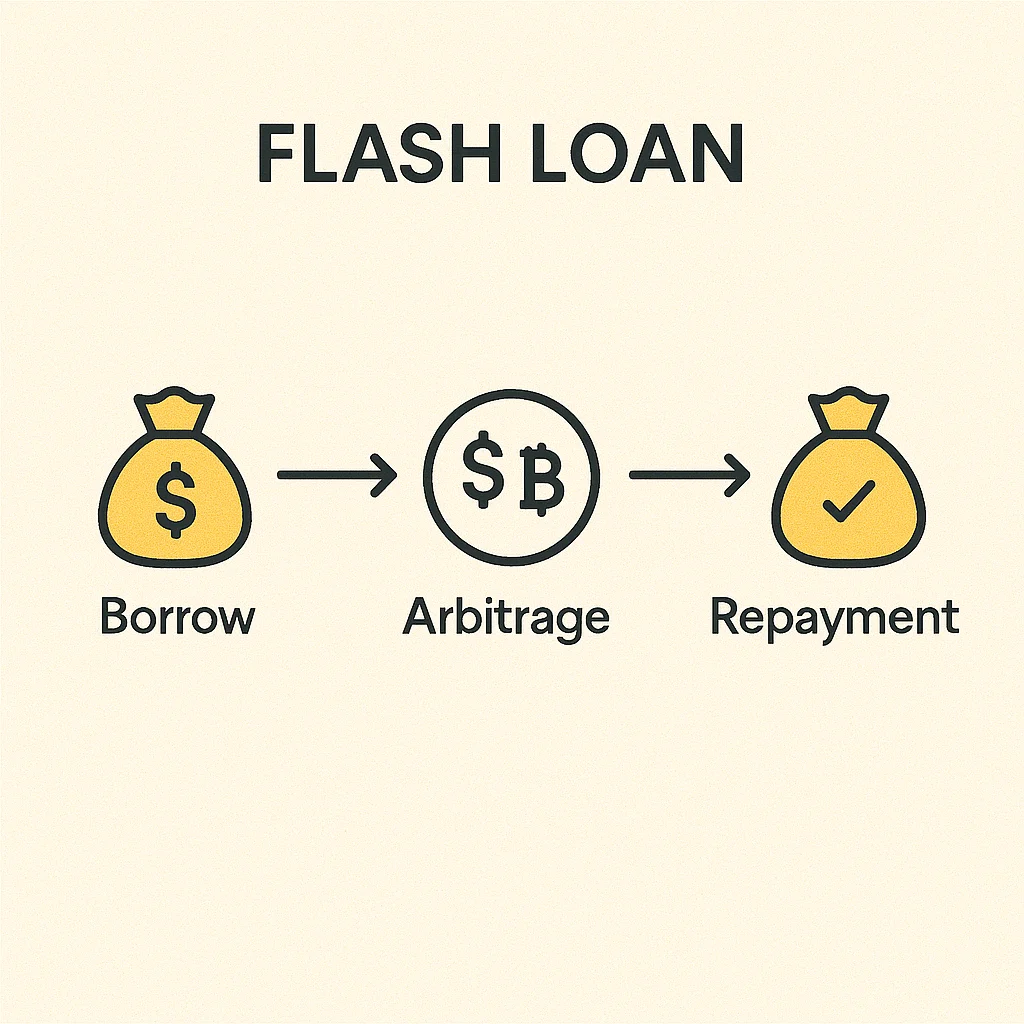
Infographic showing flash loan process with steps: borrow, arbitrage trade, and repayment—all within one atomic transaction

Real-World Examples

  • Aave pioneered flash loans and processes billions in flash loan volume monthly
  • Arbitrage bots use flash loans to exploit price differences across DEXs instantly
  • Complex DeFi strategies combine multiple protocols in single transactions using flash loan capital

Why Beginners Should Care

Flash loans democratize access to large amounts of capital for sophisticated trading strategies. You don’t need to be wealthy to execute million-dollar arbitrage trades.

However, flash loans require advanced programming knowledge and understanding of DeFi protocols. They’re also used in some exploit attacks against vulnerable smart contracts.

Learn the basics of DeFi and smart contracts before attempting flash loan strategies. The complexity makes it easy to lose money through coding errors or failed transaction logic.

Related Terms: Smart Contract, Arbitrage, Liquidation, DeFi

Back to Crypto Glossary

Similar Posts

  • Real Yield

    Real Yield: Sustainable Return GenerationReal yield refers to returns generated from actual economic activity and revenue rather than token emissions or inflationary rewards. It's like earning interest from a bank's profitable lending operations instead of them just printing more money to pay you.Real yield describes investment returns generated from genuine economic activity, protocol revenue, or…

  • Wallet Integration

    Wallet Integration: Seamless Application ConnectivityWallet integration enables applications to connect with cryptocurrency wallets for user authentication and transaction processing. It's like having a universal credit card reader that works with every type of payment card, making transactions smooth and effortless.Wallet integration refers to the technical implementation that allows decentralized applications to connect with various cryptocurrency…

  • Secondary Market

    Secondary Market: Resale Trading VenuesSecondary markets enable trading of assets after their initial issuance, providing liquidity and price discovery for existing holdings. They're like used car lots for digital assets.A secondary market is where previously issued assets are bought and sold between investors rather than being purchased directly from the original issuer. These markets provide liquidity…

  • Storage Rent

    Storage Rent: Pay-per-Use Blockchain StorageStorage rent is a proposed mechanism where users pay ongoing fees for maintaining data on blockchain networks. It's like paying monthly rent for keeping files in cloud storage instead of a one-time purchase.Storage rent refers to fee mechanisms that charge users for ongoing blockchain storage rather than allowing permanent storage after…

  • Time-Weighted Average Price (TWAP)

    Time-Weighted Average Price (TWAP): Manipulation-Resistant Pricing TWAP calculates asset prices over extended time periods to resist manipulation and provide more stable price references for protocols. It’s like taking your temperature every hour instead of just once. Time-Weighted Average Price (TWAP) is a pricing mechanism that calculates the average price of an asset over a specific…

  • DeFi Aggregator

    DeFi Aggregator: Finding the Best Yields DeFi aggregators automatically find the best rates across multiple protocols for lending, borrowing, or trading. They’re like Expedia for decentralized finance. A DeFi aggregator is a platform that searches multiple protocols to find the best rates, yields, or liquidity for users’ specific needs. Instead of manually checking dozens of…