
Autonomous World (AW)

Autonomous World (AW): Persistent Virtual Realities

Autonomous worlds are persistent virtual environments that continue existing and evolving even when no players are actively participating. They’re like having a Minecraft world that keeps running and changing forever.

An Autonomous World (AW) is a virtual environment that operates independently through blockchain infrastructure, maintaining state and enabling interactions without requiring central servers or active management. These worlds persist and evolve according to their programmed rules.

How Autonomous Worlds Work

Blockchain persistence ensures the virtual world continues existing as long as the underlying blockchain operates, independent of any company or server infrastructure.

Player-driven evolution allows inhabitants to modify the world through their actions, with changes permanently recorded on-chain.

Economic sovereignty enables native economies with real value exchange, ownership rights, and governance systems controlled by world inhabitants.
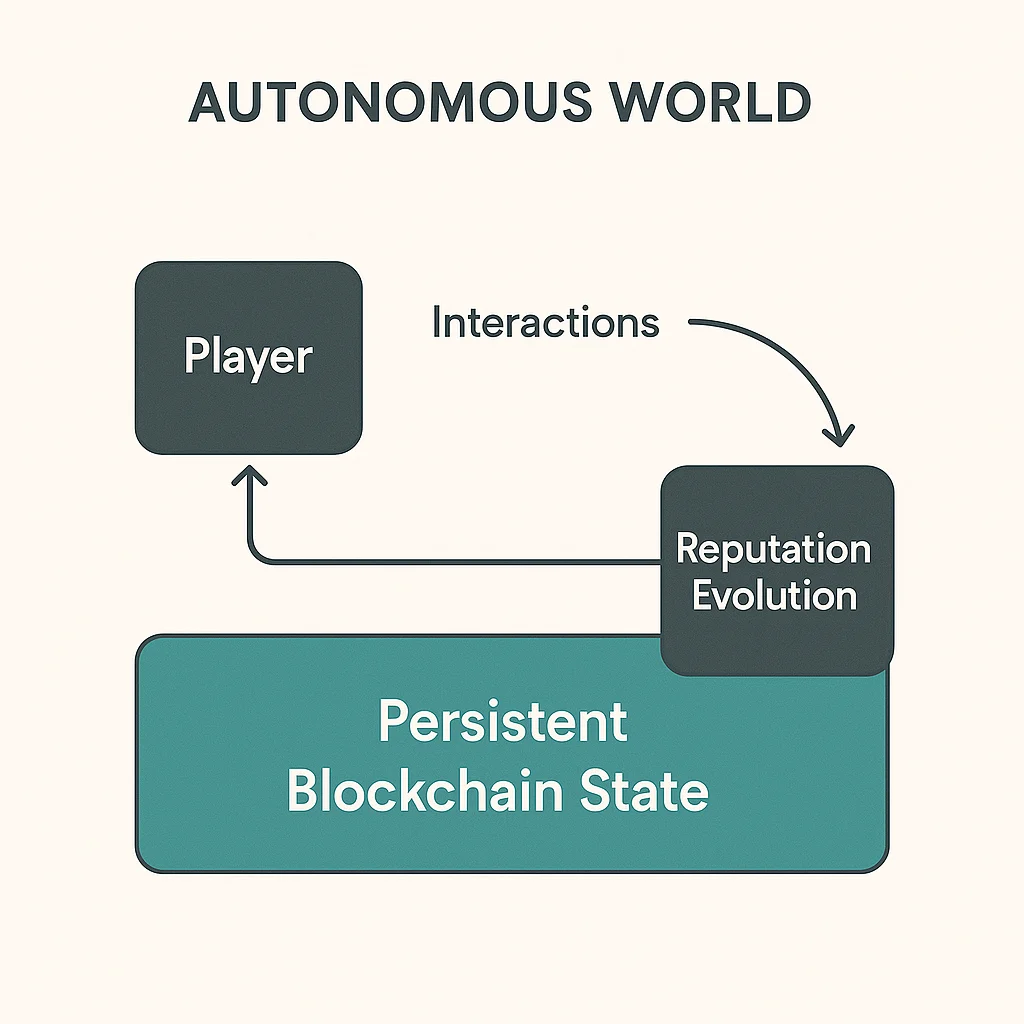
Autonomous world architecture showing player interactions, reputation evolution, and persistent blockchain state enabling independent system behavior.

Real-World Examples

  • Dark Forest – Space exploration game that runs entirely on-chain with hidden information
  • Loot derivatives creating persistent fantasy worlds based on text-based NFTs
  • MUD engine provides infrastructure for building complex autonomous worlds

Why Beginners Should Care

True ownership of virtual assets and land that can’t be taken away by game companies going out of business or changing policies.

Persistent value creation where time and effort invested in virtual worlds retains value indefinitely through blockchain permanence.

Experimental economics as autonomous worlds become laboratories for testing new forms of governance, economics, and social organization.

Related Terms: Metaverse, On-Chain Gaming, Virtual Real Estate, Persistence

Back to Crypto Glossary

Similar Posts

  • Staking Rewards

    Staking Rewards: Earning from Network Security Staking rewards compensate users for locking up cryptocurrency to help secure proof-of-stake networks. It’s like earning interest for helping guard the bank vault. Staking rewards are cryptocurrency payments earned by users who lock up tokens to participate in proof-of-stake network consensus and security. These rewards incentivize honest participation while…

  • Supply

    Supply: Total Token Quantity AvailableSupply refers to the total amount of cryptocurrency tokens available, including those in circulation, locked up, or held by various parties. It's a fundamental economic factor affecting token value.Supply encompasses all cryptocurrency tokens that exist or will exist, including circulating supply available for trading and locked supply held by teams, investors,…

  • Democratic Governance

    Democratic Governance: Community-Controlled Decision MakingDemocratic governance enables community members to participate in project decisions through voting and proposal systems. It's like having a democracy where token holders are the citizens.Democratic governance refers to decision-making systems where community members have voting rights and influence over project direction, protocol changes, and resource allocation. Token holdings typically determine voting…

  • Rug Pull

    Rug Pull: When Projects Disappear With Your Money Rug pulls are crypto’s version of old-fashioned exit scams. Developers build hype, collect investor money, then vanish into the digital night. A rug pull is when cryptocurrency project developers abandon the project and steal investor funds. The term comes from “pulling the rug out” from under investors…

  • Governance Attack

    Governance Attack: Exploiting Democratic Decision SystemsA governance attack involves manipulating blockchain governance mechanisms to make malicious changes to protocols. It's like rigging an election to pass laws that benefit you at everyone else's expense.A governance attack refers to exploiting voting or decision-making mechanisms in blockchain protocols to implement changes that benefit attackers while harming other…

  • Order Matching

    Order Matching: Connecting Buyers and SellersOrder matching is the process of pairing buy and sell orders to execute trades on exchanges. It's like a digital matchmaker that finds the perfect trading partners for each transaction.Order matching refers to the algorithmic process that pairs compatible buy and sell orders to execute trades at agreed prices on…