
Paper Hands

Paper Hands: Quick to Sell, Quick to Regret

Paper hands describes investors who sell at the first sign of trouble or take profits too early. It’s crypto’s version of weak stomach syndrome.

Paper hands refers to investors who sell their cryptocurrency holdings quickly due to fear, panic, or impatience rather than holding through volatility. The term suggests hands too weak to grip investments during turbulent periods.

How Paper Hands Behavior Works

Loss aversion drives paper hands selling – the psychological pain of losing money feels worse than the pleasure of gaining equivalent amounts. First-time investors often sell during initial crashes.

FOMO and FUD cycles trigger paper hands behavior. Investors buy during euphoria (FOMO) then sell during fear campaigns (FUD), repeatedly buying high and selling low.

Lack of conviction in investment thesis makes it easy to abandon positions when prices move against expectations or negative news emerges.
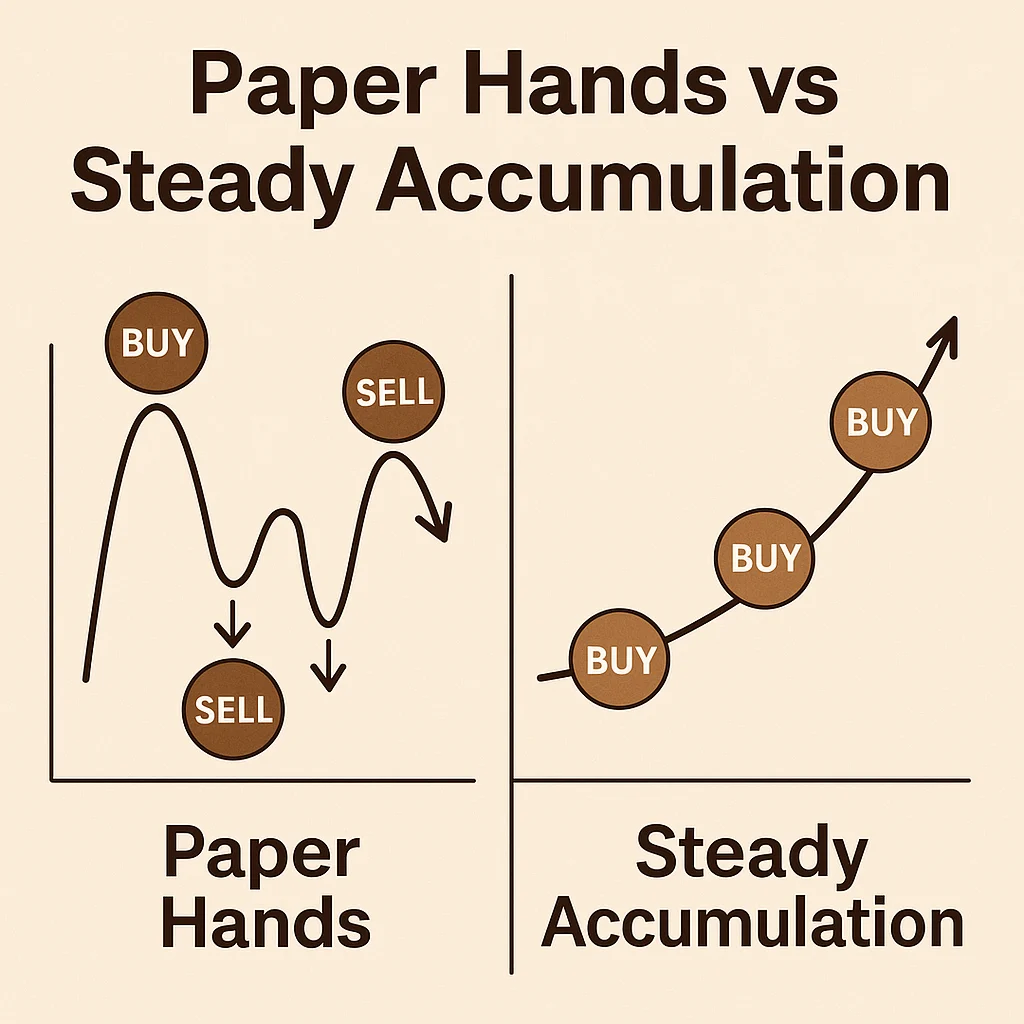
Infographic comparing paper hands behavior of buying high and selling low versus steady accumulation strategy with consistent upward buys

Real-World Examples

  • 2018 crypto crash saw many retail investors sell at losses, missing the 2020-2021 recovery
  • COVID market crash triggered massive selling that reversed within months
  • FTX collapse caused paper hands selling of quality assets due to contagion fears

Why Beginners Should Care

Paper hands behavior destroys wealth through poor timing decisions. Emotional reactions to volatility typically result in buying peaks and selling bottoms.

Education reduces paper hands tendencies. Understanding market cycles, volatility patterns, and fundamental analysis builds conviction needed for successful long-term investing.

Position sizing helps prevent paper hands by only investing amounts you can afford to lose completely, reducing emotional attachment to daily price movements.

Related Terms: Diamond Hands, FOMO, FUD, HODL

Back to Crypto Glossary

Similar Posts

  • Message Passing

    Message Passing: Cross-System CommunicationMessage passing enables different blockchain networks or applications to communicate by transmitting information across system boundaries. It's like having a universal postal service that can deliver letters between different countries with different languages and customs.Message passing refers to communication protocols that enable different blockchain networks, smart contracts, or applications to exchange information…

  • Sandwich Attack

    Sandwich Attack: Extracting Value from Your Trades Sandwich attacks place trades before and after your transaction to manipulate prices and extract profit from your slippage. It’s like cutting in line twice – once in front of you and once behind you. A sandwich attack involves placing a buy order immediately before a victim’s trade and…

  • Transaction Cost

    Transaction Cost: The Price of Blockchain OperationsTransaction cost refers to the total expense of executing operations on blockchain networks, including fees, gas, and opportunity costs. It's the price you pay for using decentralized financial infrastructure.Transaction cost encompasses all expenses associated with executing blockchain operations, including network fees, gas costs, slippage, and time value. Understanding total transaction…

  • WAGMI (We’re All Gonna Make It)

    WAGMI: Crypto’s Battle Cry WAGMI (We’re All Gonna Make It) is crypto’s rallying cry during tough times. It represents community solidarity and shared optimism about long-term success. WAGMI stands for “We’re All Gonna Make It” – a popular crypto community phrase expressing collective optimism about future success despite current market conditions. It originated from bodybuilding…

  • Smart Order Routing

    Smart Order Routing: Optimal Trade Execution Smart order routing automatically finds the best prices across multiple exchanges and liquidity sources for each trade. It’s like having a shopping bot that checks every store for the best deal. Smart order routing is an algorithmic system that automatically splits and routes orders across multiple trading venues to…

  • Price Discovery

    Price Discovery: Finding Fair Market ValuePrice discovery is the process by which markets determine the fair value of assets through buyer and seller interactions. It's like a continuous auction where everyone votes with their money.Price discovery refers to the mechanism by which markets establish asset prices through the interaction of supply and demand from buyers…