
Session Keys

Session Keys: Temporary Wallet Permissions

Session keys provide temporary, limited permissions for applications to perform specific actions without exposing main wallet private keys. It’s like giving valet keys instead of your full car keys.

Session keys are temporary cryptographic keys that grant limited permissions to applications for specific time periods or transaction types. They enable seamless user experiences while maintaining security through restricted access scope.

How Session Keys Work

Permission scoping limits what actions session keys can perform, such as trading specific tokens, interacting with certain contracts, or spending up to defined amounts.

Time expiration automatically revokes session key access after predetermined periods, preventing indefinite exposure if keys are compromised.

Revocation mechanisms allow users to immediately cancel session keys if they detect suspicious activity or no longer want to grant access.
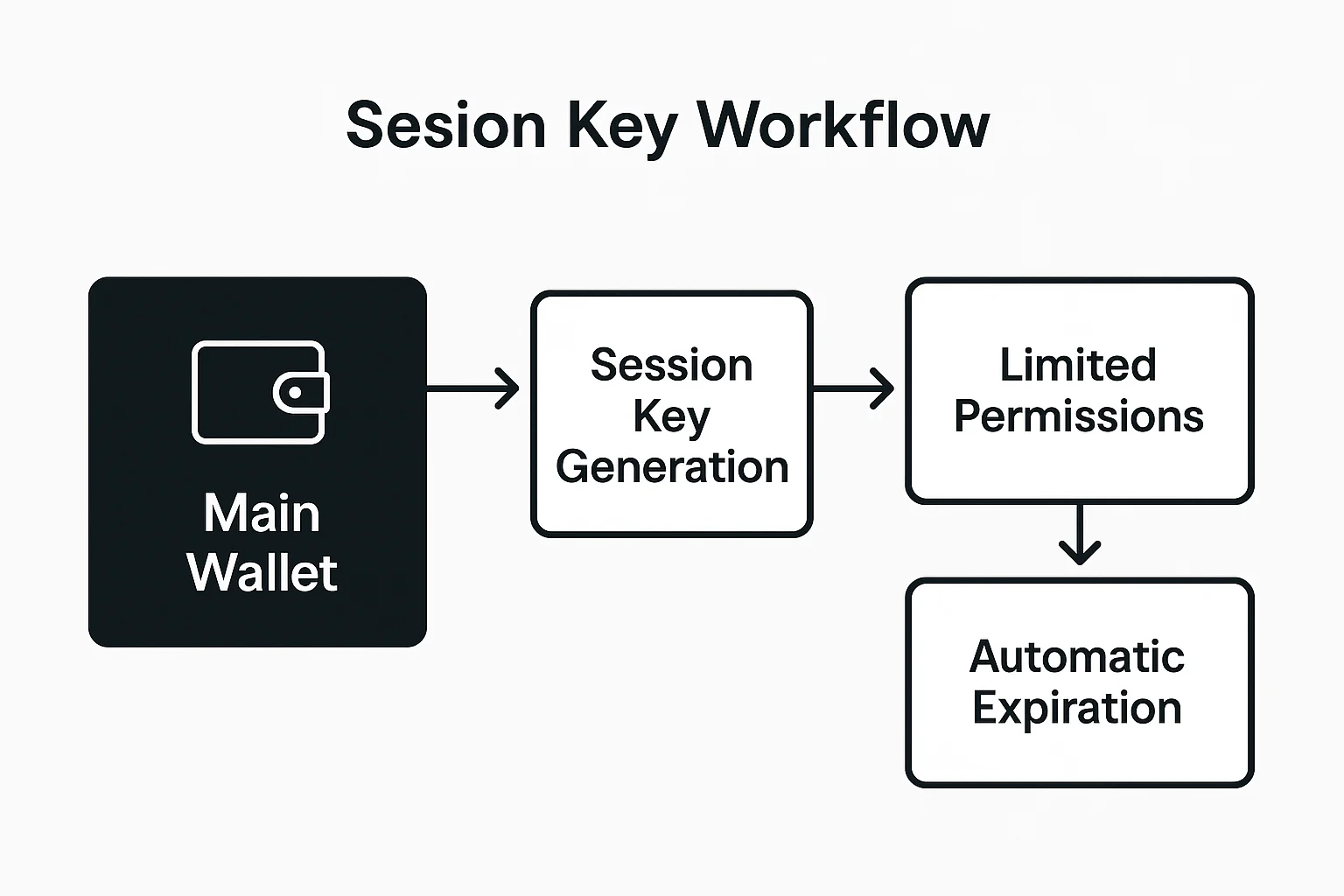
Session key workflow diagram showing main wallet generating a session key with limited permissions and automatic expiration.

Real-World Examples

  • Gaming applications use session keys for in-game transactions without requiring wallet approval for every action
  • DeFi protocols enable automated trading strategies with spending limits and time constraints
  • Mobile wallets create session keys for app interactions while keeping main keys in secure storage

Why Beginners Should Care

Improved UX eliminates constant wallet approval prompts for routine actions while maintaining security through limited permission scope.

Risk reduction means compromised session keys can only perform limited actions rather than providing full wallet access to attackers.

Automation enablement allows complex multi-step operations to execute automatically within predefined parameters without manual intervention.

Related Terms: Account Abstraction, Smart Contract, Security

Back to Crypto Glossary

Similar Posts

  • Ledger

    Ledger: Hardware Wallet Security Leader Ledger is a leading hardware wallet company that provides secure offline storage for cryptocurrency private keys. They’re like the Fort Knox of crypto storage devices. Ledger is a hardware wallet manufacturer that creates secure devices for storing cryptocurrency private keys offline, protecting them from online threats and hacking attempts. These…

  • Parabolic

    Parabolic: Exponential Price MovementParabolic describes extremely rapid price increases that follow exponential growth curves, often unsustainable in the long term. It's like a rocket shooting straight up into the sky – impressive to watch but likely to come back down eventually.Parabolic refers to price movements that follow exponential growth patterns, characterized by accelerating increases that…

  • Decentralized Computing

    Decentralized Computing: Distributed Processing PowerDecentralized computing distributes computational tasks across networks of independent computers rather than relying on centralized data centers. It's like having a supercomputer made of everyone's spare processing power.Decentralized computing refers to distributed systems where computational tasks are processed across multiple independent nodes rather than centralized servers or data centers. This creates more…

  • Scalability

    Scalability: Handling Growing Network DemandScalability refers to a blockchain network's ability to handle increasing transaction volumes without degrading performance or significantly increasing costs. It's like building highways that don't get congested as more cars use them.Scalability describes how well blockchain networks can accommodate growing user bases and transaction volumes while maintaining reasonable fees and confirmation…

  • Transaction

    Transaction: Moving Value on the BlockchainA cryptocurrency transaction transfers value from one address to another on a blockchain network. It's like writing a check, but with mathematical guarantees instead of trust.A transaction is a digitally signed transfer of cryptocurrency from one wallet address to another, recorded permanently on the blockchain. Every transaction includes sender information, recipient…

  • Sovereignty

    Sovereignty: Independent Control and GovernanceSovereignty in blockchain refers to independent control over governance, economics, and technical decisions without external interference. It's like having your own country with its own rules.Sovereignty refers to complete independence and self-governance for blockchain networks, applications, or communities without requiring permission from or dependence on external authorities. This includes technical, economic, and…