
HODL

HODL: The Art of Doing Nothing

HODL started as a typo but became crypto’s most important investment strategy. Sometimes the best move is not moving at all.

HODL means holding cryptocurrency long-term regardless of short-term price volatility, derived from a misspelled “hold” in a 2013 Bitcoin forum post. It represents the strategy of buying and holding rather than actively trading.

How HODL Works

Time arbitrage leverages crypto’s long-term growth trends while avoiding the stress and fees of constant trading. HODLers believe in underlying technology adoption over short-term price movements.

Emotional discipline prevents panic selling during crashes and FOMO buying during peaks. HODLing removes timing decisions that most retail traders get wrong.

Dollar cost averaging often accompanies HODL strategies – consistently buying fixed dollar amounts regardless of price to smooth out volatility over time.
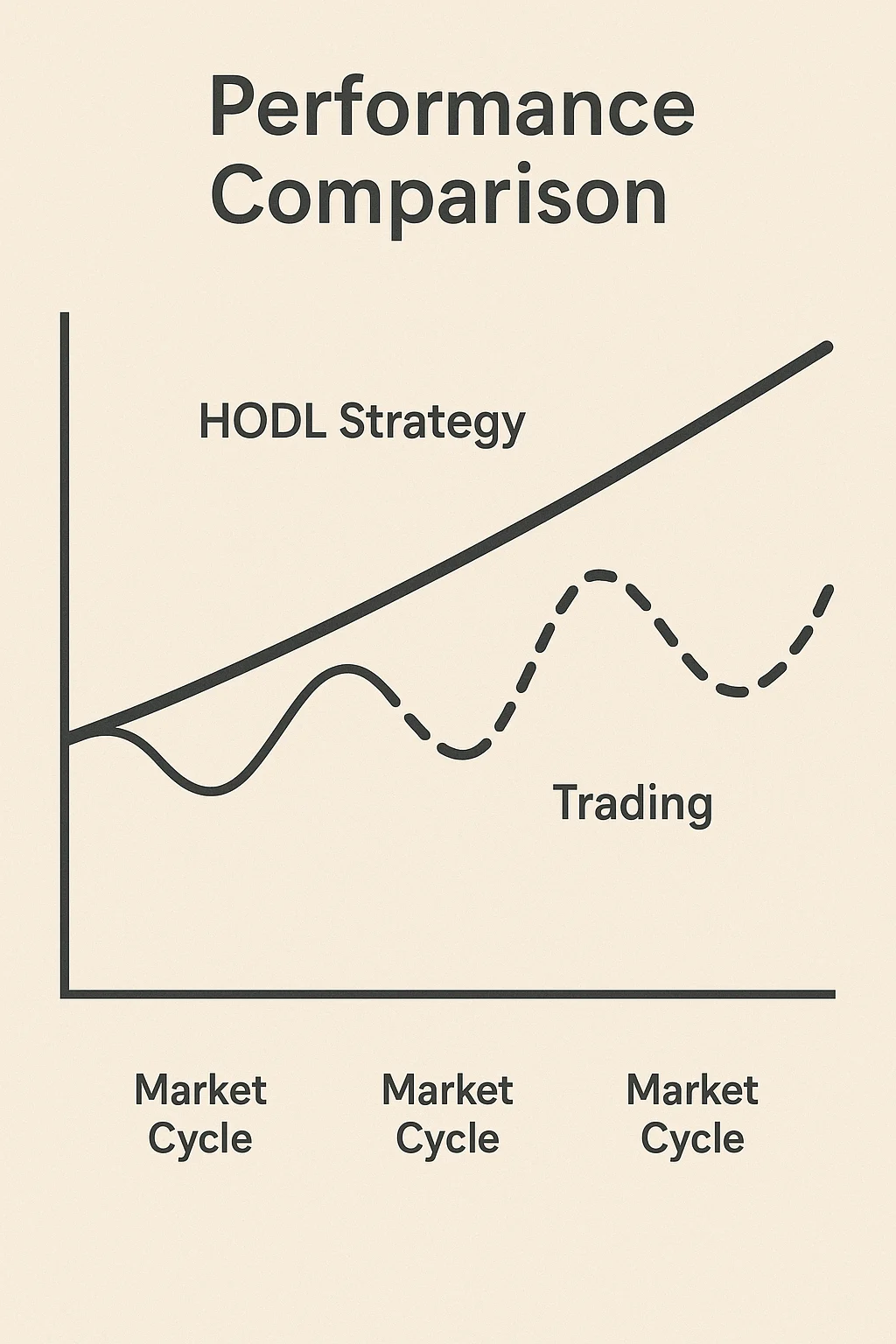
Line chart comparing HODL strategy with trading over multiple market cycles, showing steady gains for HODL and volatility for trading

Real-World Examples

  • Early Bitcoin adopters who held through multiple 80%+ crashes are now wealthy
  • Ethereum holders from 2016 experienced massive gains despite severe volatility
  • “Bitcoin pizza guy” spent 10,000 BTC on pizza in 2010 – worth $300+ million today

Why Beginners Should Care

HODLing beats trading for most people. Studies show active traders typically underperform simple buy-and-hold strategies after accounting for fees and taxes.

Psychological benefits include reduced stress from daily price watching and elimination of complex timing decisions that even professionals struggle with.

Tax advantages in many jurisdictions favor long-term holding over short-term trading, reducing overall tax burden on crypto gains.

Related Terms: Diamond Hands, DCA, Bull Market, Bear Market

Back to Crypto Glossary

Similar Posts

  • State Channel

    State Channel: Off-Chain Interaction Highways State channels enable instant, low-cost transactions between parties by moving interactions off-chain while maintaining blockchain security. It’s like having a private highway between two cities. A state channel is a two-way communication channel between blockchain users that enables off-chain transactions with on-chain security guarantees. Participants can transact instantly and cheaply,…

  • Liquidation Bot

    Liquidation Bot: Automated Debt Collection Liquidation bots monitor lending protocols for undercollateralized positions and automatically liquidate them for profit. They’re like repo men but for DeFi loans. A liquidation bot is an automated program that monitors DeFi lending protocols for loans that fall below required collateral ratios and triggers liquidations to earn rewards. These bots…

  • MEV (Maximal Extractable Value)

    MEV (Maximal Extractable Value): The Hidden Tax on DeFi MEV is the extra profit that miners and validators can extract by reordering, including, or excluding transactions within blocks. It’s like cutting in line at the blockchain cafeteria. Maximal Extractable Value (MEV) is the additional profit that block producers can capture by strategically ordering transactions, beyond…

  • Team Doxxing

    Team Doxxing: Revealing Anonymous IdentitiesTeam doxxing involves revealing the real identities of previously anonymous cryptocurrency project team members. It's like unmasking superheroes to show who's really behind the project.Team doxxing refers to the disclosure of real identities, backgrounds, and personal information of cryptocurrency project team members who were previously anonymous or pseudonymous. This can be voluntary…

  • Inter Chain Protocol

    Inter Chain Protocol: Cross-Blockchain CommunicationInter-chain protocols enable different blockchain networks to communicate and exchange data or assets securely. They're like universal translators that help different blockchain languages understand each other.Inter-chain protocols are standardized communication systems that enable different blockchain networks to exchange information, transfer assets, and coordinate actions across network boundaries. These protocols create interoperability between…

  • Tokenomics

    Tokenomics: The Economics of Digital Assets Tokenomics determines how cryptocurrencies create, distribute, and maintain value over time. It’s the difference between digital money and digital monopoly money. Tokenomics refers to the economic design and mechanics of a cryptocurrency token, including supply schedules, distribution methods, utility functions, and incentive structures. Good tokenomics align stakeholder interests while…