
Oracle

Oracle: Connecting Blockchains to Reality

Oracles are the bridges between blockchain smart contracts and real-world data. Without them, DeFi would be a closed system talking only to itself.

An oracle is a service that provides external data to blockchain networks, enabling smart contracts to access real-world information like prices, weather, sports scores, or any off-chain data. Blockchains can’t access external APIs directly, so oracles act as trusted data feeds.

How Oracles Work

Data aggregation combines information from multiple sources to prevent single points of failure. Price oracles might average data from 10+ exchanges to provide accurate, manipulation-resistant feeds.

Cryptographic proofs ensure data integrity during transmission from external sources to blockchain networks. Oracles sign data with private keys that smart contracts can verify.

Decentralized oracle networks use multiple independent node operators to fetch and verify data, reducing risks of manipulation or single points of failure that plague centralized oracles.
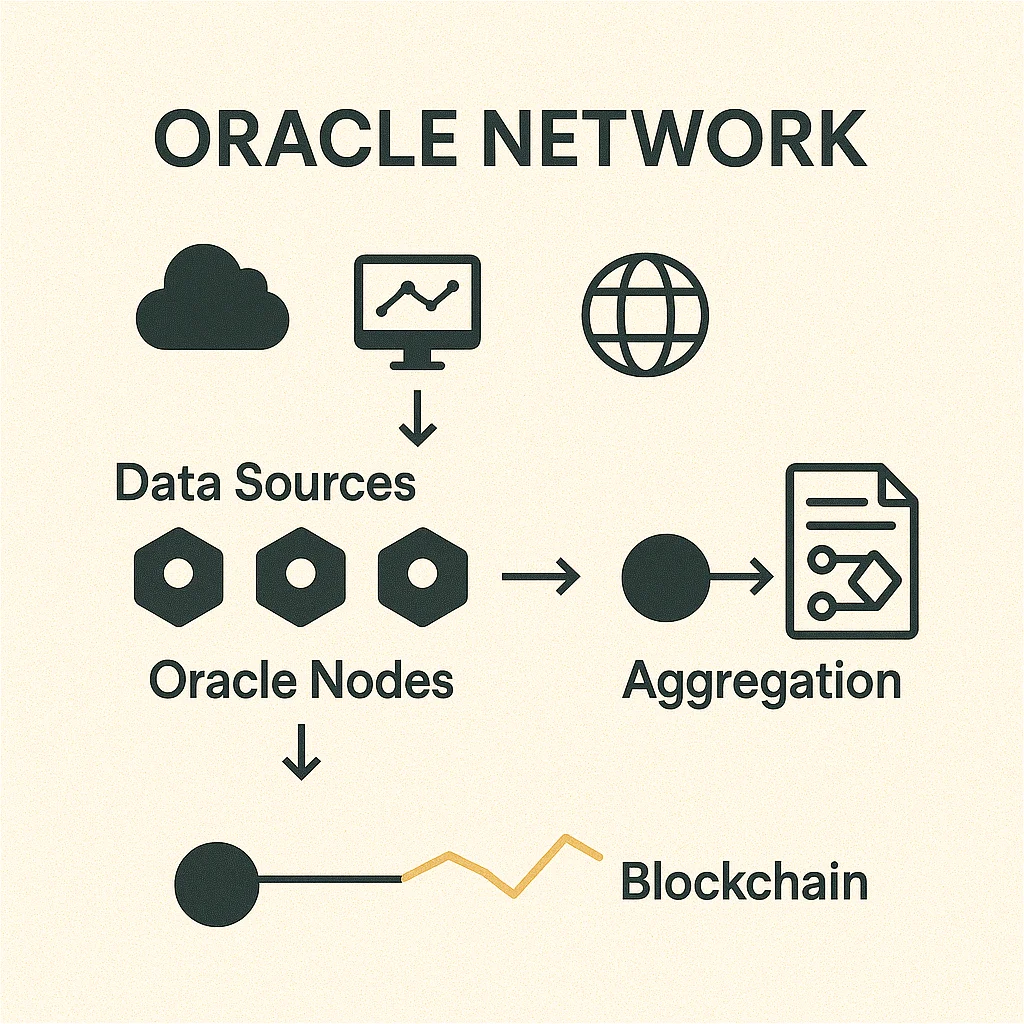
Infographic showing how oracle networks connect multiple data sources to blockchain smart contracts via aggregation and oracle nodes

Real-World Examples

  • Chainlink – Largest oracle network providing price feeds to thousands of DeFi protocols
  • Band Protocol – Cross-chain oracle solution supporting multiple blockchains
  • Tellor – Decentralized oracle network secured by crypto-economic incentives

Why Beginners Should Care

Oracle failures can catastrophically break DeFi protocols. If price feeds fail or get manipulated, lending protocols can liquidate healthy positions or allow undercollateralized borrowing.

Oracle attacks have caused hundreds of millions in DeFi losses. Attackers manipulate price feeds to exploit smart contracts that rely on inaccurate data.

Choose DeFi protocols that use reputable, decentralized oracle solutions rather than single-source price feeds vulnerable to manipulation.

Related Terms: Smart Contract, DeFi, Price Feed, Chainlink

Back to Crypto Glossary

Similar Posts

  • Paper Hands

    Paper Hands: Quick to Sell, Quick to Regret Paper hands describes investors who sell at the first sign of trouble or take profits too early. It’s crypto’s version of weak stomach syndrome. Paper hands refers to investors who sell their cryptocurrency holdings quickly due to fear, panic, or impatience rather than holding through volatility. The…

  • Soft Fork

    Soft Fork: Backward-Compatible Upgrades Soft forks tighten blockchain rules without breaking compatibility. They’re the diplomatic approach to network upgrades – everyone can still participate even if they don’t upgrade immediately. A soft fork is a backward-compatible change to blockchain protocol rules that makes previously valid blocks invalid while keeping previously invalid blocks invalid. Old nodes…

  • AI Coins

    AI Coins: Cryptocurrency Meets Artificial Intelligence AI coins are cryptocurrencies focused on artificial intelligence applications, data marketplaces, or computational resources for machine learning. They’re betting that AI and crypto will merge into something bigger than both. AI coins are cryptocurrencies that facilitate artificial intelligence development, deployment, or monetization through decentralized networks. These tokens enable AI…

  • Digital Securities

    Digital Securities: Blockchain-Based Financial InstrumentsDigital securities are traditional financial instruments like stocks and bonds represented as tokens on blockchain networks. They're like digitizing paper stock certificates to work on the internet.Digital securities are blockchain-based tokens that represent ownership in traditional financial instruments such as stocks, bonds, or real estate, subject to securities regulations. These bridge conventional…

  • Digital Currency

    Digital Currency: Electronic Money SystemsDigital currency refers to money that exists only in electronic form, including both centralized and decentralized varieties. It's like having money that lives entirely in computers and phones instead of physical bills and coins in your wallet.Digital currency encompasses all forms of money that exist exclusively in electronic format, including cryptocurrencies,…

  • Verifiable Credentials

    Verifiable Credentials: Tamper-Proof Digital DocumentsVerifiable credentials are digital documents that can be cryptographically verified without contacting the issuing authority. They're like diplomas that anyone can authenticate instantly.Verifiable credentials are digital documents that use cryptographic techniques to enable instant verification of authenticity without requiring contact with the issuing organization. These credentials enable trusted digital identity and qualification…