
Paper Hands

Paper Hands: Quick to Sell, Quick to Regret

Paper hands describes investors who sell at the first sign of trouble or take profits too early. It’s crypto’s version of weak stomach syndrome.

Paper hands refers to investors who sell their cryptocurrency holdings quickly due to fear, panic, or impatience rather than holding through volatility. The term suggests hands too weak to grip investments during turbulent periods.

How Paper Hands Behavior Works

Loss aversion drives paper hands selling – the psychological pain of losing money feels worse than the pleasure of gaining equivalent amounts. First-time investors often sell during initial crashes.

FOMO and FUD cycles trigger paper hands behavior. Investors buy during euphoria (FOMO) then sell during fear campaigns (FUD), repeatedly buying high and selling low.

Lack of conviction in investment thesis makes it easy to abandon positions when prices move against expectations or negative news emerges.
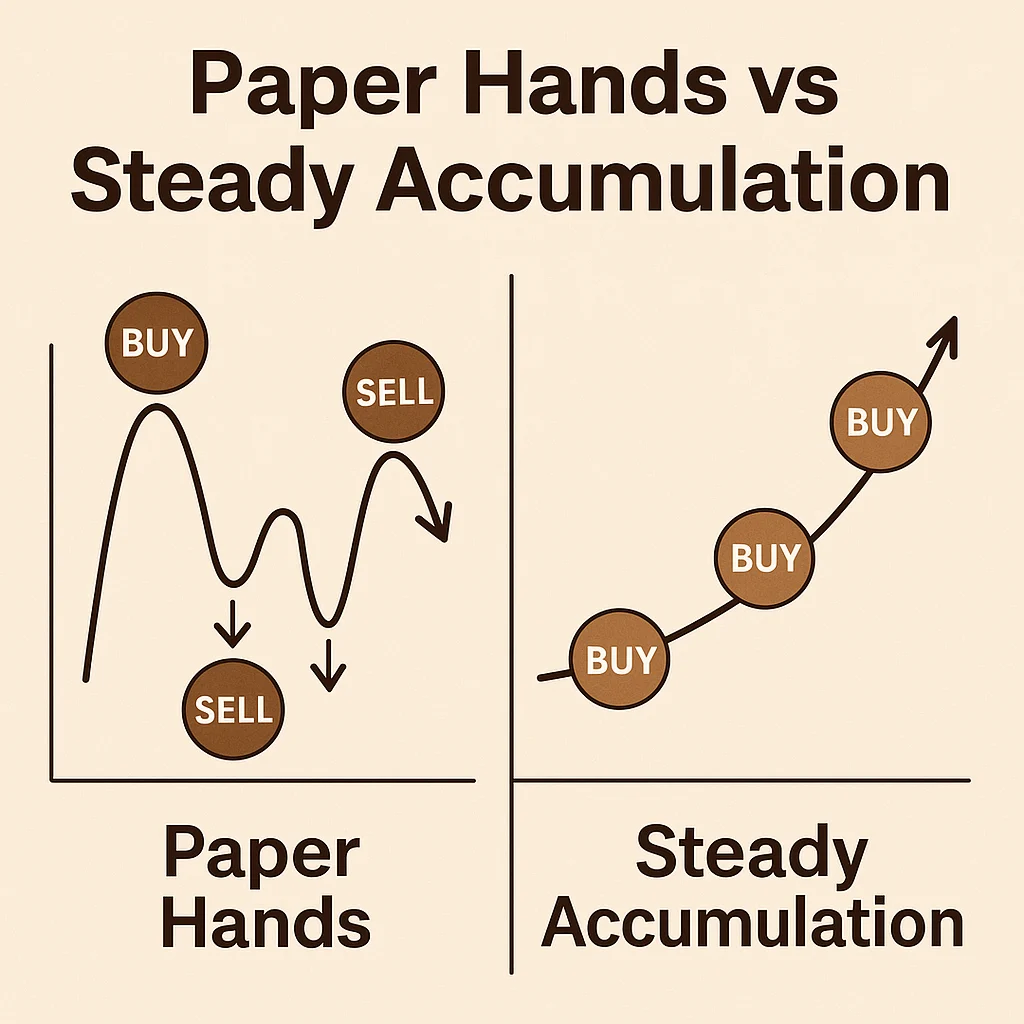
Infographic comparing paper hands behavior of buying high and selling low versus steady accumulation strategy with consistent upward buys

Real-World Examples

  • 2018 crypto crash saw many retail investors sell at losses, missing the 2020-2021 recovery
  • COVID market crash triggered massive selling that reversed within months
  • FTX collapse caused paper hands selling of quality assets due to contagion fears

Why Beginners Should Care

Paper hands behavior destroys wealth through poor timing decisions. Emotional reactions to volatility typically result in buying peaks and selling bottoms.

Education reduces paper hands tendencies. Understanding market cycles, volatility patterns, and fundamental analysis builds conviction needed for successful long-term investing.

Position sizing helps prevent paper hands by only investing amounts you can afford to lose completely, reducing emotional attachment to daily price movements.

Related Terms: Diamond Hands, FOMO, FUD, HODL

Back to Crypto Glossary

Similar Posts

  • DeFi Composability

    DeFi Composability: Building Block Finance DeFi composability allows protocols to integrate seamlessly, creating complex financial products by combining simpler components. It’s like financial Lego blocks that snap together perfectly. DeFi composability refers to the ability of decentralized finance protocols to interact and build upon each other, creating more complex financial products through modular integration. This…

  • Delegation

    Delegation: Assigning Voting or Staking RightsDelegation allows token holders to assign their voting power or staking rights to other participants while retaining ownership. It's like giving someone your vote without giving them your tokens.Delegation refers to assigning voting rights, staking authority, or other token-based powers to third parties while maintaining ownership of the underlying tokens. This…

  • EVM Compatibility

    EVM Compatibility: Ethereum Code EverywhereEVM compatibility allows blockchain networks to run Ethereum applications without modification. It's like having different computers that can all run the same software.EVM compatibility refers to blockchain networks that can execute Ethereum smart contracts and support Ethereum-based applications without requiring code changes. This enables easy migration and cross-deployment of Ethereum applications.How EVM…

  • Layer 1

    Layer 1: The Foundation Blockchain Layer 1 refers to the base blockchain protocol that processes transactions and maintains consensus. It’s the foundation that everything else builds on top of. Layer 1 (L1) is the main blockchain network that handles transaction processing, consensus, and security independently without relying on other blockchains. These are the foundational networks…

  • Launchpad

    Launchpad: The Crypto Startup Accelerator Launchpads are platforms that help new crypto projects raise funds and launch tokens. They’re like Kickstarter for cryptocurrencies, but with more speculation and less product delivery. A launchpad is a platform that facilitates fundraising and token launches for new cryptocurrency projects. They provide infrastructure, marketing, and community access to help…

  • Gas Fees

    Gas Fees: The Cost of Using Ethereum Gas fees are the tolls you pay to use Ethereum. Sometimes they’re pennies, sometimes they’re hundreds of dollars. Welcome to decentralized computing. Gas fees are transaction costs paid to miners or validators for processing transactions on blockchain networks. Think of gas as the fuel needed to power your…