
Privacy Coin

Privacy Coin: Digital Cash That Actually Hides

Privacy coins use advanced cryptography to hide transaction details like amounts, senders, and receivers. They’re what Bitcoin was supposed to be before everyone realized blockchain transactions are completely transparent.

Privacy coins are cryptocurrencies designed to provide anonymous or untraceable transactions through advanced cryptographic techniques. Unlike Bitcoin where all transactions are publicly visible, privacy coins obscure transaction details to protect user financial privacy.

How Privacy Coins Work

Ring signatures mix your transaction with others, making it impossible to determine which participant actually sent the funds. It’s like having multiple people sign a document with identical handwriting.

Stealth addresses generate unique one-time addresses for each transaction, preventing outside observers from linking multiple payments to the same recipient.

Zero-knowledge proofs verify transaction validity without revealing amounts, addresses, or other sensitive information to network validators or blockchain observers.
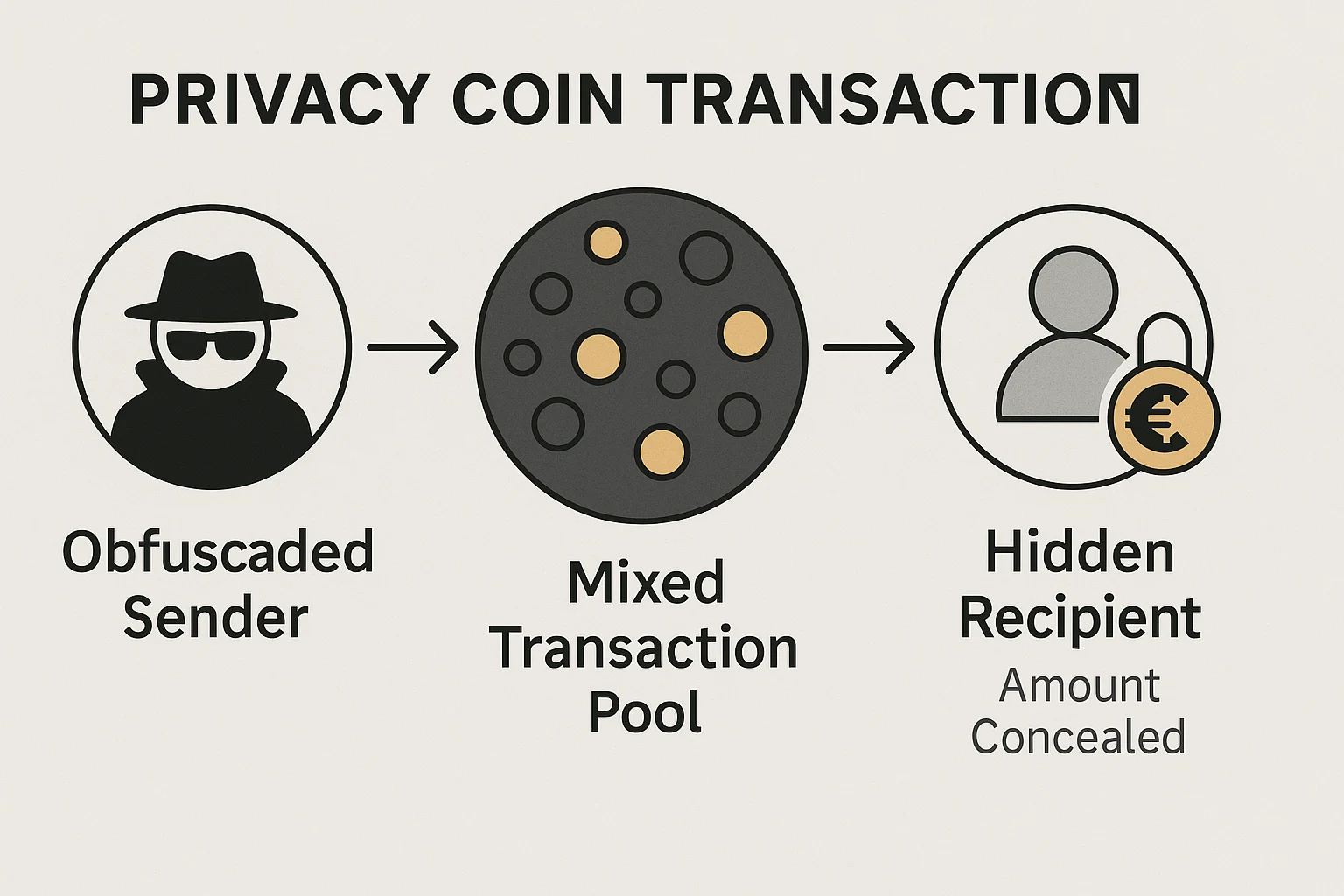
Infographic showing a privacy coin transaction flow with obfuscated sender, mixed transaction pool, and hidden recipient with concealed amount

Real-World Examples

  • Monero (XMR) – Uses ring signatures, stealth addresses, and RingCT for comprehensive privacy
  • Zcash (ZEC) – Offers optional privacy through zero-knowledge proofs called zk-SNARKs
  • Dash – Provides mixing services through CoinJoin-style transactions

Why Beginners Should Care

Financial privacy matters for legitimate reasons like preventing targeted theft, business confidentiality, and protection from authoritarian surveillance.

Regulatory pressure has forced many exchanges to delist privacy coins, limiting liquidity and adoption despite growing demand for financial privacy.

Enhanced security protects users from physical attacks since transaction histories can’t be used to identify wealthy targets for robbery or extortion.

Related Terms: Zero-Knowledge Proof, Ring Signatures, Stealth Address, Mixing Service

Back to Crypto Glossary

Similar Posts

  • Market Cycle

    Market Cycle: Recurring Price PatternsMarket cycles are recurring patterns of price movements in cryptocurrency markets driven by investor psychology and market dynamics. They're like seasons that markets go through repeatedly over time.Market cycles refer to recurring patterns of price appreciation and depreciation in cryptocurrency markets driven by alternating periods of optimism and pessimism among investors. These…

  • Slippage

    Slippage: The Cost of Market Impact Slippage is the difference between expected and actual trade prices. It’s the tax you pay for moving markets when your trade is large relative to available liquidity. Slippage occurs when the execution price of a trade differs from the expected price due to market movement or insufficient liquidity. Large…

  • Go

    Go: Programming Language for BlockchainGo is a programming language widely used for building blockchain infrastructure and cryptocurrency applications. It's like the construction language for digital money systems.Go (also called Golang) is a programming language developed by Google that's popular for blockchain development due to its performance, simplicity, and excellent concurrency support. Many major cryptocurrency projects use…

  • Smart Contract Royalties

    Smart Contract Royalties: Automated Creator Payments Smart contract royalties automatically pay creators a percentage every time their NFTs are resold. It’s like having a永続 commission that follows your work forever. Smart contract royalties are automated payment mechanisms built into NFT contracts that send a percentage of each resale back to the original creator. These payments…

  • Utility Token

    Utility Token: Digital Tools with PurposeUtility tokens provide access to specific products, services, or features within blockchain ecosystems. They're like arcade tokens that let you play specific games or use certain services.A utility token is a cryptocurrency designed to provide access to a product, service, or feature within a specific blockchain ecosystem rather than serving…

  • Timelock

    Timelock: Time-Based Access ControlTimelock mechanisms prevent access to funds or functions until predetermined time conditions are met. It's like having a safe that only opens at specific times.A timelock is a smart contract feature that restricts access to funds, functions, or actions until a specified time period has elapsed. These mechanisms provide security through delayed execution…