
Public Key

Public Key: Your Crypto Receiving Address

Your public key is like your email address for crypto – you can share it freely without security concerns.

A public key is cryptographically derived from your private key and generates your wallet addresses where others can send you cryptocurrency. It’s mathematically linked to your private key but reveals nothing about it.

How Public Keys Work

Your private key mathematically generates your public key through one-way cryptographic functions. This public key then creates your wallet addresses.

Anyone can use your public key to verify that transactions were actually signed by your private key, but they can’t work backwards to discover your private key.

It’s like a mathematical lock that only your private key can open, but everyone can verify the lock belongs to you.
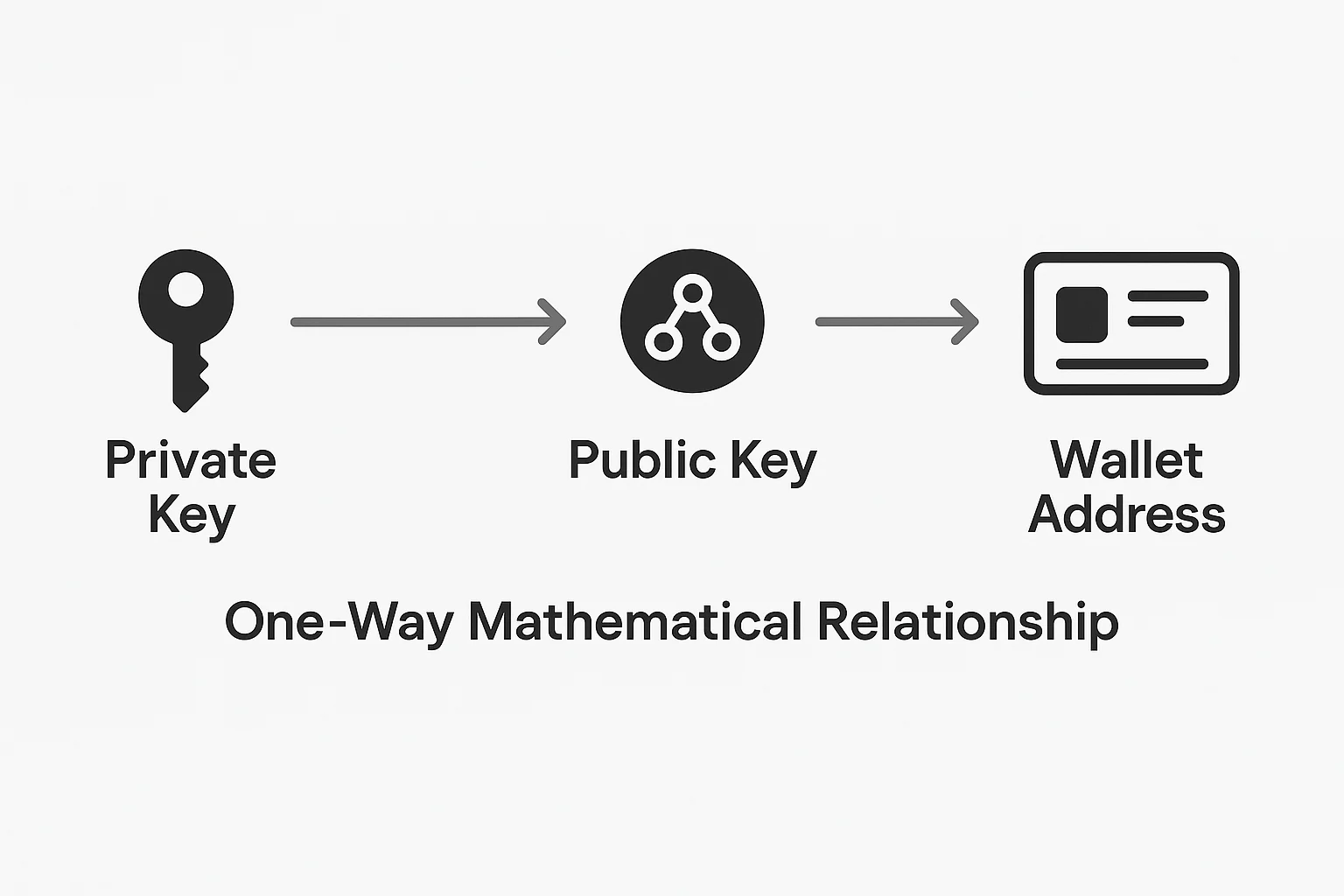
Diagram showing one-way cryptographic relationship from private key to public key to wallet address

Real-World Examples

  • Bitcoin addresses start with 1, 3, or bc1 and are derived from public keys
  • Ethereum addresses are 42-character strings starting with 0x
  • QR codes often encode public keys for easy mobile payments

Why Beginners Should Care

Understanding the private key/public key relationship helps you grasp crypto security fundamentals. Your public information (addresses) can be shared freely, while your private information (keys) must remain secret.

This cryptographic system enables trustless transactions. People can send you crypto without knowing anything about you except your public address.

Related Terms: Private Key, Wallet Address, Digital Signature, Cryptography

Back to Crypto Glossary

Similar Posts

  • Liquid Restaking

    Liquid Restaking: Flexible High-Yield Staking Liquid restaking combines the capital efficiency of liquid staking with additional yield from securing multiple networks. It’s like having your cake and eating it too, but with slashing risks. Liquid restaking allows staked assets to secure additional protocols while remaining liquid through tokenized representations. Users can earn enhanced yields from…

  • Bonding Curve

    Bonding Curve: Algorithmic Token Pricing Bonding curves use mathematical formulas to automatically price tokens based on supply. As more tokens get bought, prices increase predictably according to the curve’s formula. A bonding curve is an algorithmic pricing mechanism that determines token price based on token supply through a mathematical function. Prices increase as supply grows…

  • Flashbots

    Flashbots: MEV Infrastructure Flashbots is a research and development organization that builds infrastructure to mitigate the negative externalities of MEV. They’re trying to make the blockchain economy more fair and transparent. Flashbots develops tools and infrastructure to democratize MEV extraction and reduce its harmful effects on regular users. Their products include private mempools, MEV-protected transaction…

  • DEX

    DEX: Decentralized ExchangeA DEX is a cryptocurrency exchange that operates without central authority through smart contracts. It's like a marketplace where buyers and sellers trade directly without a middleman.A decentralized exchange (DEX) is a cryptocurrency trading platform that facilitates peer-to-peer trading through smart contracts without requiring a central operator or intermediary. Users maintain control of their…

  • Consensus Mechanism

    Consensus Mechanism: How Networks Agree Consensus mechanisms solve the fundamental problem of getting thousands of independent computers to agree on a single version of truth without central authority. A consensus mechanism is the process by which a distributed network of nodes agrees on the validity of transactions and the current state of the blockchain. It…

  • SegWit

    SegWit: Bitcoin's Transaction Efficiency UpgradeSegregated Witness (SegWit) is a Bitcoin protocol upgrade that increased transaction capacity by separating signature data from transaction data. It's like reorganizing luggage to fit more in the same space.SegWit (Segregated Witness) is a Bitcoin protocol upgrade that moves signature data outside the main transaction block, effectively increasing block capacity and…