
Slippage

Slippage: The Cost of Market Impact

Slippage is the difference between expected and actual trade prices. It’s the tax you pay for moving markets when your trade is large relative to available liquidity.

Slippage occurs when the execution price of a trade differs from the expected price due to market movement or insufficient liquidity. Large trades relative to available liquidity create more slippage as they consume multiple price levels.

How Slippage Works

Order book depth determines slippage for traditional exchanges. Large trades consume multiple price levels, with each level offering worse prices than the previous one.

AMM slippage follows mathematical curves where larger trades cause more price impact. A $1000 swap might have 0.1% slippage while a $100,000 swap has 5% slippage.

Market volatility can cause slippage even on small trades when prices move significantly between order submission and execution.
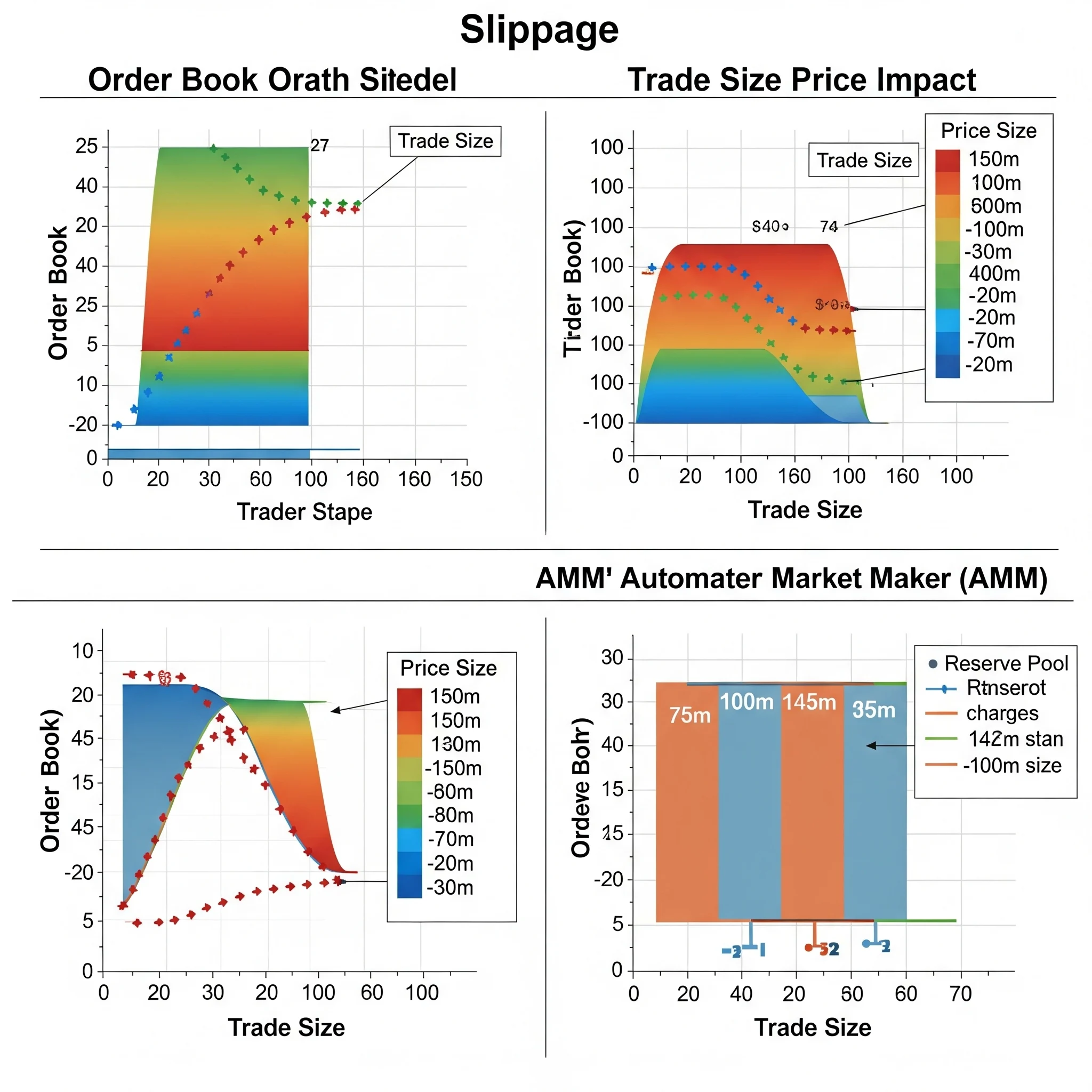
Visualization showing slippage in crypto trading, comparing price impact on order book and AMM models for different trade sizes.

Real-World Examples

  • Large DEX trades on Uniswap can face 5-10% slippage during low liquidity periods
  • Memecoin trading often has extreme slippage due to shallow liquidity pools
  • Front-running bots can increase slippage by trading ahead of pending transactions

Why Beginners Should Care

Hidden costs from slippage can exceed visible trading fees, especially for larger trades or illiquid token pairs with shallow liquidity.

Slippage tolerance settings protect against excessive price impact but may cause transaction failures if markets move beyond acceptable ranges.

Timing matters for reducing slippage – trading during high liquidity periods or splitting large orders into smaller chunks can minimize price impact.

Related Terms: Liquidity, AMM, Price Impact, MEV

Back to Crypto Glossary

Similar Posts

  • Transaction Privacy

    Transaction Privacy: Protecting Financial InformationTransaction privacy keeps cryptocurrency transaction details confidential while maintaining network security. It's like having private bank accounts in a transparent financial system.Transaction privacy refers to techniques that conceal cryptocurrency transaction information such as sender addresses, recipient addresses, and transaction amounts from public observation. This enables financial privacy while maintaining blockchain functionality.How Transaction…

  • Execution Environment

    Execution Environment: Runtime for Smart ContractsAn execution environment provides the runtime infrastructure where smart contracts and decentralized applications operate. It's like the operating system that runs your computer programs.An execution environment is the runtime infrastructure that executes smart contracts and processes transactions on blockchain networks. This environment defines how code runs, what resources are available, and…

  • Diamond Hands

    Diamond Hands: Unshakeable Conviction Diamond hands represent the ultimate HODLer mentality – holding through extreme volatility without selling. It’s a badge of honor in crypto communities. Diamond hands refers to the unwavering determination to hold cryptocurrency positions through significant price volatility and market stress. It celebrates investors who resist selling during crashes or euphoric peaks….

  • Liquidity Mining

    Liquidity Mining: Earning Rewards for Providing Liquidity Liquidity mining rewards users who provide capital to DeFi protocols with governance tokens. It’s like getting paid to be the house money at a casino. Liquidity mining is a DeFi incentive mechanism where protocols distribute governance tokens to users who provide liquidity to their platforms. Users earn both…

  • Social Recovery

    Social Recovery: Community-Based Account RecoverySocial recovery allows regaining access to cryptocurrency accounts through trusted contacts rather than relying solely on seed phrases. It's like having friends hold spare keys to your house.Social recovery is a wallet security mechanism that enables account recovery through a network of trusted contacts rather than requiring users to manage seed…

  • Tokenomics

    Tokenomics: The Economics of Digital Assets Tokenomics determines how cryptocurrencies create, distribute, and maintain value over time. It’s the difference between digital money and digital monopoly money. Tokenomics refers to the economic design and mechanics of a cryptocurrency token, including supply schedules, distribution methods, utility functions, and incentive structures. Good tokenomics align stakeholder interests while…