
Wrapped Token

Wrapped Token: Bringing Assets Cross-Chain

Wrapped tokens let you use Bitcoin on Ethereum, Ethereum on Solana, and any asset on any blockchain. They’re the universal adapters of crypto.

A wrapped token is a cryptocurrency that represents another asset on a different blockchain, maintaining a 1:1 peg through collateralization. The original asset gets locked in a smart contract while an equivalent wrapped version gets minted on the target chain.

How Wrapped Tokens Work

Custodial wrapping involves trusted entities holding the original asset and minting wrapped versions. WBTC uses this model – BitGo holds real Bitcoin while minting wrapped Bitcoin on Ethereum.

Decentralized bridges use smart contracts and multi-signature schemes to lock assets and mint wrapped versions without single custodians. These are more decentralized but also more complex.

Burning and redemption processes allow users to destroy wrapped tokens and receive the underlying asset back, maintaining the 1:1 peg relationship.
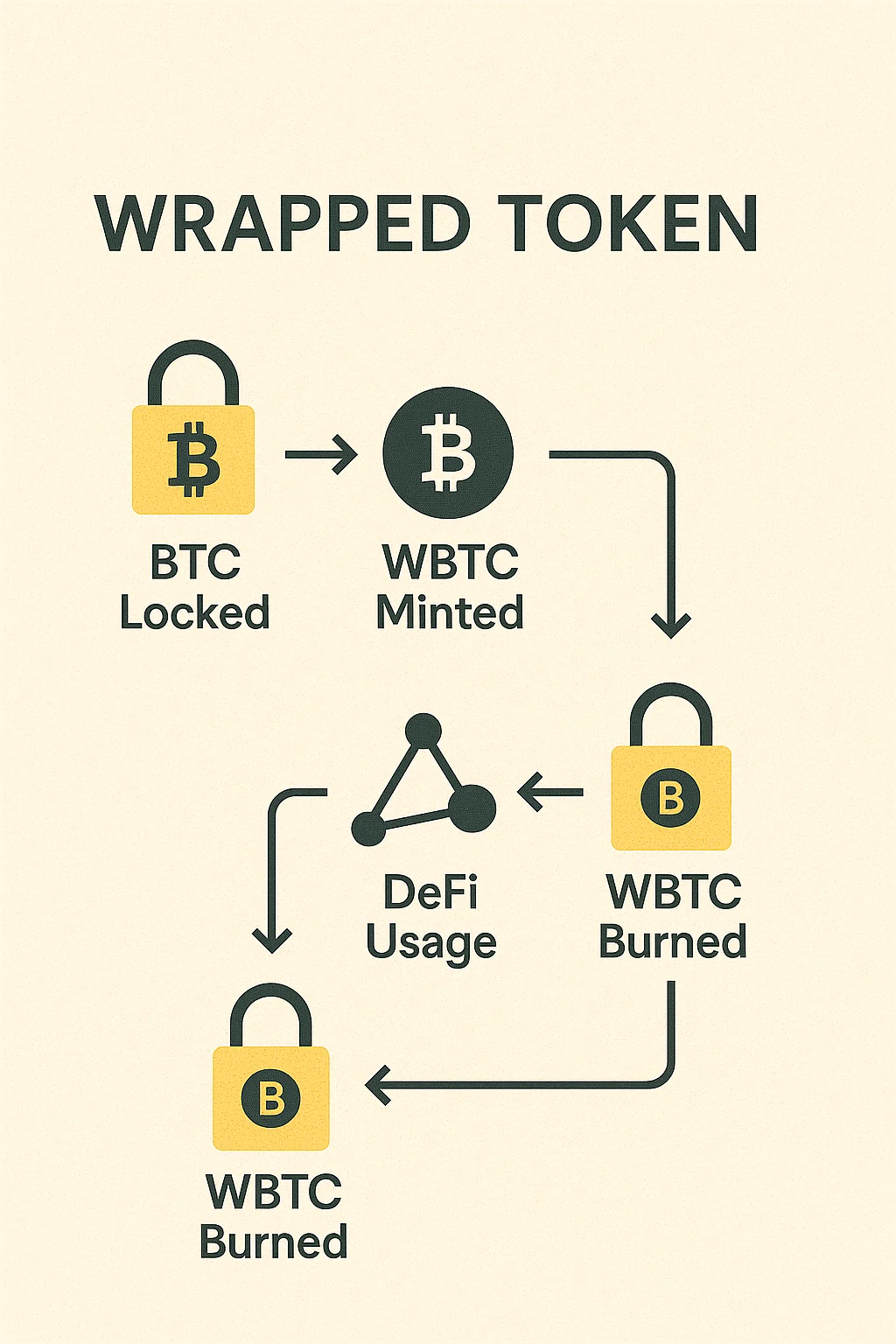
Infographic showing the wrapped token process: BTC locked, WBTC minted, used in DeFi, burned, and BTC returned

Real-World Examples

  • Wrapped Bitcoin (WBTC) – Bitcoin usable in Ethereum DeFi with $1+ billion market cap
  • Wrapped Ethereum (WETH) – ETH conforming to ERC-20 standards for DeFi compatibility
  • Cross-chain bridges creating wrapped versions of tokens across different blockchains

Why Beginners Should Care

Wrapped tokens unlock cross-chain DeFi opportunities. You can earn yield on Bitcoin through Ethereum protocols or use Ethereum assets on faster, cheaper chains.

Trust assumptions vary significantly. Custodial wrapped tokens require trusting centralized entities, while decentralized bridges have smart contract risks.

Depeg risks exist if the backing mechanism fails. Wrapped tokens should trade at 1:1 with underlying assets, but this isn’t guaranteed during extreme market stress.

Related Terms: Bridge, Cross-Chain, DeFi, Smart Contract

Back to Crypto Glossary

Similar Posts

  • Public Key

    Public Key: Your Crypto Receiving Address Your public key is like your email address for crypto – you can share it freely without security concerns. A public key is cryptographically derived from your private key and generates your wallet addresses where others can send you cryptocurrency. It’s mathematically linked to your private key but reveals…

  • Anonymity Set

    Anonymity Set: Privacy Through NumbersAn anonymity set is the group of possible participants who could have performed a specific action, making it harder to identify the actual participant. It's like hiding in a crowd.An anonymity set refers to the group of all possible participants who could plausibly be responsible for a particular transaction or action,…

  • Yield Optimization

    Yield Optimization: Maximizing Investment ReturnsYield optimization involves strategies and protocols that automatically maximize returns on cryptocurrency investments through dynamic allocation and compounding. It's like having a financial advisor that works 24/7 to find the best returns.Yield optimization refers to automated strategies that maximize returns on cryptocurrency investments by continuously monitoring opportunities and reallocating funds to…

  • Cross-Chain Communication

    Cross-Chain Communication: Blockchain InteroperabilityCross-chain communication enables different blockchain networks to exchange information and coordinate actions seamlessly. It's like having universal translators that allow people speaking completely different languages to have detailed conversations and work together on complex projects.Cross-chain communication refers to protocols and technologies that enable different blockchain networks to share data, transfer assets, and…

  • Leverage

    Leverage: Borrowing Money to Amplify TradesLeverage lets you control larger positions than your actual capital by borrowing funds from exchanges or platforms. It's like using a lever to lift heavy objects – small movements create big effects.Leverage in cryptocurrency trading allows borrowing funds to increase position sizes beyond available capital, amplifying both potential profits and…

  • Optimistic Rollup

    Optimistic Rollup: Trust but Verify Scaling Optimistic rollups assume transactions are valid by default but allow challenges during dispute periods. It’s like innocent until proven guilty for blockchain transactions. An optimistic rollup is a Layer 2 scaling solution that assumes transactions are valid by default and only verifies them if someone submits a fraud proof…