
zkSync

zkSync: Ethereum’s Zero-Knowledge Scaling

zkSync is a Layer 2 scaling solution that uses zero-knowledge proofs to bundle transactions while maintaining Ethereum’s security. It’s like having an express lane that’s mathematically guaranteed to follow traffic laws.

zkSync is a zero-knowledge rollup that scales Ethereum by processing transactions off-chain and submitting cryptographic proofs of validity to the main network. It enables faster, cheaper transactions while inheriting Ethereum’s security guarantees.

How zkSync Works

Zero-knowledge proofs validate transaction bundles without revealing individual transaction details, enabling privacy and scalability simultaneously.

Batch processing combines hundreds of transactions into single proofs that get submitted to Ethereum, dramatically reducing per-transaction costs.

EVM compatibility (in zkSync Era) allows existing Ethereum applications to deploy without modification while benefiting from improved performance.
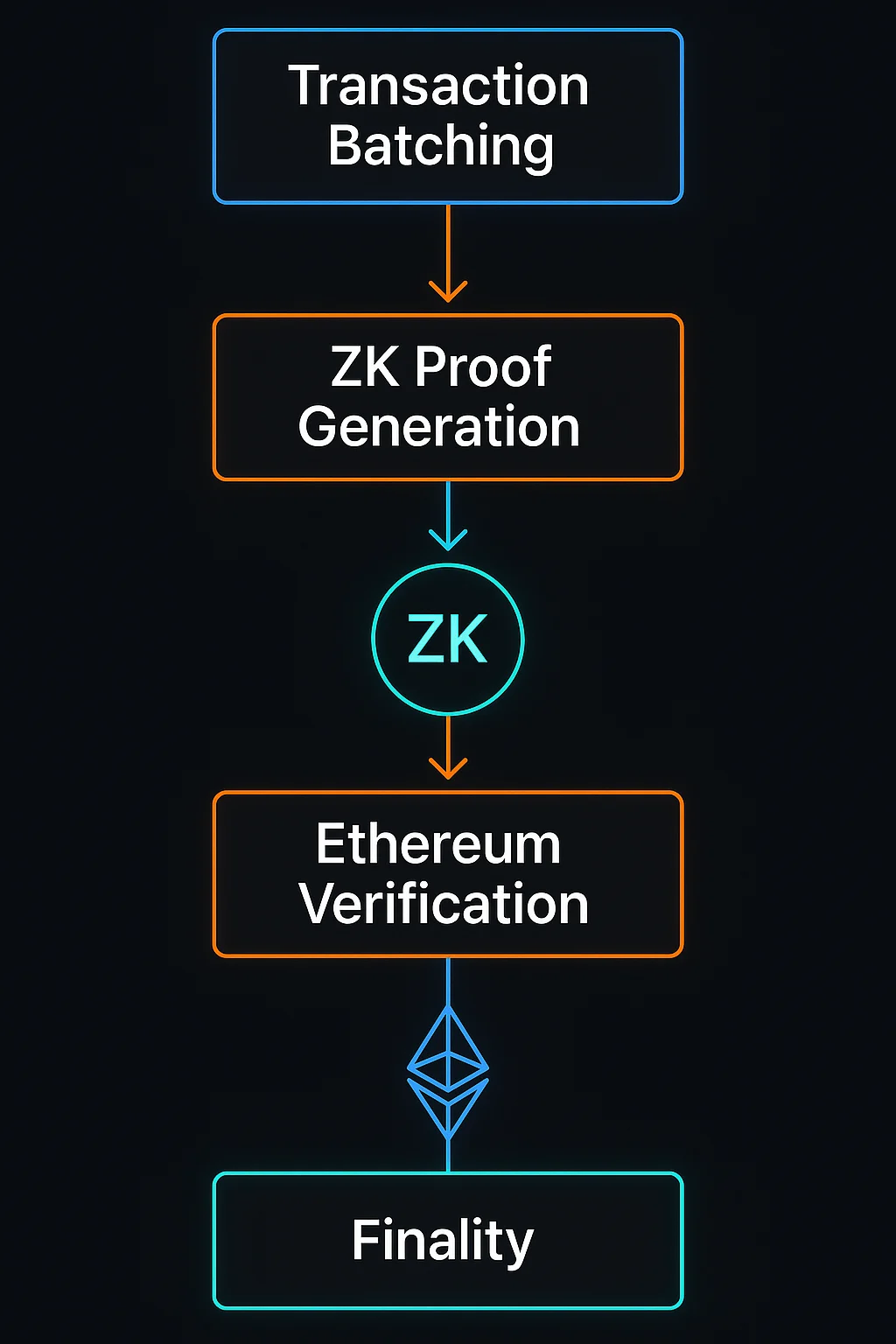
zkSync architecture showing transaction batching, ZK proof generation, Ethereum verification, and finality

Real-World Examples

  • zkSync Era supports full EVM compatibility for seamless dApp migration from Ethereum
  • Major DeFi protocols have deployed on zkSync for lower fees and faster confirmation
  • NFT marketplaces use zkSync to reduce minting and trading costs significantly

Why Beginners Should Care

Significant cost savings compared to Ethereum mainnet while maintaining the same security guarantees through mathematical proofs.

Faster finality for most transactions since ZK proofs provide immediate validity confirmation rather than requiring fraud proof waiting periods.

Technical complexity in ZK proof generation creates different trade-offs compared to optimistic rollups, affecting developer experience and computational requirements.

Related Terms: Zero-Knowledge Proof, Layer 2, Rollups, EVM Compatibility

Back to Crypto Glossary

Similar Posts

  • Token Emissions

    Token Emissions: New Cryptocurrency CreationToken emissions refer to the creation and distribution of new cryptocurrency tokens over time according to predetermined schedules. It's like a factory that produces new money at controlled rates rather than printing it all at once.Token emissions describe the systematic creation and release of new cryptocurrency tokens into circulation according to…

  • LayerZero

    LayerZero: Omnichain Interoperability Protocol LayerZero is an interoperability protocol that enables applications to send messages and transfer assets across different blockchains. It’s like having a universal translator for blockchain networks. LayerZero is a cross-chain communication protocol that enables decentralized applications to operate across multiple blockchains seamlessly. It provides infrastructure for omnichain applications that can access…

  • Digital Securities

    Digital Securities: Blockchain-Based Financial InstrumentsDigital securities are traditional financial instruments like stocks and bonds represented as tokens on blockchain networks. They're like digitizing paper stock certificates to work on the internet.Digital securities are blockchain-based tokens that represent ownership in traditional financial instruments such as stocks, bonds, or real estate, subject to securities regulations. These bridge conventional…

  • Anti-Sybil Mechanism

    Anti-Sybil Mechanism: Preventing Fake Identity Attacks Anti-Sybil mechanisms prevent individuals from creating multiple fake identities to gain unfair advantages in voting, airdrops, or governance systems. They’re like requiring photo ID to prevent ballot stuffing. Anti-Sybil mechanisms are systems designed to prevent or detect when single entities create multiple fake identities to manipulate voting, governance, or…

  • Shared Security

    Shared Security: Collective Network ProtectionShared security allows multiple blockchain applications or chains to benefit from common security infrastructure rather than maintaining separate validator sets. It's like having a shared security service for multiple buildings.Shared security refers to security models where multiple blockchain networks or applications are protected by a common set of validators or consensus…

  • Persistence

    Persistence: Maintaining Data Across TimePersistence refers to data storage that survives system restarts, crashes, or power failures. In blockchain, it ensures transaction history remains permanently accessible and unalterable.Persistence describes the characteristic of data storage systems that maintain information across system interruptions, ensuring data survives restarts, failures, or other disruptions. Blockchain networks achieve persistence through distributed storage…