
Dynamic Gas Pricing

Dynamic Gas Pricing: Adaptive Fee Markets

Dynamic gas pricing automatically adjusts transaction fees based on network demand. It’s like surge pricing for blockchain transactions – pay more when everyone wants to transact.

Dynamic gas pricing is a mechanism that automatically adjusts transaction fees based on current network congestion and demand. This creates more efficient fee markets while maintaining network performance during high usage periods.

How Dynamic Gas Pricing Works

Demand monitoring tracks network usage and mempool congestion to determine appropriate fee levels that balance accessibility with spam prevention.

Automatic adjustment increases fees during high demand periods and decreases them when the network is less congested, creating responsive pricing.

User experience improvements through predictable fee estimation and reduced need for manual gas price optimization.
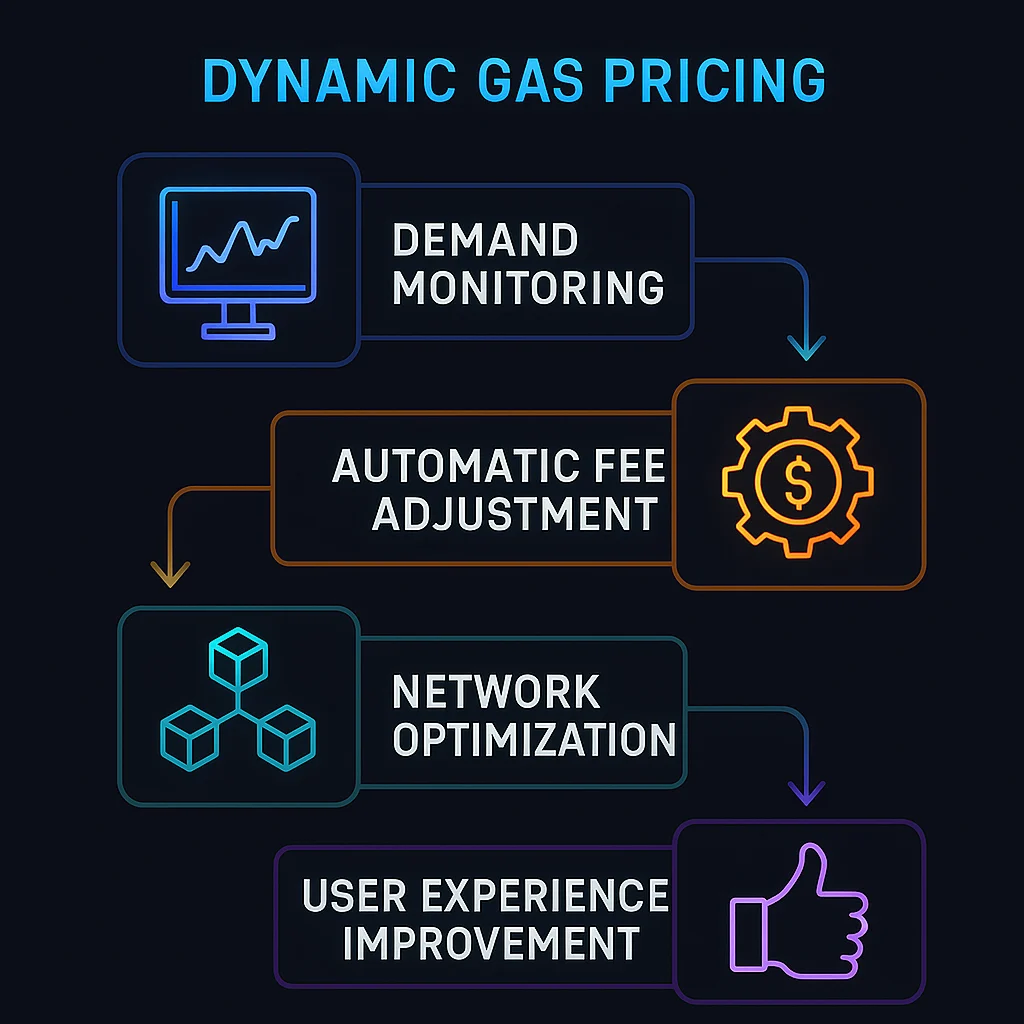
Dynamic gas pricing diagram showing demand monitoring, automatic fee adjustment, network optimization, and user experience improvement

Real-World Examples

  • EIP-1559 introduced dynamic base fees on Ethereum that burn with usage
  • Polygon uses dynamic fee adjustment to maintain consistent block times
  • Various Layer 2s implement dynamic pricing to optimize for their specific use cases

Why Beginners Should Care

Predictable costs as dynamic pricing provides better fee estimation and reduces the guesswork in transaction pricing.

Network efficiency through automatic congestion management that maintains performance without manual intervention.

Fair access as dynamic pricing prevents spam while ensuring legitimate users can always access the network by paying appropriate fees.

Related Terms: Gas Fees, EIP-1559, Network Congestion, Fee Market

Back to Crypto Glossary

Similar Posts

  • Cold Storage

    Cold Storage: Maximum Security for Crypto Assets Cold storage keeps cryptocurrency private keys completely offline, away from any internet connection. It’s the digital equivalent of storing gold bars in a bank vault rather than your wallet. Cold storage refers to keeping cryptocurrency private keys on devices or media that have never been connected to the…

  • MEV (Maximal Extractable Value)

    MEV (Maximal Extractable Value): The Hidden Tax on DeFi MEV is the extra profit that miners and validators can extract by reordering, including, or excluding transactions within blocks. It’s like cutting in line at the blockchain cafeteria. Maximal Extractable Value (MEV) is the additional profit that block producers can capture by strategically ordering transactions, beyond…

  • Price Stability

    Price Stability: Maintaining Consistent ValuePrice stability refers to maintaining consistent cryptocurrency values over time with minimal volatility. It enables practical use as medium of exchange and store of value.Price stability describes the characteristic of maintaining relatively constant value over time with limited price fluctuations. This stability is essential for practical cryptocurrency adoption in payments and savings.How…

  • Airdrop

    Airdrop: Free Tokens From the Sky Airdrops distribute free tokens to wallet addresses, usually to reward early users or generate buzz for new projects. Some are worth pennies, others change lives. An airdrop is the distribution of free cryptocurrency tokens to wallet addresses, typically as a marketing strategy, reward for early adoption, or method of…

  • Consensus Layer

    Consensus Layer: Agreement Coordination SystemThe consensus layer coordinates agreement among network participants about the valid state of the blockchain. It's like having a voting system that everyone trusts to make fair decisions.The consensus layer is the component of blockchain architecture responsible for coordinating agreement among network participants about transaction validity and blockchain state. This layer ensures…

  • Liquidity

    Liquidity: How Easily You Can Buy or Sell Liquidity determines whether you can actually trade your crypto at fair prices. High liquidity means smooth trading. Low liquidity means getting rekt by slippage. Liquidity refers to how easily an asset can be bought or sold without significantly affecting its price. In crypto markets, liquidity comes from…