
Smart Order Routing

Smart Order Routing: Optimal Trade Execution

Smart order routing automatically finds the best prices across multiple exchanges and liquidity sources for each trade. It’s like having a shopping bot that checks every store for the best deal.

Smart order routing is an algorithmic system that automatically splits and routes orders across multiple trading venues to achieve optimal execution prices and minimize market impact. This technology maximizes value for traders by finding the best available liquidity.

How Smart Order Routing Works

Liquidity aggregation scans multiple exchanges, DEXs, and market makers to identify the best available prices for required trade sizes.

Order splitting divides large trades into smaller pieces distributed across multiple venues to reduce price impact and improve overall execution.

Real-time optimization continuously adjusts routing decisions based on changing market conditions, fees, and liquidity availability.
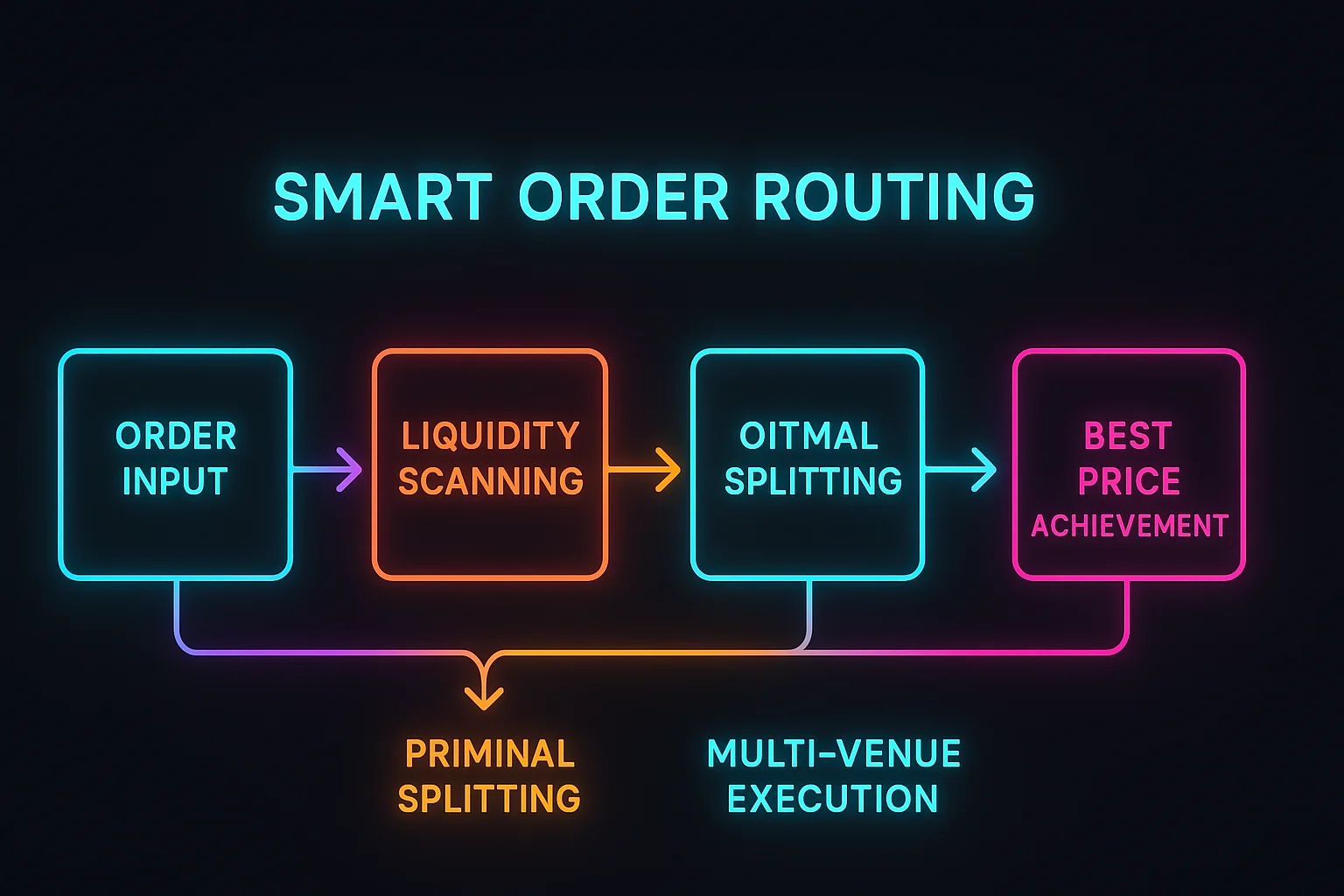
Smart order routing diagram showing order input, liquidity scanning, optimal splitting, multi-venue execution, and best price achievement

Real-World Examples

  • 1inch aggregates DEX liquidity to find optimal trading routes across DeFi protocols
  • CoW Protocol uses batch auctions and routing to improve execution quality
  • Traditional finance has used smart order routing for decades to optimize institutional trading

Why Beginners Should Care

Better prices through automatic optimization that individual traders couldn’t achieve manually across multiple platforms.

Reduced slippage by splitting large orders and finding optimal liquidity sources rather than dumping orders on single exchanges.

Complexity abstraction hides sophisticated routing logic behind simple trading interfaces that anyone can use.

Related Terms: DEX Aggregator, Slippage, Liquidity, Price Impact

Back to Crypto Glossary

Similar Posts

  • Cross-Chain Messaging

    Cross-Chain Messaging: Inter-Blockchain Communication Cross-chain messaging enables smart contracts on different blockchains to communicate and trigger actions across networks. It’s like having a universal translator for blockchain conversations. Cross-chain messaging allows smart contracts on different blockchain networks to send data, trigger functions, and coordinate actions across multiple chains. This enables true interoperability beyond simple asset…

  • Minting

    Minting: Creating New Tokens or NFTs Minting is the moment digital assets come into existence. Whether it’s new cryptocurrency tokens or unique NFTs, minting transforms code into valuable digital property. Minting is the process of creating new tokens or NFTs by executing a smart contract function that adds them to a blockchain. It’s like printing…

  • Atomic Swap

    Atomic Swap: Trustless Cross-Chain Trading Atomic swaps enable direct trading between different cryptocurrencies without exchanges or intermediaries. Either both trades complete successfully, or neither happens – no middle ground. An atomic swap is a smart contract technology that enables the exchange of cryptocurrencies from different blockchains without requiring a trusted third party. The swap either…

  • Fungibility

    Fungibility: Equal Value InterchangeabilityFungibility means that individual units of currency are interchangeable and hold equal value regardless of their history. It's like how any dollar bill has the same value as any other dollar bill, regardless of where it's been or who owned it previously.Fungibility describes the property where individual units of currency or assets…

  • Security Token

    Security Token: Regulated Digital AssetsSecurity tokens are cryptocurrency tokens that represent ownership in real-world assets and are subject to securities regulations. They're like digital stock certificates that comply with financial laws.Security tokens are cryptocurrency tokens that represent ownership stakes in real-world assets and are subject to securities regulations and compliance requirements. These bridge traditional finance with…

  • Node

    Node: The Network’s Backbone Nodes are individual computers that maintain copies of the blockchain and enforce network rules. They’re the distributed infrastructure that makes cryptocurrency possible. A node is a computer that participates in a blockchain network by maintaining a copy of the distributed ledger and relaying transactions. Nodes validate transactions, store blockchain history, and…