
Proof of Humanity

Proof of Humanity: Verifying Human Uniqueness

Proof of Humanity creates registries of verified unique humans to prevent Sybil attacks in voting and distribution systems. It’s like having a bouncer who knows everyone isn’t wearing a disguise.

Proof of Humanity is a system for creating verifiable registries of unique human beings to prevent individuals from claiming multiple identities in democratic or distribution systems. It aims to enable “one person, one vote” in digital contexts.

How Proof of Humanity Works

Identity verification through video submissions, vouching systems, and social verification to establish that each registration represents a unique human being.

Continuous validation requires periodic renewal and community challenges to maintain registry accuracy and remove fake or duplicate entries.

Application integration enables other protocols to use humanity verification for fair voting, airdrops, or governance participation.
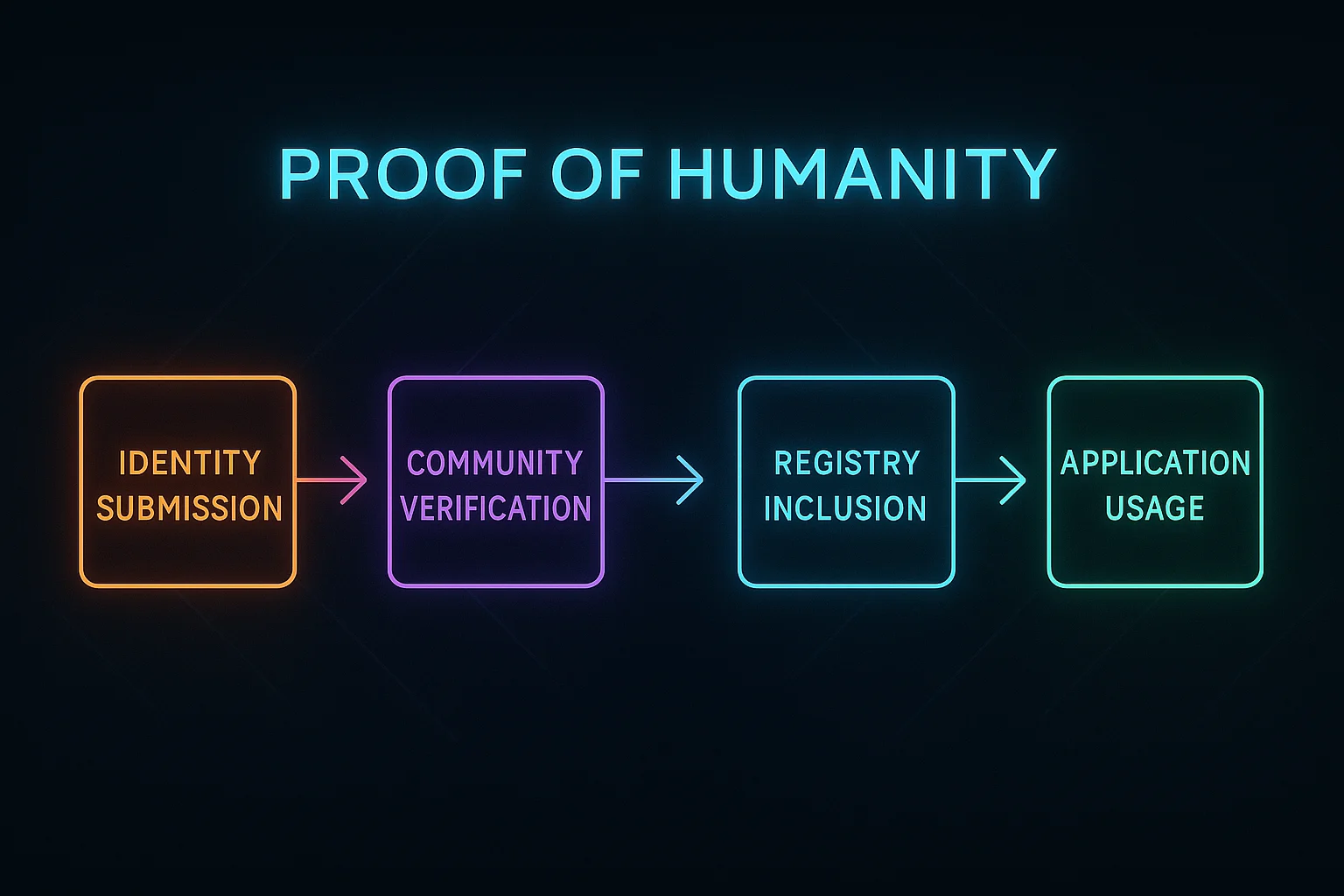
Proof of Humanity flow showing identity submission, community verification, registry inclusion, and application usage

Real-World Examples

  • Proof of Humanity protocol creates Ethereum-based registries of verified humans
  • Worldcoin uses biometric iris scanning for humanity verification
  • BrightID relies on social graph analysis to identify unique humans

Why Beginners Should Care

Democratic participation in crypto governance systems that need to prevent wealthy individuals from claiming multiple votes through fake identities.

Fair distribution mechanisms for airdrops and universal basic income programs that should reach real people rather than bot farms.

Privacy trade-offs as humanity verification often requires revealing personal information or biometric data to prove uniqueness.

Related Terms: Sybil Attack, Anti-Sybil Mechanism, Democratic Governance

Back to Crypto Glossary

Similar Posts

  • Community

    Community: Decentralized Project StakeholdersCommunity refers to the users, developers, investors, and supporters who participate in and contribute to cryptocurrency projects. They're like the citizens of a digital nation working toward common goals.Community encompasses all stakeholders who participate in cryptocurrency projects including users, developers, investors, validators, and supporters who collectively contribute to project success. Strong communities drive…

  • Gwei

    Gwei: Ethereum’s Gas Price Unit Gwei is the denomination used for Ethereum gas prices. Understanding gwei helps you avoid overpaying for transactions when the network gets congested. Gwei (gigawei) is a unit of Ethereum’s native currency equal to one billionth of an ETH (10^-9 ETH). It’s the standard unit for expressing gas prices, making it…

  • Derivatives

    Derivatives: Financial Contracts Based on Underlying AssetsCryptocurrency derivatives are financial contracts whose value depends on underlying crypto assets. They're like betting on sports outcomes instead of playing the game yourself.Derivatives are financial instruments that derive their value from underlying cryptocurrency assets, enabling trading, hedging, and speculation without direct ownership of the base assets. These include futures,…

  • Gas Limit

    Gas Limit: Setting Your Transaction Budget Gas limit is the maximum amount of gas you’re willing to spend on a transaction. Set it too low and your transaction fails. Set it too high and you overpay for simple operations. Gas limit is the maximum amount of computational work (measured in gas units) that a user…

  • Blockchain

    Blockchain: The Unchangeable Digital Ledger Forget the hype – blockchain is simply a better way to keep records. It’s like a ledger book that everyone can see, but no one can cheat. Blockchain is a chain of digital records (blocks) that are linked together and secured using cryptography. Once information goes into a block, changing…

  • Asset Locking

    Asset Locking: Securing Value Across ChainsAsset locking involves securing cryptocurrency on one blockchain to enable representation or usage on another network. It's like putting money in escrow while you get a receipt to spend elsewhere.Asset locking refers to securing cryptocurrency tokens in smart contracts or custody solutions to enable their representation or usage on different…