
Decentralized Exchange (DEX)

Decentralized Exchange (DEX): Trading Without Middlemen

DEXs are what happens when you remove the corporate overlords from crypto trading. No account required, no permission needed – just you, your wallet, and the market.

A decentralized exchange (DEX) is a cryptocurrency trading platform that operates without a central authority controlling user funds. You trade directly from your wallet using smart contracts that automatically execute trades when conditions are met.

How DEXs Work

Instead of depositing funds into an exchange account, you connect your wallet directly to the DEX. Smart contracts hold the trading logic and automatically swap tokens when you make a trade.

Liquidity pools replace traditional order books. Users deposit token pairs into pools, earning fees when others trade against their liquidity. No market makers, no trading desks – just code and math.

Your funds never leave your control until the exact moment of the trade. No KYC forms, no account freezes, no “maintenance” that locks you out during market crashes.
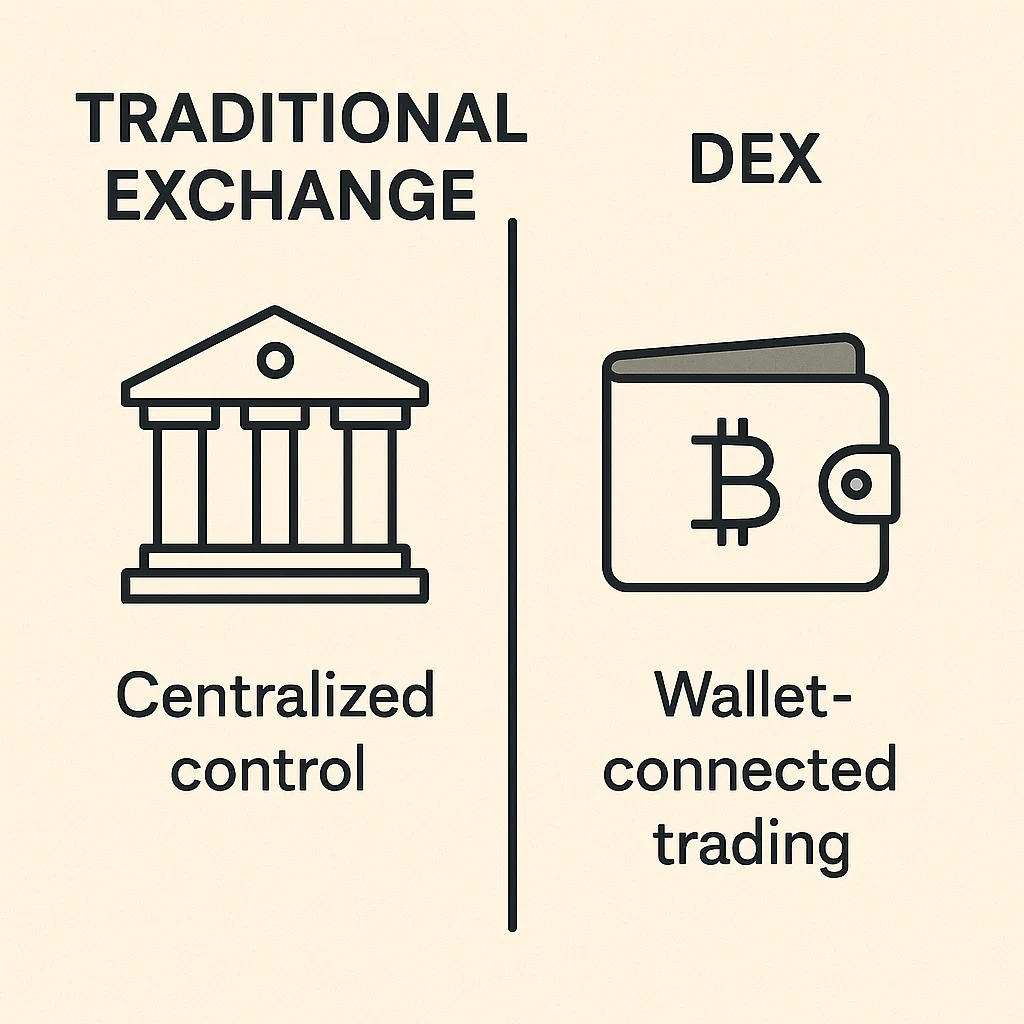
Side-by-side comparison of a traditional crypto exchange and a DEX, showing centralized control vs wallet-connected trading

Real-World Examples

  • Uniswap – Largest DEX on Ethereum with billions in trading volume
  • PancakeSwap – Popular DEX on Binance Smart Chain with lower fees
  • SushiSwap – Community-owned DEX with governance tokens

Why Beginners Should Care

DEXs give you true financial sovereignty. No exchange can freeze your account, require additional verification, or shut down withdrawals when markets get volatile.

The trade-off is complexity – DEX interfaces assume you understand gas fees, slippage, and wallet management. Start small and practice before committing serious money.

Related Terms: Smart Contract, Liquidity Pool, Gas Fees, Exchange

Back to Crypto Glossary

Similar Posts

  • Capitulation

    Capitulation: Market Surrender and Mass SellingCapitulation occurs when investors give up hope and sell their holdings en masse, often marking market bottoms. It's like throwing in the towel when everything seems hopeless.Capitulation refers to the point where investors abandon hope and sell their cryptocurrency holdings in large volumes, typically occurring near market bottoms after prolonged…

  • Stable Yield

    Stable Yield: Predictable DeFi Returns Stable yield refers to DeFi strategies that provide consistent returns with lower volatility than traditional yield farming. It’s like finding the boring but reliable investment in a casino full of slot machines. Stable yield strategies focus on generating consistent returns from DeFi protocols with lower risk and volatility than high-APY…

  • Proof of Work (PoW)

    Proof of Work (PoW): Bitcoin’s Security Model Proof of Work is how Bitcoin solves the double-spending problem without trusted authorities. It’s energy-intensive by design – that’s a feature, not a bug. Proof of Work is a consensus mechanism where miners compete to solve computationally difficult puzzles to validate transactions and create new blocks. The winning…

  • Node Operator

    Node Operator: Network Infrastructure Providers Node operators run the computers that power blockchain networks. They’re the internet service providers of crypto – invisible but essential infrastructure. A node operator is an individual or organization that runs blockchain network infrastructure by maintaining nodes that validate transactions, store data, and relay information. They provide the computational backbone…

  • Collateral Ratio

    Collateral Ratio: Loan Security MeasurementCollateral ratio measures the value of assets securing a loan compared to the loan amount. It's like the down payment percentage when buying a house with a mortgage.Collateral ratio is the percentage relationship between the value of collateral assets and the amount borrowed against them. Higher ratios provide more security for lenders…

  • Staking

    Staking: Earning Rewards by Holding Crypto Staking turns your crypto into a money-making machine. Hold tokens, earn more tokens – it’s that simple. But the devil’s in the details. Staking is the process of locking up cryptocurrency tokens to support a blockchain network’s operations and earning rewards in return. Think of it as earning interest…