
Hash Rate

Hash Rate: Network Security Measurement

Hash rate measures how much computational power secures a blockchain network. Higher hash rates mean stronger security against attacks and manipulation.

Hash rate is the total computational power used by miners to process transactions and secure a proof-of-work blockchain network. It’s measured in hashes per second – calculations attempting to solve the cryptographic puzzle for each block.

How Hash Rate Works

Mining competition drives hash rate as miners add computational power to increase their chances of earning block rewards. More miners mean higher total hash rate.

Difficulty adjustment maintains consistent block times as hash rate changes. If hash rate doubles, difficulty increases to keep block times steady at target intervals.

Security correlation exists between hash rate and network security. Higher hash rates make 51% attacks more expensive and practically impossible for major networks.
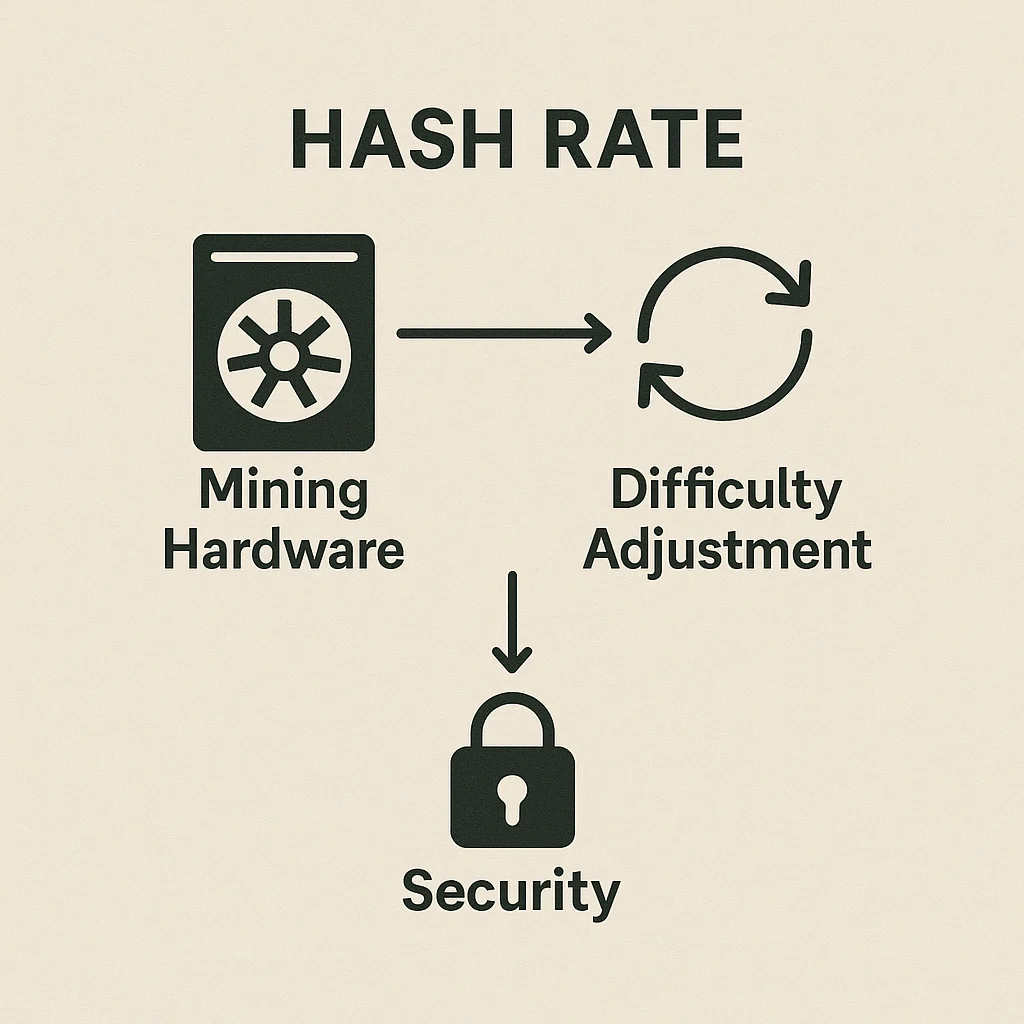
Infographic showing the relationship between mining hardware, difficulty adjustment, and blockchain security in hash rate dynamics

Real-World Examples

  • Bitcoin hash rate exceeded 500 exahashes per second at peak – more computing power than all global supercomputers combined
  • Hash rate crashes during miner capitulation events can temporarily reduce network security
  • Geographic distribution of hash rate affects decentralization and regulatory risks

Why Beginners Should Care

Hash rate trends indicate miner confidence in long-term profitability. Sustained hash rate growth suggests healthy network fundamentals and security.

Network security depends on hash rate distribution. Concentrated hash rate in single locations or entities creates centralization risks and potential attack vectors.

Mining bans or regulatory crackdowns can cause temporary hash rate drops, affecting transaction processing times until difficulty adjusts downward.

Related Terms: Mining, Proof of Work, Difficulty, 51% Attack

Back to Crypto Glossary

Similar Posts

  • Reputation System

    Reputation System: Building Digital TrustReputation systems track and score user behavior to enable trust and coordination in decentralized environments. They're like credit scores but for overall trustworthiness and competence.A reputation system records and evaluates user actions, contributions, and behavior to create trustworthiness scores that enable cooperation in decentralized systems. These systems help identify reliable participants without…

  • Slashing Conditions

    Slashing Conditions: Validator Penalty Rules Slashing conditions define specific behaviors that result in validators losing staked funds as punishment for malicious or negligent actions. They’re the rules of engagement for network security. Slashing conditions are predetermined criteria that trigger automatic penalties for validators who violate network consensus rules or behave maliciously. These penalties involve destroying…

  • Transaction Analysis

    Transaction Analysis: Blockchain Data InvestigationTransaction analysis involves examining blockchain data to understand patterns, track funds, and investigate suspicious activities. It's like being a detective who follows money trails in the digital world.Transaction analysis refers to the systematic examination of blockchain transaction data to identify patterns, trace fund flows, and investigate potential illegal or suspicious activities. This…

  • Cross-Chain Protocol

    Cross-Chain Protocol: Blockchain Communication StandardsCross-chain protocols establish standardized methods for different blockchain networks to communicate and transfer assets safely. They're like diplomatic translation services that enable countries speaking different languages to negotiate treaties and trade agreements.Cross-chain protocols are standardized communication frameworks that enable different blockchain networks to exchange information, transfer assets, and coordinate operations across…

  • Sniper Bot

    Sniper Bot: Automated MEV Extraction Sniper bots automatically execute trades ahead of other users to capture arbitrage opportunities and extract MEV. They’re the high-frequency traders of DeFi, but without regulatory oversight. A sniper bot is an automated program that monitors blockchain mempools for profitable trading opportunities and executes transactions faster than human traders. These bots…

  • Leverage

    Leverage: Borrowing Money to Amplify TradesLeverage lets you control larger positions than your actual capital by borrowing funds from exchanges or platforms. It's like using a lever to lift heavy objects – small movements create big effects.Leverage in cryptocurrency trading allows borrowing funds to increase position sizes beyond available capital, amplifying both potential profits and…